

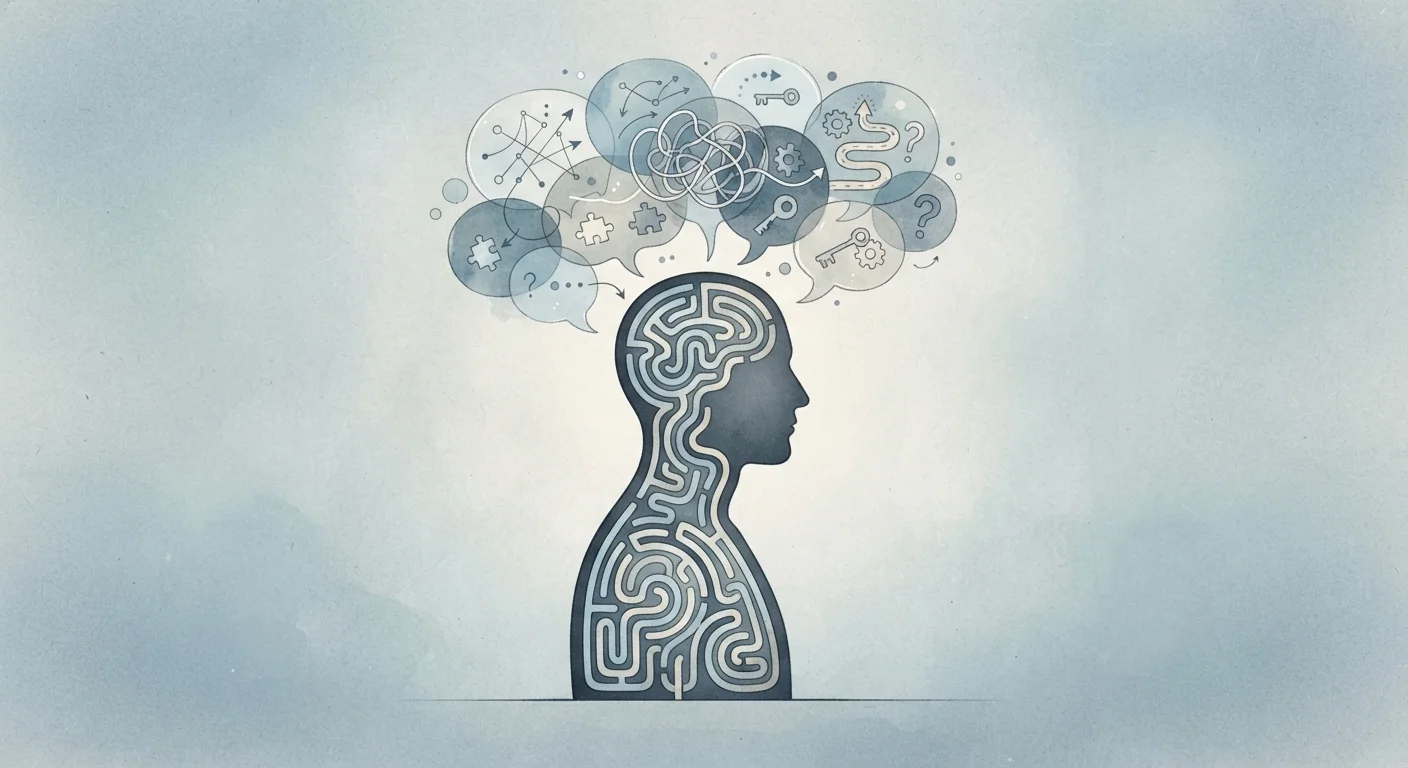
What Cognitive Distortions Are - and Why They Matter
Cognitive distortions are systematic errors in thinking that skew how we interpret events, other people, and ourselves. The term comes from cognitive behavioral therapy (CBT), where clinicians use it to describe thought patterns that are biased, exaggerated, or logically unsound - and that tend to sustain negative emotions like anxiety, guilt, and low mood.
Crucially, these patterns are common. They are not signs of mental illness or weakness; most people experience several of them regularly. Understanding them matters because distorted thinking often drives behavior in ways we don't consciously choose - affecting everything from how we handle setbacks at work to how we respond to financial pressure.
This reference covers the most well-documented distortions from the CBT literature, describing what each one looks like in practice.
| Origin of the term | Cognitive behavioral therapy (CBT), developed by Aaron Beck (Beck, A.T. - foundational CBT literature, 1960s-1970s) |
| Number of distortions commonly cited | 10-15 patterns in major CBT frameworks (Burns, D. - Cognitive distortion taxonomy) |
| Conditions associated with distorted thinking | Anxiety, depression, OCD, and others (American Psychological Association) |
| Evidence base for CBT | One of the most extensively researched psychotherapies (National Institute of Mental Health (NIMH)) |
| Who experiences distortions | Most people, to varying degrees - not only those with a diagnosis |
This article is for general informational and educational purposes only and is not a substitute for professional mental health advice. If distorted thinking is significantly affecting your daily life, consult a licensed mental health professional.
A Reference Guide to Common Cognitive Distortions
The following patterns were largely systematized by psychiatrist Aaron Beck and later expanded by David Burns in clinical research and practice. Each entry describes the distortion, how it typically shows up, and the type of thinking it reinforces.
Cognitive distortion
A systematic, predictable error in thinking that produces a biased or inaccurate interpretation of a situation. The concept originates in cognitive behavioral therapy (CBT) research.
Cognitive behavioral therapy (CBT)
A structured, evidence-based form of psychotherapy that examines the relationship between thoughts, emotions, and behaviors. It is the primary clinical framework in which cognitive distortions are identified and addressed.
All-or-nothing thinking
A distortion that evaluates situations in absolute, binary terms - entirely good or entirely bad - with no recognition of gradations or nuance.
Catastrophizing
A pattern of exaggerating the likelihood or consequences of a negative outcome, often by treating unlikely worst-case scenarios as near-certain.
Emotional reasoning
Treating a subjective emotional state as objective evidence about reality - for example, concluding that because you feel worthless, you must be worthless.
Personalization
Assuming excessive personal responsibility for events that are partly or fully outside one's control, often leading to unwarranted guilt or self-blame.
Overgeneralization
Drawing a broad, sweeping conclusion from a single or limited set of events, typically expressed using absolute words like 'always' or 'never.'
Mental filter
The tendency to focus exclusively on one negative detail of a situation while filtering out contradictory positive information, reinforcing a skewed overall impression.
All-or-Nothing Thinking
Also called black-and-white thinking, this pattern evaluates situations in absolute terms - perfect or failed, always or never - with no middle ground. A person who makes one dietary slip may conclude they have «ruined» their health goals entirely. This kind of thinking can derail efforts to build healthier habits by making small setbacks feel catastrophic.
Catastrophizing
Catastrophizing magnifies the likelihood or severity of a negative outcome. A missed deadline becomes imagined job loss; a headache becomes feared illness. It reinforces anxiety by training the mind to treat unlikely worst-case scenarios as probable ones.
Mind Reading
This distortion involves assuming you know what others are thinking - usually something critical or negative - without evidence. It can damage relationships and cause unnecessary social avoidance.
Fortune Telling
Related to catastrophizing, fortune telling is predicting a negative outcome as though it were certain: «I'll fail the interview» or «This will never work out.» It discourages effort by framing the future as already decided.
Emotional Reasoning
Emotional reasoning treats a feeling as proof of a fact: «I feel stupid, therefore I am stupid.» Because emotions are real and powerful, this distortion is especially persuasive and difficult to challenge without deliberate reflection.
Should Statements
Using «should,» «must,» or «ought» as rigid rules creates an internal pressure system that generates guilt when directed inward and resentment when directed at others. These rules often reflect absorbed social expectations rather than considered personal values.
Labeling
Labeling collapses a behavior into an identity: instead of «I made a mistake,» the thought becomes «I am a failure.» The label replaces nuanced self-assessment and makes change feel impossible.
Personalization
Personalization involves taking excessive responsibility for events outside your control - assuming a friend's bad mood was caused by something you did, for example. It reinforces guilt and a distorted sense of personal power over circumstances. This same pattern appears in financial decisions; for more on how thinking errors influence spending, see the psychology behind overspending.
Overgeneralization
Drawing a sweeping conclusion from a single event: «This went wrong once, so it always goes wrong.» The words always, never, and everyone are common signals.
Mental Filter
Focusing exclusively on one negative detail while ignoring the broader picture. A presentation goes well except for one fumbled sentence - the mental filter replays only the fumble. It selectively confirms a negative self-narrative. For a parallel look at how these kinds of thinking errors show up in persistent mental health misconceptions, that companion piece is worth reading alongside this one.
Recognizing a Pattern Is Not the Same as Fixing It
Labeling a thought as a distortion can be a useful first step, but insight alone does not reliably change deeply ingrained thinking patterns. CBT-based interventions typically involve structured practice with a trained therapist. If you notice these patterns frequently and find them distressing or disruptive, speaking with a licensed mental health professional is the appropriate next step - not continued self-analysis.
The content provided on our blog site traverses numerous categories, offering readers valuable and practical information. Readers can use the editorial team’s research and data to gain more insights into their topics of interest. However, they are requested not to treat the articles as conclusive. The website team cannot be held responsible for differences in data or inaccuracies found across other platforms. Please also note that the site might also miss out on various schemes and offers available that the readers may find more beneficial than the ones we cover.