

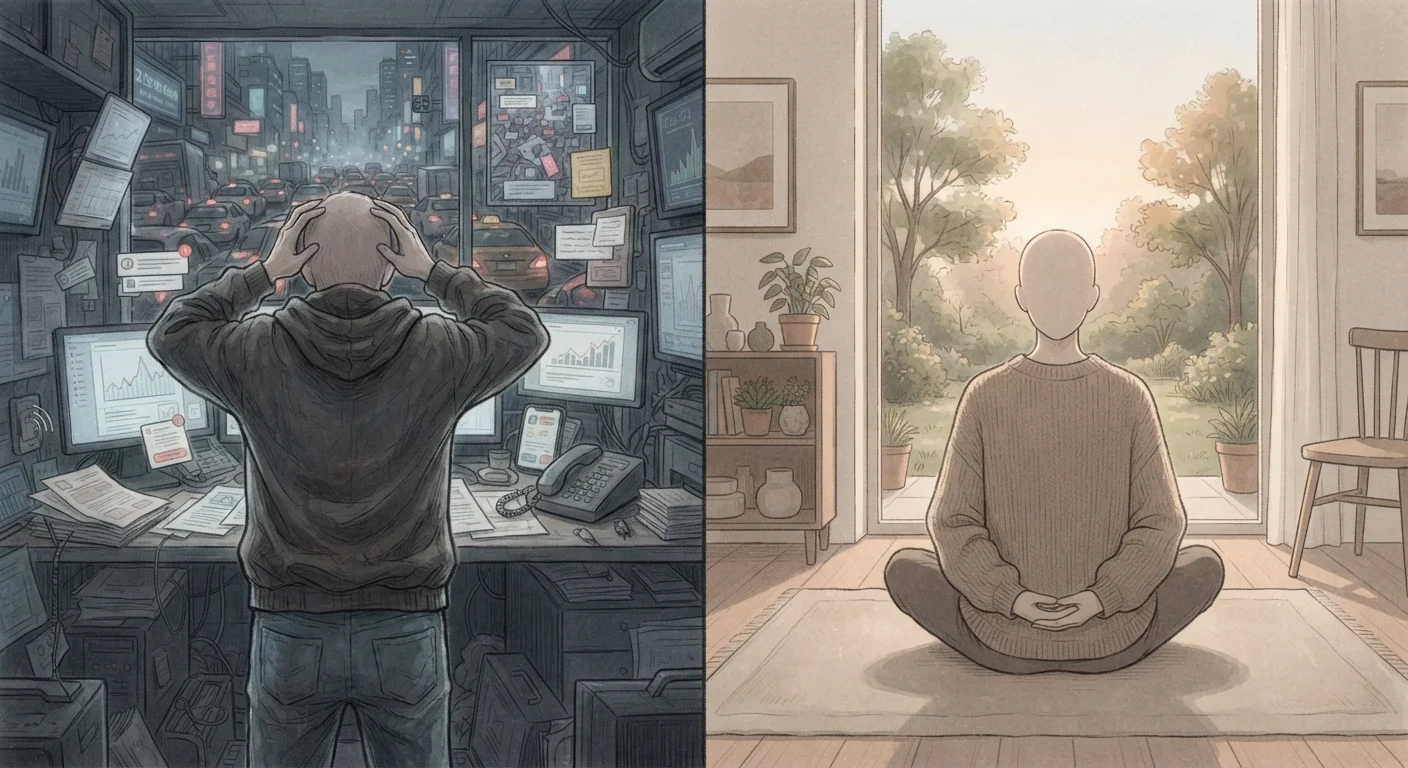
Option A
Stress
An external-driven, time-limited response.
Best for: Understanding reactions tied to identifiable pressures like deadlines, conflict, or financial strain.
Option B
Anxiety
An internal, forward-focused state of threat perception.
Best for: Recognizing persistent worry or dread that continues even when no clear external trigger is present.
What Stress Actually Is
Stress is the body's response to a perceived demand or threat that comes from outside you. A looming deadline, a heated argument, or unexpected financial pressure can all trigger the physiological cascade known as the stress response - a release of cortisol and adrenaline that primes the body for action.
Crucially, stress is typically reactive and time-limited. When the stressor is removed - the deadline passes, the conflict resolves - the physiological arousal generally subsides. This means stress, uncomfortable as it is, carries a built-in endpoint. It also means the most direct coping path often involves addressing the trigger itself: negotiating a deadline, having a difficult conversation, or building a budget.
Not all stress is harmful. Psychologists distinguish between eustress (moderate, motivating pressure) and distress (overwhelming, damaging strain). The body doesn't draw this distinction automatically, which is why even positive events like a job promotion can feel taxing. For subtler signs you may be under more strain than you realize, see lesser-known stress signals your body may be sending.
What Anxiety Actually Is
Anxiety shares many physical features with stress - elevated heart rate, muscle tension, disrupted sleep - but its defining characteristic is different: it is internally generated and future-oriented. Rather than responding to a present threat, the anxious brain anticipates harm that may not materialize, and often continues doing so after the triggering situation has resolved.
This forward-focused threat appraisal is the engine of anxiety. It is not a character flaw or a sign of weakness; it reflects a brain that has, for various reasons, set its threat-detection threshold unusually low. Anxiety exists on a spectrum, from everyday nervousness before a presentation to clinically significant disorders such as generalized anxiety disorder (GAD) or panic disorder, which require professional diagnosis and treatment.
Because anxiety is driven by internal cognitive patterns rather than external circumstances, simply removing a stressor rarely resolves it. This is the practical reason the distinction matters.
| Criterion | Stress | Anxiety |
|---|---|---|
| Primary trigger | External, identifiable event | Internal; often no clear cause |
| Time orientation | Present or immediate past | Future-focused, anticipatory |
| Duration | Typically resolves with stressor | Persists beyond triggering event |
| Core mechanism | Physiological arousal from demand | Threat appraisal; low-threshold alarm |
| Best coping approach | Problem-solving, removing stressor | Cognitive reappraisal, exposure work |
| When to seek help | If distress is severe or prolonged | If impairing daily life; may signal a disorder |
Why the Difference Shapes Your Coping Strategy
Treating anxiety like stress - and stress like anxiety - is one of the most common reasons coping efforts fall flat. Problem-solving works well for stress because there is a concrete problem to solve. Applied to anxiety, the same strategy can backfire: researching every possible worst-case outcome feels productive but often reinforces the worry cycle rather than breaking it.
Research in cognitive behavioral therapy (CBT) supports a different approach for anxiety: cognitive reappraisal, which involves examining the evidence for feared outcomes and developing more accurate threat assessments, and where appropriate, exposure-based techniques that reduce avoidance. These approaches target the appraisal process directly rather than the circumstances.
For stress, behavioral science points toward practical strategies: prioritizing demands, setting limits on controllable stressors, and building recovery time into daily routines. Mindfulness and meditation practices can support both conditions, but through slightly different mechanisms - grounding attention in the present is particularly useful for anxiety, while structured relaxation helps stress recovery.
If coping tools stop working or seem to make things worse, that itself is useful information. Coping strategies can lose effectiveness over time or become misapplied when the underlying condition has shifted.
When to Seek Professional Support
If worry or dread feels uncontrollable, lasts most days for six months or more, or meaningfully disrupts work, relationships, or daily routines, these may be signs of a clinical anxiety disorder. A licensed psychologist, psychiatrist, or licensed clinical social worker can provide an accurate assessment and evidence-based treatment. Early intervention generally leads to better outcomes.
This article is for general informational purposes only and does not constitute medical or mental health advice. If you are experiencing persistent anxiety, significant distress, or impairment in daily functioning, please consult a qualified mental health professional.
The content provided on our blog site traverses numerous categories, offering readers valuable and practical information. Readers can use the editorial team’s research and data to gain more insights into their topics of interest. However, they are requested not to treat the articles as conclusive. The website team cannot be held responsible for differences in data or inaccuracies found across other platforms. Please also note that the site might also miss out on various schemes and offers available that the readers may find more beneficial than the ones we cover.