

The Overlooked Role of Food in Daily Hydration
Most hydration conversations focus on how many glasses of water to drink. But a meaningful portion of the fluid your body uses each day arrives through food - not from a bottle or tap. Understanding this helps clarify why rigid drinking rules often don't hold up under scrutiny.
According to research reviewed by the European Food Safety Authority and echoed by US nutrition scientists, food contributes approximately 20-30% of total daily water intake for adults eating a typical mixed diet. For people who eat generous amounts of fruits and vegetables, that figure can be even higher. The body does not distinguish whether water arrives in a glass or inside a celery stalk - it all counts toward fluid balance.
20-30%
Daily water intake from food
Estimated contribution of solid and semi-solid foods to total daily fluid intake, per European Food Safety Authority review data cited by US nutrition researchers.
~95%
Water content in cucumbers and celery
Among the highest water-content foods routinely consumed, making them efficient contributors to dietary hydration.
125 oz
Total daily water target for adult men
Adequate intake level set by the National Academies of Sciences, Engineering, and Medicine - covering all beverage and food sources combined.
Which Foods Deliver the Most Water?
Not all foods are equal hydrators. Water content varies widely across food categories, and knowing which foods are richest can inform smarter dietary choices - particularly for those who struggle to drink enough throughout the day.
Fruits and Vegetables
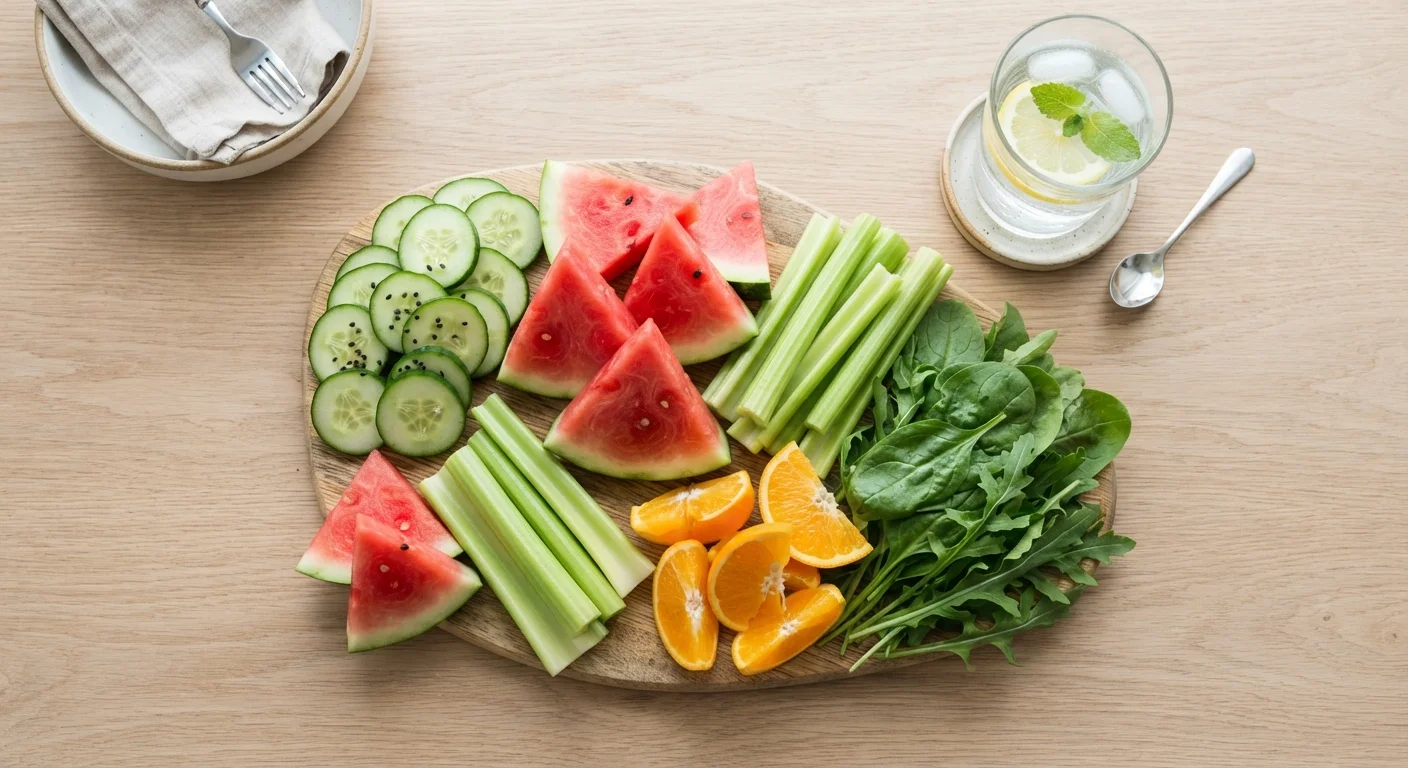
Produce dominates the hydration-from-food category. Cucumbers, iceberg lettuce, celery, and tomatoes each hover around 95% water by weight. Watermelon, strawberries, peaches, and oranges range from 85-92%. Even denser vegetables like broccoli and carrots contain 85-90% water. A single large salad can deliver close to 12 oz of water before you take a sip of anything.
Soups and Broths
Broth-based soups are among the most efficient food-based hydration sources, and they also tend to supply electrolytes - particularly sodium - that support fluid retention. A standard serving of vegetable or chicken broth soup can supply 8-12 oz of fluid.
Dairy and Dairy Alternatives
Milk is roughly 87% water. Plain yogurt, depending on type, contains 75-88% water. These foods provide fluid alongside protein and calcium, making them nutritionally efficient choices. Many fortified plant-based milks carry similar water content.
Cooked Grains and Legumes
Oatmeal prepared with water is approximately 84% water after cooking. Cooked lentils and beans sit in the 60-70% range. These are easy to underestimate because they don't appear wet, but they contribute notably to daily intake - and as fiber-rich foods also help support digestive health.
How Much Fluid Do You Actually Need?
The National Academies of Sciences, Engineering, and Medicine set general adequate intake levels at approximately 3.7 liters (125 oz) of total water per day for men and 2.7 liters (91 oz) for women - from all sources combined, including food and beverages. These are population-level estimates, not individual prescriptions.
Actual needs shift with body size, physical activity, ambient temperature, altitude, and health status. Athletes, outdoor workers, pregnant individuals, and those with certain medical conditions have different requirements and should consult a healthcare provider for personalized guidance.
“The best hydration strategy is not counting glasses - it is eating a varied diet rich in vegetables and fruits, and drinking when you are thirsty. The body's regulatory mechanisms are remarkably effective under normal conditions.”
— Heinz Valtin, Renal physiologist and professor emeritus, Dartmouth Medical School, whose research questioned the scientific basis for the '8 x 8' water rule
The practical implication: if you eat a diet reasonably rich in fruits, vegetables, and whole foods, your food is already doing meaningful hydration work. This doesn't eliminate the need to drink water, but it does suggest that rigid counting rules - like "eight 8-oz glasses daily" - are oversimplifications not grounded in current evidence.
Practical Takeaways for Everyday Eating
You don't need a tracking app to improve food-based hydration. A few consistent dietary habits make a significant difference:
- Build meals around produce. Even simple additions - sliced cucumber in a sandwich, berries with breakfast - add meaningful water content to your day.
- Choose broth-based soups regularly. They're among the most underrated hydration tools in a practical diet, especially in cooler months when cold water is less appealing.
- Pay attention to urine color as a low-effort hydration check. Pale yellow is a generally reliable indicator of adequate hydration for healthy adults.
- Don't dismiss coffee or tea. Evidence shows that moderate caffeine consumption does not cause net dehydration in habitual consumers. These beverages contribute to daily fluid intake.
Hydration is part of the broader picture of eating well. A diet structured around minimally processed whole foods - the same dietary pattern supported by decades of nutrition research - tends to supply substantially more water than one built on shelf-stable, low-moisture processed foods.
This article is for general informational and educational purposes only and does not constitute medical or dietary advice. Individual hydration needs vary. Consult a qualified healthcare professional for guidance tailored to your health circumstances.
Frequently Asked Questions
Research estimates that food contributes roughly 20-30% of total daily water intake for most adults eating a varied diet. This proportion increases substantially if the diet is high in fruits, vegetables, and soups. Individual variation is significant depending on dietary patterns.
Cucumbers, lettuce, celery, tomatoes, watermelon, strawberries, and zucchini are among the highest, typically containing 90-97% water by weight. Soups, broths, and yogurt are also high-water foods worth noting.
Not entirely. While food-sourced water meaningfully contributes to hydration, beverages - primarily water - remain the dominant source for most people. Both sources work together to maintain fluid balance.
This widely repeated figure lacks strong clinical evidence as a universal target. Fluid needs vary by body size, activity level, climate, and diet. General guidance from organizations like the National Academies sets broader adequate intake ranges rather than a fixed daily glass count.
Urine color is a practical indicator - pale yellow generally suggests adequate hydration, while dark yellow may indicate a need for more fluid. For healthy adults in typical conditions, thirst is also a reasonably reliable guide.
Yes. Despite mild diuretic properties, caffeinated beverages like coffee and tea still provide a net positive contribution to fluid balance at typical consumption levels, according to current research. They should not be treated as dehydrating for most people.
The content provided on our blog site traverses numerous categories, offering readers valuable and practical information. Readers can use the editorial team’s research and data to gain more insights into their topics of interest. However, they are requested not to treat the articles as conclusive. The website team cannot be held responsible for differences in data or inaccuracies found across other platforms. Please also note that the site might also miss out on various schemes and offers available that the readers may find more beneficial than the ones we cover.