

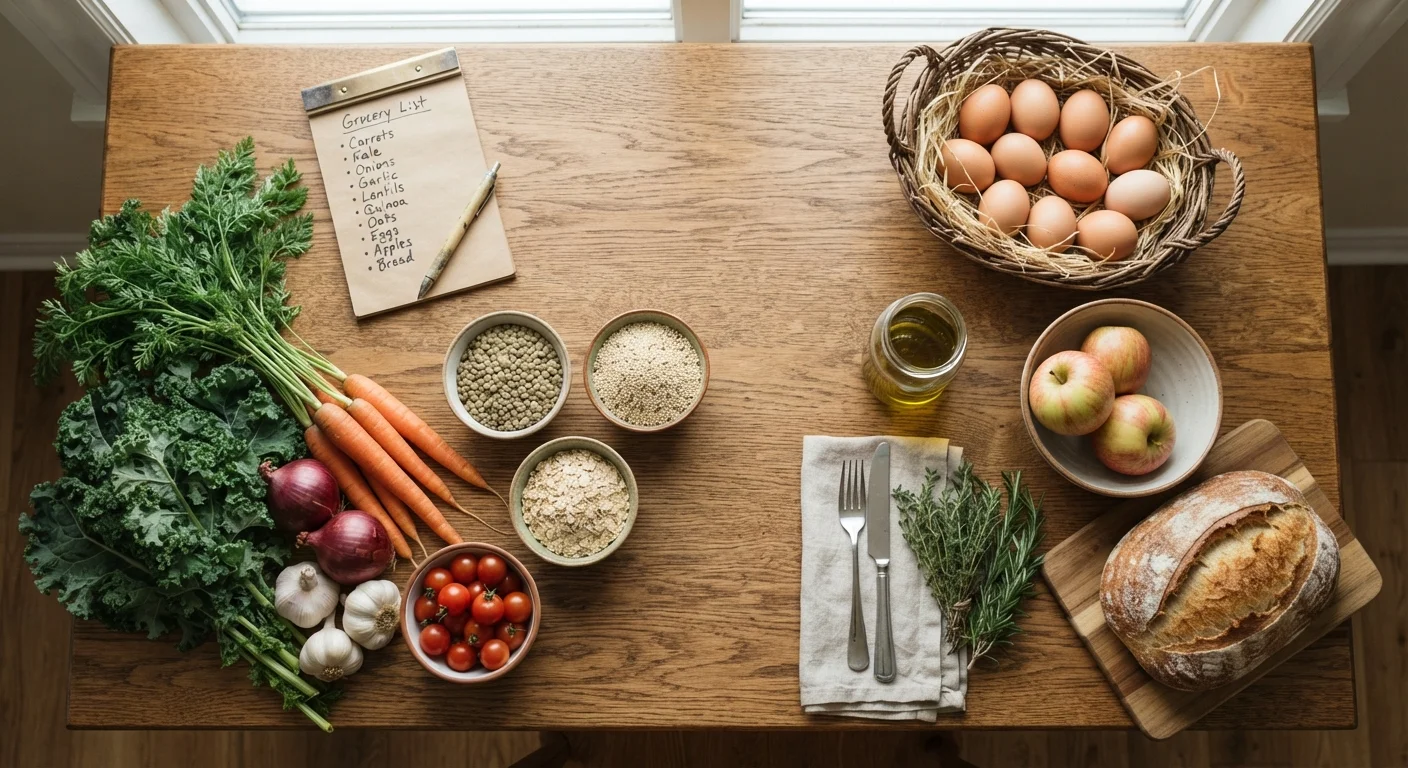
Why a Structured Grocery Plan Beats Improvising
Most people who struggle to eat a balanced diet do not lack nutritional knowledge - they lack a reliable system. Research on eating behavior consistently shows that food environments and availability at home are stronger predictors of dietary quality than stated intentions. In practical terms: what you buy shapes what you eat far more than what you plan to eat in the abstract.
Improvising at the store, or shopping when hungry without a list, tends to produce a cart weighted toward convenient, processed options. A written plan shifts decisions to a calmer moment, when you can account for variety, quantity, and realistic cooking time. It also makes budgeting more predictable. For those working through a monthly spending review, a monthly budget reset checklist can help align your food spending with broader financial goals.
This Is General Nutrition Information
The guidance here is educational and not a substitute for personalized advice from a registered dietitian or physician. Individual nutritional needs vary based on age, health status, activity level, and medical history. If you have a diagnosed condition or specific dietary concern, consult a qualified healthcare professional before making significant changes to your diet.
Tools and What You Need Before Starting
The tools for this process are deliberately minimal. Effective grocery planning requires a way to record your list, a kitchen audit, and a reference framework for food groups - nothing more. Expensive meal-kit subscriptions, nutrition-tracking apps, and supplement regimens are not prerequisites for a well-structured diet.
Notepad or grocery list app
Records your planned meals and corresponding ingredients before you shop.
Weekly meal planner template
Provides a structured grid to map each day's meals and identify gaps in variety.
Kitchen inventory checklist
Helps you audit what is already in your pantry, fridge, and freezer before writing your list.
Nutrition reference guide (e.g., USDA MyPlate)
Offers evidence-based food group proportions to guide category coverage in your plan.
What you will need
One important framing note: the USDA's MyPlate framework, freely available online, provides a reasonable, evidence-informed starting point for food group proportions. It is not a rigid prescription, but a useful reference that has been developed with public health research in mind.
Frozen and Canned Produce Count
Frozen vegetables and legumes are nutritionally comparable to fresh counterparts - often more so, since they are processed shortly after harvest. Canned beans, tomatoes, and fish are cost-effective options that anchor many balanced meals. Choosing low-sodium canned goods where available is a practical refinement, not a requirement.
The Step-by-Step Planning Process
The following steps can be completed in a single sitting of 20 to 45 minutes. Repeating the process weekly - ideally on the same day before your usual shopping trip - builds it into a habit that requires progressively less effort over time.
Audit your kitchen before writing a single item
Open your fridge, freezer, and pantry and note what is already usable. This prevents duplicate purchases, reduces food waste, and reveals true gaps in your current supply. Perishables nearing their use-by date should anchor this week's meals first.
Map out a rough meal framework for the week
You do not need a rigid meal-by-meal schedule, but sketching out how many breakfasts, lunches, and dinners you will prepare at home gives you a realistic quantity target. Account for nights you are unlikely to cook, and build in planned leftovers - these reduce both cost and decision fatigue mid-week.
Structure your list around food groups, not products
Use the major food group framework - vegetables, fruits, whole grains, proteins, and dairy or fortified alternatives - as your list's skeleton. Aim to have at least two to three different options within each category. This approach naturally produces variety without requiring you to track individual vitamins or minerals.
For proteins, rotate between animal and plant sources over the week: eggs, legumes, fish, poultry, and tofu each bring a distinct micronutrient profile. For grains, mix oats, brown rice, whole-wheat bread, and other whole options rather than defaulting to one staple.
Assign quantities based on servings, not guesses
Estimate how many servings each item needs to cover. A standard serving of cooked grains is roughly half a cup; a protein serving is typically three to four ounces. Multiplying servings by meals prevents both shortfall and overbuying. Overbuying fresh produce is one of the leading drivers of household food waste in the US.
Review the list for gaps in color and variety
Before finalizing, scan the produce section of your list. A useful heuristic from nutrition research is color variety - different pigments in vegetables and fruits generally reflect different antioxidant and phytonutrient profiles. If your list is heavy on one color (say, all green vegetables), add one or two items from another range: orange sweet potatoes, red bell peppers, or purple cabbage are affordable and widely available.
Shop with the list and stick to the perimeter first
The perimeter of most US grocery stores houses fresh produce, proteins, and dairy. Starting there ensures these whole foods fill your cart before you reach the center aisles. Work through your list systematically to avoid revisiting sections, which tends to add unplanned items. For budget guidance that complements this habit, practical grocery spending strategies are worth reviewing.
Avoid Eliminating Entire Food Groups
Cutting whole categories - such as all carbohydrates or all fats - without clinical guidance can create nutrient gaps that are difficult to identify without bloodwork. Many popular diets encourage this, but research consistently shows that variety across food groups supports long-term health better than restriction. See common healthy eating mistakes for patterns worth avoiding.
Common Patterns That Undermine Nutritional Balance
Even well-intentioned grocery plans can develop blind spots. Over-relying on a small number of "healthy" staples - plain chicken breast and broccoli every night, for instance - can leave gaps in fat-soluble vitamins, minerals, and fiber diversity that a broader rotation would cover. Similarly, products marketed as "superfoods" or "nutritionally complete" often displace simpler, cheaper whole foods that perform just as well by any evidence-based measure.
Supplements are frequently presented as an easy fix for dietary gaps, but the research base for most isolated supplements in otherwise healthy adults is weaker than their marketing suggests. Whole-food sources of nutrients come packaged with fiber, water content, and co-occurring compounds that affect absorption and satiety in ways isolated supplements do not replicate. The spending wisely framework applies here: spending on whole food variety consistently outperforms spending on supplementation for most people without diagnosed deficiencies.
This article is for general informational and educational purposes only and does not constitute medical or dietary advice. Individual nutritional needs vary. Consult a registered dietitian or qualified healthcare provider for guidance tailored to your personal health circumstances.
The content provided on our blog site traverses numerous categories, offering readers valuable and practical information. Readers can use the editorial team’s research and data to gain more insights into their topics of interest. However, they are requested not to treat the articles as conclusive. The website team cannot be held responsible for differences in data or inaccuracies found across other platforms. Please also note that the site might also miss out on various schemes and offers available that the readers may find more beneficial than the ones we cover.