

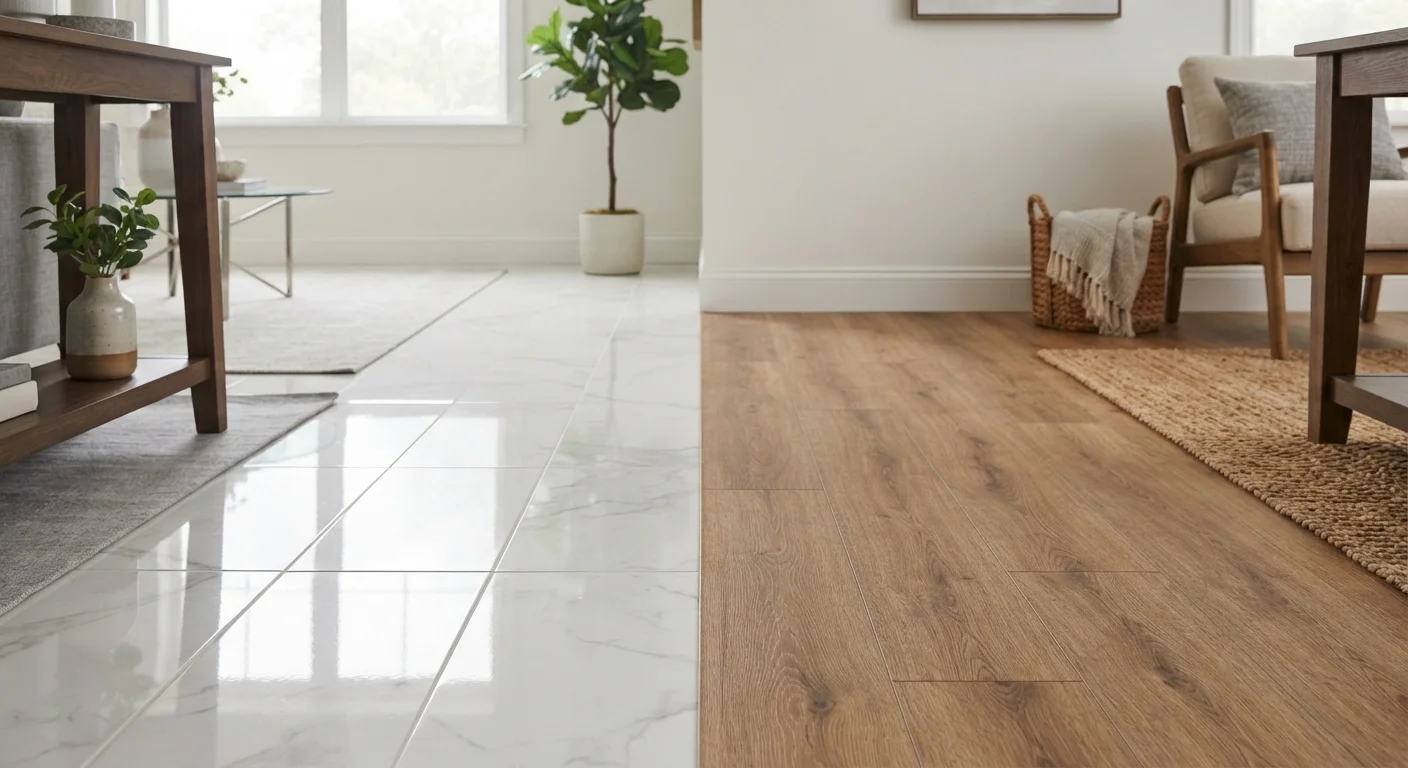
Option A
Ceramic & Porcelain Tile
The time-tested, hard-surface workhorse.
Best for: Homeowners who want maximum longevity and water resistance in kitchens, bathrooms, and entryways.
Option B
Luxury Vinyl Plank (LVP)
The comfortable, DIY-friendly modern contender.
Best for: Budget-conscious homeowners seeking a warm, forgiving floor that can be installed quickly without professional help.
Durability and Scratch Resistance
In high-traffic areas, durability is the first question every homeowner should ask. Ceramic and porcelain tile score exceptionally well here. Porcelain, in particular, has a Mohs hardness rating of around 7, meaning it resists scratching from most everyday items including furniture legs, pet claws, and grit tracked in from outside. The primary vulnerability for tile isn't the tile itself - it's the grout lines, which can crack, stain, or crumble under heavy impact or shifting subfloors.
Luxury vinyl plank is rated using a wear-layer measurement expressed in mils (thousandths of an inch). For genuinely high-traffic residential areas, look for a wear layer of 12 mils or higher; commercial-grade LVP often reaches 20 mils. Thicker wear layers resist scratching well under normal household use, but LVP can still dent or gouge under sharp or very heavy point loads in ways that tile would not. Both materials are water-resistant at the surface, but tile - particularly porcelain - edges out LVP for long-term moisture resilience when the subfloor is sound.
| Criterion | Ceramic & Porcelain Tile | Luxury Vinyl Plank (LVP) |
|---|---|---|
| Typical lifespan | 30-50+ years | 15-25 years |
| DIY-friendliness | Moderate to difficult | Beginner to intermediate |
| Water resistance | Excellent (grout must be sealed) | Very good (seams not waterproof) |
| Comfort underfoot | Hard and cold | Softer, warmer feel |
| Scratch resistance | Very high | Good (wear-layer dependent) |
| Ease of repair | Difficult - color matching issues | Easy - individual plank swap |
| Ongoing maintenance | Grout sealing required | Sweep and damp mop only |
| Sound transmission | High - noisy underfoot | Lower - better acoustics |
Installation Complexity and Cost
Tile installation is a multi-step process requiring substrate preparation, thinset mortar, tile layout, grouting, and sealing. For most homeowners, hiring a licensed tile installer is strongly advisable, especially for larger areas or rooms with complex layouts. Professional tile installation typically runs higher per square foot than LVP due to labor intensity, material prep, and the cost of grout, spacers, and sealers. Tile also demands a rigid, level subfloor - any flex will cause cracked tiles or failed grout over time.
LVP's floating click-lock systems have dramatically lowered the barrier to DIY installation. Most products can go directly over existing hard flooring (within height tolerances) and do not require adhesive in floating applications. This translates to meaningfully lower labor costs when professionally installed and a realistic self-install option for experienced DIYers. The main installation caveat for LVP is acclimation: planks should sit in the room for 24-48 hours before installation to adjust to ambient temperature and humidity.
12-20 mils
Recommended wear layer for high-traffic LVP
Industry guidance from flooring trade associations suggests residential high-traffic areas use at least 12-mil wear layers, with 20 mils for commercial-grade durability.
1-3 years
Grout resealing interval for tile floors
Most flooring professionals recommend resealing cement-based grout every one to three years depending on traffic volume and exposure to moisture or staining agents.
24-48 hrs
LVP acclimation time before installation
Manufacturers generally require luxury vinyl plank to acclimate to room temperature and humidity for at least 24 hours before installation to minimize expansion gaps.
Comfort, Acoustics, and Everyday Livability
Tile's hard, dense surface means it transmits noise readily - dropped items are loud, footsteps click, and the floor stays cool even in heated homes. In climates with cold winters, tile without in-floor radiant heating can be genuinely uncomfortable in kitchens and bathrooms. On the positive side, tile stays cool in summer and is easy to clean with a damp mop.
LVP offers a noticeably softer feel underfoot, reducing leg and back fatigue during extended standing. Its layered construction also dampens sound better than tile in multi-story homes, though it does not match carpet for acoustic absorption. Many LVP products include an attached underlayment that further improves both comfort and noise reduction. For households where people spend significant time on their feet - cooking, laundry, childcare - this comfort difference is practical, not just perceptual.
Long-Term Maintenance and Repair
Tile maintenance centers on the grout. Even epoxy grout can stain over time in food-prep and entryway areas. Cement-based grout should be sealed every one to three years depending on foot traffic and exposure. Individual cracked or chipped tiles can be replaced, but matching discontinued tile colors or textures mid-floor is notoriously difficult, often resulting in a visible patch.
LVP requires little beyond regular sweeping and damp mopping - no sealing, no grout treatment. However, it is not impervious to long-term wear: UV exposure can cause fading near windows unless the product is UV-rated, and heavy furniture without protective pads can leave permanent indentations. Scratches in the wear layer are typically not repairable, so replacement of the affected plank is the standard fix. Thanks to the floating installation method, individual planks can usually be swapped without dismantling the entire floor.
Both materials are low-maintenance relative to hardwood, but tile demands more consistent preventive care while LVP asks for more careful avoidance of its specific vulnerabilities.
Subfloor Condition Matters for Both
Neither tile nor LVP can compensate for a structurally compromised subfloor. Tile requires a rigid, deflection-free base - typically cement board or an uncoupling membrane over plywood. LVP tolerates minor imperfections but still requires a flat surface within manufacturer tolerances (commonly 3/16 inch over 10 feet). Before choosing either material, assess and repair your subfloor first. In older homes, this step can add meaningful cost to your project budget and should be factored into any estimates.
The content provided on our blog site traverses numerous categories, offering readers valuable and practical information. Readers can use the editorial team’s research and data to gain more insights into their topics of interest. However, they are requested not to treat the articles as conclusive. The website team cannot be held responsible for differences in data or inaccuracies found across other platforms. Please also note that the site might also miss out on various schemes and offers available that the readers may find more beneficial than the ones we cover.