

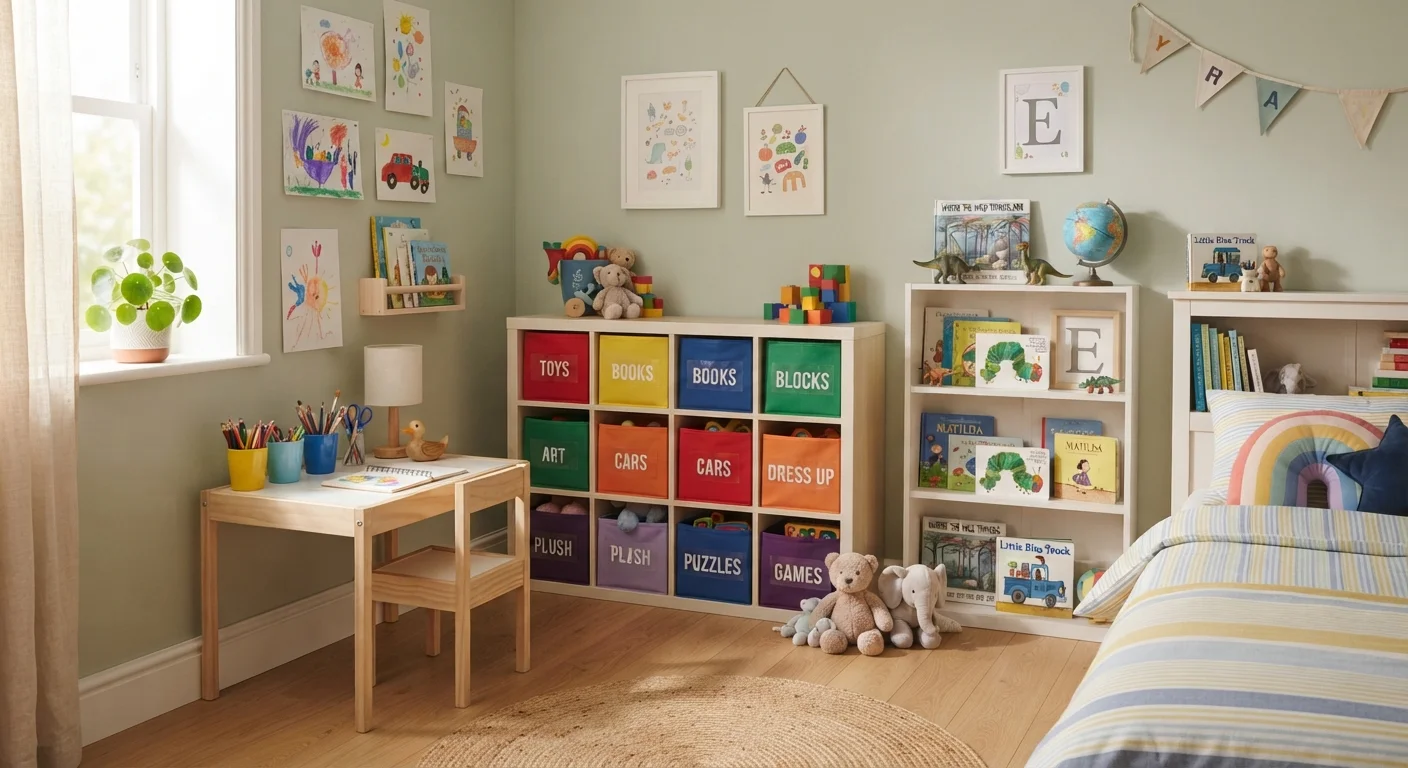
Why Children Need Systems, Not Just Instructions
Telling a child to "clean their room" without providing a defined system is roughly equivalent to handing an adult a disorganized toolkit and asking them to build something. The instruction is real, but the infrastructure to act on it is missing. Children develop organizational thinking gradually, and the environment you set up either supports or undermines that development.
Research in child development consistently suggests that young children learn habits through physical and environmental cues more than verbal reminders. A labeled bin at eye level does more behavioral work than a repeated request. This is why starting with a clear, simple framework matters as much for a child's space as it does for any adult room reset.
Start With Less, Not More Containers
Adding storage bins to an overcrowded room rarely solves the problem - it typically just hides it temporarily. Before setting up any system, reduce the volume of belongings to what your child actually uses and values. As explained in why reorganizing without decluttering first always fails, skipping the purge is the single most common reason new organization systems collapse within weeks.
Age also shapes what is realistic. A five-year-old can return toys to an open bin but cannot realistically sort clothing by type and fold it neatly. A ten-year-old can manage a multi-step morning checklist. Calibrating expectations to developmental stage prevents both frustration and learned helplessness.
Low, open-top bins or baskets
Allow young children to drop items in without wrestling with lids, making independent tidying faster.
Picture labels or icon stickers
Help pre-readers and early readers identify where items belong without adult help.
Adhesive hooks at child height
Give kids a designated spot for backpacks, jackets, and bags they use every day.
Small whiteboard or chore chart
Provides a visual daily checklist so kids can self-monitor tasks without prompting.
Setting Up and Sustaining the System
The steps below walk through a practical setup process that works for most children between ages four and twelve. Adapt the specifics - label type, bin height, reset timing - to your child's age and your home's layout. For a broader view of how to think about organizing shared family spaces alongside children's rooms, the room-by-room organization checklist provides useful structure.
What you will need
Declutter together before setting up any system
Sit down with your child and sort belongings into three groups: keep, donate, and discard. Let them lead as much as possible - children who make their own keep decisions are more invested in maintaining the resulting system. Aim to keep only what fits comfortably in the available space without crowding.
Design storage that matches your child's age and reach
Everything a child is expected to maintain independently must be physically accessible to them. For children under eight, this means low shelves, open bins, and hooks mounted at shoulder height. Avoid systems that require stacking, reaching overhead, or operating complex closures. Consider how the zone method can be adapted at a small scale - group items by activity (art, reading, building) rather than by type, so your child's brain can find things intuitively.
Label every storage location clearly
Labels remove ambiguity and eliminate the most common source of parental nagging: "put it where it belongs." For non-readers, print or draw simple pictures and tape them to the front of each bin. For early readers, combine a picture with a one-word label. Older children can use written labels alone, or even create their own - which reinforces ownership further.
Build a short daily reset into the existing routine
A ten-minute tidy at the same time each day is far more effective than a weekend overhaul. Anchor the reset to something already happening - before dinner, after homework, or just before screen time. Consistency of timing matters more than duration. A visual checklist on a small whiteboard lets children check off tasks themselves, building self-monitoring habits that transfer well beyond the bedroom. For more on building habits that stick, the principles in strategies backed by learning science apply directly to children learning household routines.
Involve children in evaluating and adjusting the system
After two to three weeks, sit down with your child and honestly assess what is working and what is not. Is any bin consistently overflowing? Is a category missing? Are labels still accurate? Systems that get adjusted based on real use last far longer than those treated as permanent setups. This also teaches children that organization is a living process, not a one-time event.
Once the system is running, the parental role shifts from director to coach. Offer encouragement when you notice the system working, and ask questions rather than giving solutions when it slips: "Where do you think that should go?" or "What do we need to change so this is easier?" That shift in language builds genuine competence over time - the kind that outlasts childhood and carries into how your kids eventually manage their own homes.
The content provided on our blog site traverses numerous categories, offering readers valuable and practical information. Readers can use the editorial team’s research and data to gain more insights into their topics of interest. However, they are requested not to treat the articles as conclusive. The website team cannot be held responsible for differences in data or inaccuracies found across other platforms. Please also note that the site might also miss out on various schemes and offers available that the readers may find more beneficial than the ones we cover.