

Our Verdict
Neither hard nor soft skills alone will carry a career-employers across industries increasingly expect both. Hard skills get you through the screening stage; soft skills often determine who gets hired, promoted, and retained. The most practical approach is to honestly assess where your gaps are, then build in the direction that will have the greatest professional return.
| Best for | Recommended |
|---|---|
| Early-career job seekers with limited work history | Hard Skills First |
| Mid-career professionals targeting leadership or management roles | Soft Skills Development |
| Career changers entering a new industry or field | Both, prioritized by skills gap analysis |
| Workers in technical roles facing automation risk | Soft Skills Development |
What Hard Skills and Soft Skills Actually Mean
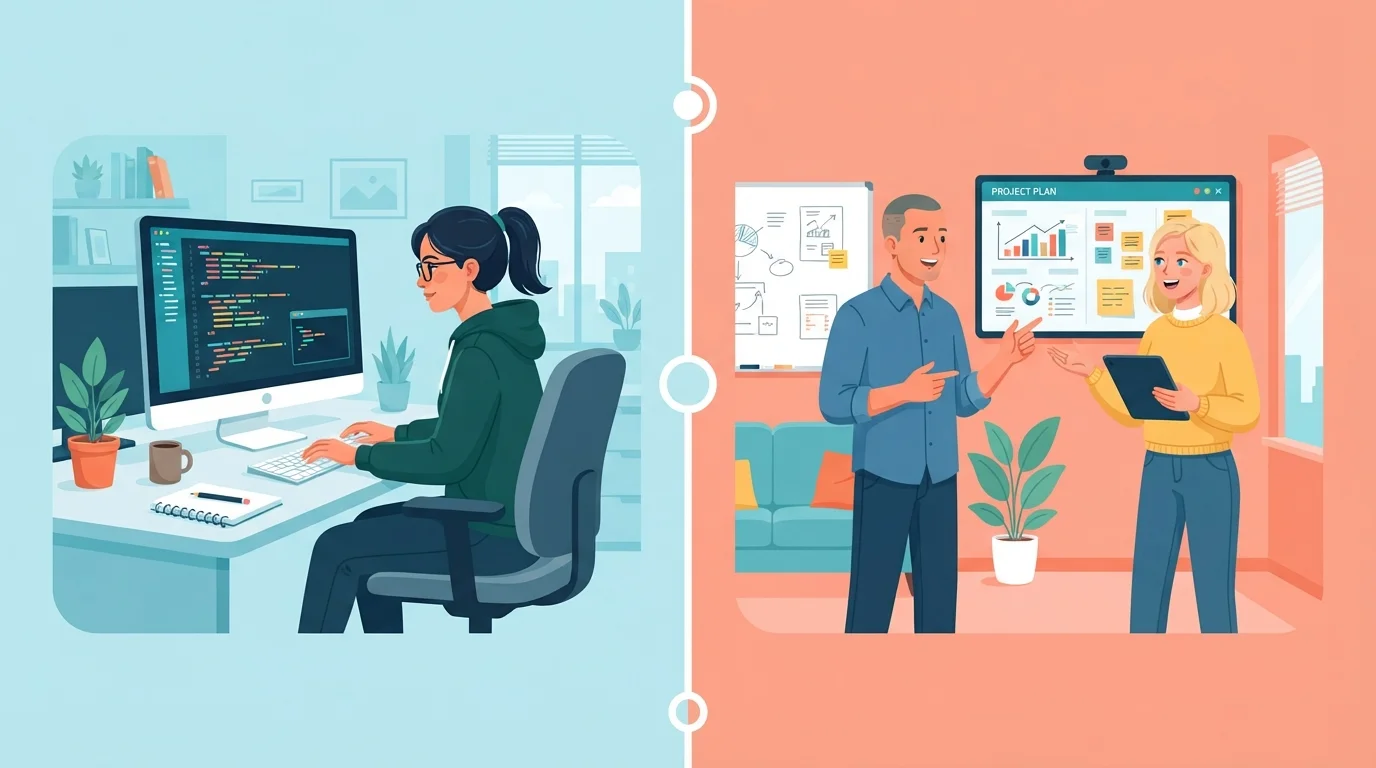
Hard skills are specific, learnable competencies that can be directly measured and verified - think data analysis in Python, financial modeling, medical coding, or fluency in a second language. They are typically acquired through formal training, certifications, or hands-on practice, and employers can test for them relatively objectively.
Soft skills, by contrast, are behavioral and interpersonal - communication, conflict resolution, adaptability, time management, and leadership. They're developed over time through experience and reflection, and they're harder to verify on a resume, though no less real in their impact on workplace performance.
A useful way to think about the distinction: hard skills describe what you can do; soft skills describe how you work with others and handle challenges while doing it. Both categories appear in almost every job posting, and the specific language recruiters use often blurs these lines - terms like "critical thinking" can span both domains.
How Employers Assess Each Skill Type
Hard skills are typically screened through résumé review, portfolio samples, technical assessments, or skills tests administered during hiring. Certifications and degrees serve as proxies that recruiters use to shortcut verification. This is why credentialing - even from a well-regarded online course - can meaningfully move a hard-skills candidacy forward.
Soft skills are assessed less directly, but employers absolutely look for evidence of them. Behavioral interview questions ("Tell me about a time you managed a disagreement with a colleague") are the most common instrument. References are another. Some organizations use structured assessments or work-sample exercises designed to observe communication and decision-making under realistic conditions.
| Hard Skills | Soft Skills | |
|---|---|---|
| Definition | Specific, teachable technical competencies | Behavioral and interpersonal capabilities |
| How acquired | Training, courses, certifications, practice | Experience, feedback, reflection, coaching |
| How employers verify | Tests, portfolios, credentials, demos | Behavioral interviews, references, observations |
| Rate of obsolescence | Can become outdated as technology changes | Generally durable across roles and eras |
| Ease of credentialing | High - certifications and degrees available | Low - no standardized credential |
| Impact on advancement | Critical for entry and role-specific fit | Often decisive for leadership and promotion |
One implication: because soft skills are harder to verify on paper, the burden falls on candidates to surface them through specific, outcome-anchored examples rather than vague self-descriptions. Vague claims rarely impress hiring managers - concrete behavioral evidence does.
Strategies for Building Hard Skills
Hard skills development is relatively straightforward in structure, though not always in effort. The general path: identify the specific skill demanded in your target roles, find a credible learning source, practice deliberately, and produce a verifiable artifact (a project, certification, or portfolio piece) that proves competency.
- Audit job postings: Pull 10-15 listings in your target field and tally which technical skills appear most often. That frequency is your prioritization signal.
- Choose structured learning: Online courses, community college programs, and bootcamps can all deliver hard-skill gains. What matters most is whether the format forces you to practice the skill, not just read about it. See our end-to-end online learning guide for a full breakdown of how to navigate this process.
- Build something real: Apply newly learned skills to a tangible project - a data dashboard, a written sample, a small app - that you can share or discuss with interviewers.
- Pursue credentials strategically: Certifications add credibility when they are recognized in your target industry. They matter less in fields where portfolio work speaks louder.
Pair Learning with Immediate Application
The research on skill retention consistently points to the same conclusion: skills learned without prompt application fade quickly. Whenever you complete a course or workshop, identify a specific task in the next two weeks where you can use what you learned. Even a small, deliberate application - running a meeting differently, drafting a data summary - dramatically improves retention and builds confidence for the next opportunity.
Strategies for Building Soft Skills
Soft skills develop through deliberate practice and honest feedback - two things that don't happen automatically. Unlike hard skills, you rarely finish a "communication course" and emerge polished; growth requires iterative application in real or realistic settings.
- Seek structured feedback: Ask managers, peers, or mentors for specific observations about how you communicate, collaborate, or handle pressure. Vague feedback is less useful; ask for examples.
- Use low-stakes environments: Toastmasters for public speaking, volunteer leadership roles, or facilitated workshops give you room to practice without career-level consequences.
- Reflect on outcomes: After a difficult conversation or a project with friction, write a brief account of what happened, what you did, and what you'd change. This kind of structured reflection accelerates skill development.
- Translate experience into evidence: Build a mental or written library of behavioral examples - situations where you demonstrated adaptability, resolved conflict, or led without authority - so you can draw on them in interviews.
Many soft skills also qualify as transferable skills - competencies that travel with you across roles and industries, compounding in value over time.
Finding Your Own Skills Gap
The practical starting point is an honest self-assessment. Most people have an imbalance - technical specialists who struggle to communicate complexity to non-experts, or strong communicators who lack the domain credentials to break into a new field.
A simple diagnostic: compare your current skills profile against what's actually required in postings for roles one level above where you are now. Where are the consistent gaps? Are they primarily technical (hard skills) or behavioral and leadership-oriented (soft skills)? That gap is your development priority.
It also helps to ask someone who has observed your work. Self-perception of soft skills in particular tends to be unreliable - we're often blind to patterns others see clearly. A candid conversation with a mentor or trusted former colleague can surface gaps that self-assessment misses.
As you build, remember that the goal isn't perfection across all dimensions - it's enough competency in both categories to be credible and effective in the roles you're pursuing. Staying professionally relevant over time means treating skill development as an ongoing habit, not a one-time effort.
The content provided on our blog site traverses numerous categories, offering readers valuable and practical information. Readers can use the editorial team’s research and data to gain more insights into their topics of interest. However, they are requested not to treat the articles as conclusive. The website team cannot be held responsible for differences in data or inaccuracies found across other platforms. Please also note that the site might also miss out on various schemes and offers available that the readers may find more beneficial than the ones we cover.