

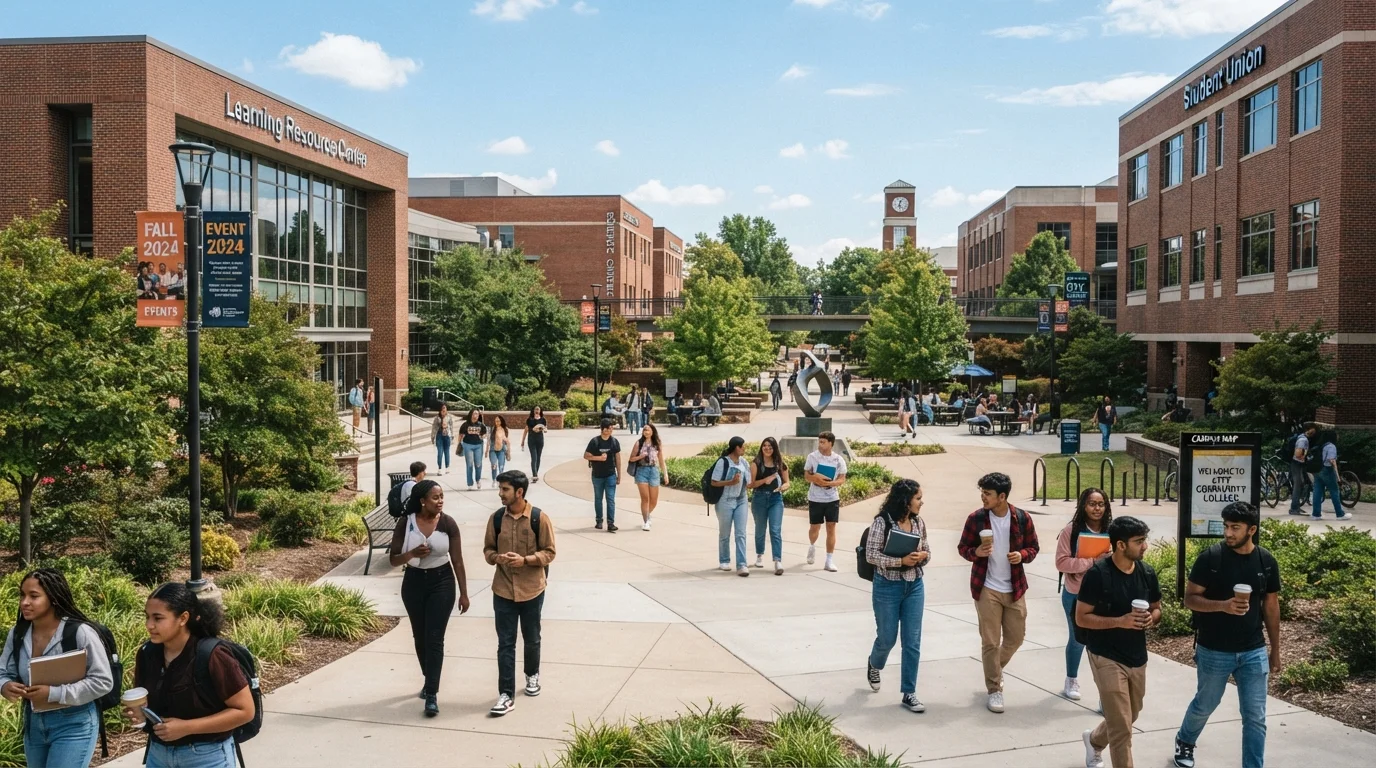
Our Verdict
Community college is a genuinely strong option for students who need to reduce upfront costs, test their academic interests, or earn vocational credentials efficiently. However, it requires deliberate planning - particularly around transfer articulation agreements and completion support - to deliver on its promise. Without that groundwork, the cost savings can be offset by lost time and incomplete credentials.
Best suited for cost-conscious students with a clear transfer plan, working adults seeking workforce credentials, or those still exploring academic directions before committing to a four-year program.
What Community College Actually Offers
Community colleges - also called two-year colleges or junior colleges - are publicly funded institutions that award associate degrees, certificates, and workforce credentials. They serve a remarkably broad population: recent high school graduates, adult learners re-entering education, working professionals, and students using them as a cost-controlled bridge to a four-year university.
According to the American Association of Community Colleges, roughly 12 million students are enrolled in community colleges across the US. Tuition at public two-year institutions averages around $3,900 per year, compared to over $10,000 per year at public four-year universities - before room, board, and fees. That gap is consequential for families weighing educational debt. For further context on how these pathways compare financially, see this breakdown of trade school versus four-year college costs.
The institutional mission is deliberately broad: community colleges are designed to be open-access, meaning admission standards are generally minimal. That access is a feature, not a bug - it allows people who faced barriers to traditional college entry a realistic route into higher education.
~$3,900
Average annual tuition at public two-year colleges
According to the College Board's Trends in College Pricing report, public two-year in-district tuition is substantially below four-year public and private institution averages.
12 million
US community college students enrolled annually
The American Association of Community Colleges reports approximately 12 million students attend community colleges each academic year across credit and non-credit programs.
Below 50%
Six-year completion rate at two-year institutions
National Center for Education Statistics data shows that completion rates at two-year public colleges remain below 50%, reflecting a significant attrition challenge.
The Real Advantages Worth Considering
The financial case for starting at a community college is straightforward, but cost isn't the only compelling reason to consider it.
Substantially lower tuition than four-year universities
Public two-year tuition averages a fraction of four-year costs, allowing students to complete general education requirements at reduced expense before transferring or entering the workforce.
Open-access admissions reduce barriers to entry
Most community colleges accept all applicants with a high school diploma or GED, giving students who didn't qualify for selective universities a viable path forward.
Flexible scheduling suits working adults
Evening, weekend, and hybrid course options allow students to maintain employment or caregiving responsibilities while progressing toward a credential.
Strong workforce credential programs in high-demand trades
Programs in healthcare, information technology, skilled trades, and business can lead to employment in under two years, often with clearly defined salary outcomes in local labor markets.
Smaller class sizes in early coursework
Introductory courses at community colleges are typically taught by instructors - not teaching assistants - in smaller settings, which can benefit students who need more direct academic support.
For students uncertain about their academic direction, community college provides a lower-stakes environment to explore subjects before committing to a major and the tuition of a four-year school. This mirrors some of the flexibility discussed in common online learning myths - the assumption that a student must have everything figured out before beginning is rarely accurate in any education format.
The Limitations That Deserve Honest Attention
Community college carries real constraints that are often underplayed in promotional materials. Understanding them upfront prevents costly missteps.
Transfer credit acceptance is inconsistent and unpredictable
Without a formal articulation agreement, individual four-year institutions may reject or reclassify credits, potentially adding time and tuition to reach a bachelor's degree.
Completion rates are persistently low
National data consistently shows that fewer than half of community college students who enroll complete a degree or certificate within six years, reflecting real structural and life-circumstance challenges.
Limited campus resources and extracurricular life
Research networks, career placement offices, alumni connections, and on-campus housing are typically less developed than at four-year institutions, which can affect networking and job placement.
Some employers and graduate programs screen by institution type
While this is decreasing, certain competitive employers and graduate programs may give preferential consideration to applicants from four-year institutions, particularly in fields like finance, law, and research.
Longer total timeline if transfer is the goal
Students who transfer after two years may take longer than four years total to complete a bachelor's degree if credits don't fully articulate or if they change direction partway through.
Students planning to eventually earn a bachelor's degree should research specific articulation agreements - formal transfer agreements between a community college and a four-year institution - before enrolling. Not all credits transfer cleanly, and discovering mid-path that key coursework won't apply can add semesters and cost. This is particularly relevant for career changers, a group whose priorities are explored in depth in this guide on online learning for career changers.
Articulation Agreements: Do Your Research First
Many states have statewide transfer agreements that guarantee credit acceptance between public two-year and four-year institutions - California's TAG program and Florida's statewide articulation agreement are well-known examples. However, these agreements vary by major and institution. Before enrolling with a transfer goal in mind, contact the transfer admissions office at your target four-year school and confirm in writing which credits will apply to your intended program.
How to Evaluate Whether It's Right for Your Goals
Community college is not a universally superior or inferior choice - its value depends on what you're trying to achieve and how you structure the path.
Ask concrete questions before enrolling: Does your target four-year school have a formal articulation agreement with the community college you're considering? Does your intended career field have licensing or credentialing requirements that a two-year credential satisfies - or does it require a specific bachelor's degree? Will your prospective employers recognize the credential?
For those weighing whether to skip higher education altogether, this look at misconceptions about skipping college offers useful counterbalance. And if a fully online degree is also on the table, the real pros and cons of earning a degree entirely online addresses a similar trade-off framework.
Community college works best when treated as a deliberate first chapter with a defined destination - not simply the path of least resistance.
The content provided on our blog site traverses numerous categories, offering readers valuable and practical information. Readers can use the editorial team’s research and data to gain more insights into their topics of interest. However, they are requested not to treat the articles as conclusive. The website team cannot be held responsible for differences in data or inaccuracies found across other platforms. Please also note that the site might also miss out on various schemes and offers available that the readers may find more beneficial than the ones we cover.