

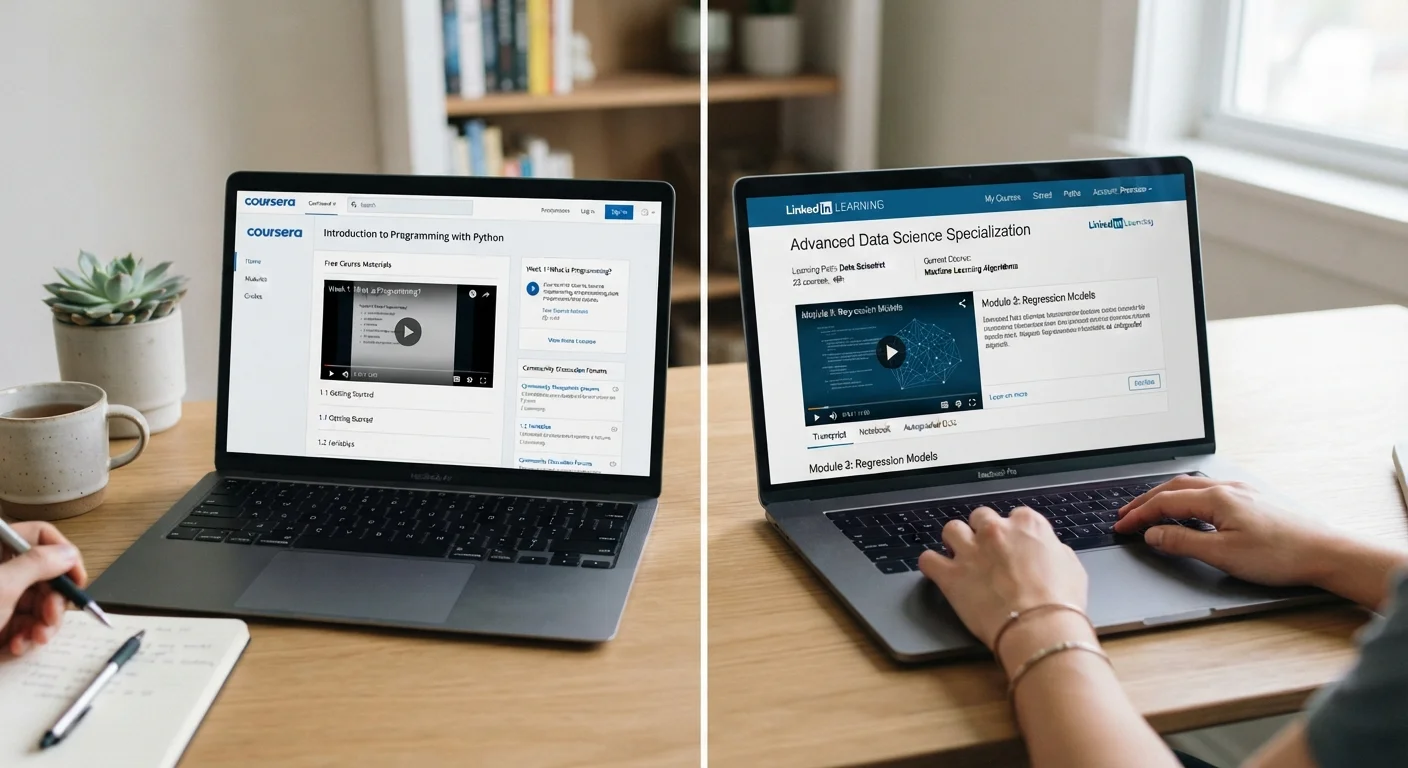
Option A
Free Online Courses
The accessible, low-risk entry point to any subject.
Best for: Exploratory learners, budget-conscious students, and anyone building foundational knowledge before committing money.
Option B
Paid Online Courses
The structured, credential-backed investment in skill development.
Best for: Career-focused learners who need verifiable credentials, mentorship, or a defined learning path to demonstrate competency to employers.
What Free Courses Actually Include
Free online courses vary enormously in scope and quality, but most share a common structure: video lectures, reading materials, and discussion forums that anyone can access without payment. Platforms affiliated with accredited universities - such as those offering massive open online courses (MOOCs) - frequently provide the same lecture content that fee-paying students receive.
What free access typically does not include is graded feedback, instructor interaction, or a shareable certificate of completion. Audit tracks, which allow free access to course materials, are specifically designed to withhold these features as a way to differentiate the paid tier. For learners whose goal is knowledge rather than credentialing, this trade-off is entirely acceptable.
Quality within the free tier also varies. A free course produced by a research university carries different academic weight than one assembled by an individual creator without institutional oversight. Evaluating the provider's credentials - their faculty, institutional affiliation, and how the course is structured - matters more than the price tag.
Audit Access vs. Full Enrollment
Many platforms allow learners to 'audit' a course for free, granting access to videos and readings but not graded work or certificates. This distinction is important: auditing a course from a well-regarded university still provides genuine learning value - it simply won't produce a shareable credential. If your goal is knowledge acquisition rather than credentialing, auditing is often the most cost-effective approach available.
What Paid Courses Add to the Equation
Paid courses do more than unlock a certificate. The features that most consistently justify cost are graded assessments with instructor or peer review, structured pacing with deadlines, and access to a learning community. These elements address the single biggest challenge in online learning: completion. Research from platforms offering both free and paid tiers consistently shows that learners who pay are significantly more likely to finish the course.
Beyond accountability, paid programs often include curated curriculum - meaning the sequence of topics has been deliberately designed to build toward a specific outcome, such as a job-ready portfolio or a defined competency. This is especially relevant for learners pursuing a career change, where a coherent learning path matters as much as the individual content. See our guide for career changers for a deeper look at evaluating programs through that lens.
Paid courses also carry reputational stakes for the provider. Institutions and platforms that charge fees have more incentive to maintain content quality, update material, and respond to learner feedback - though this is not a guarantee.
| Criterion | Free Online Courses | Paid Online Courses |
|---|---|---|
| Cost | $0 for content access | Ranges from ~$10 to thousands |
| Certificate included | Rarely; audit tracks excluded | Typically yes, upon completion |
| Graded assessments | Usually not available | Standard feature |
| Instructor feedback | Limited or none | Often included or available |
| Structured pacing | Self-directed; no deadlines | Guided schedule with milestones |
| Completion rates | Generally lower | Generally higher |
| Content quality | Varies widely by provider | Varies; higher provider accountability |
| Employer recognition | Limited without credential | Stronger with reputable issuer |
The Certificate Question: Does It Matter to Employers?
One of the most common justifications for paying is the certificate. But whether that certificate carries weight depends heavily on the issuing institution, the field, and how the hiring manager interprets it. A certificate from a program with strong industry partnerships or university affiliation can meaningfully signal competence. A certificate from an unvetted provider may add little to a résumé.
In technical fields like data analysis, programming, and project management, specific certificates have gained traction with employers because they map to demonstrable skills that can be tested in interviews. In fields where credentials are more holistic - writing, design, business strategy - a portfolio of work often outweighs any certificate, paid or free.
It is also worth accounting for the full cost picture. Paid courses can carry fees beyond enrollment tuition, including software subscriptions, proctoring services, or required materials. Our article on the hidden costs of online learning breaks down these often-overlooked expenses. For a broader framework on when spending more genuinely pays off, see our spending decision framework.
This article is for general informational and educational purposes only and does not constitute financial or career advice. Individual outcomes will vary based on personal circumstances, employer requirements, and the specific programs chosen.
The content provided on our blog site traverses numerous categories, offering readers valuable and practical information. Readers can use the editorial team’s research and data to gain more insights into their topics of interest. However, they are requested not to treat the articles as conclusive. The website team cannot be held responsible for differences in data or inaccuracies found across other platforms. Please also note that the site might also miss out on various schemes and offers available that the readers may find more beneficial than the ones we cover.