

Our Verdict
No single method outperforms the others in every situation. Luring excels when you need a behavior fast; shaping and capturing build strong, durable habits over time; and marker training amplifies the precision of whichever method you pair it with. Understanding how each works gives you a flexible, science-grounded toolkit rather than a rigid rulebook.
| Best for | Recommended |
|---|---|
| Beginners teaching new behaviors quickly | Luring |
| Owners who want precision and clean communication | Marker Training |
| Building complex or multi-step behaviors gradually | Shaping |
| Putting a cue on behaviors the pet already offers naturally | Capturing |
Why the Method You Choose Shapes How Your Pet Learns
All four methods covered here operate within the framework of positive reinforcement - rewarding desired behavior to increase its likelihood. Where they differ is in how the behavior gets produced in the first place. Before any reward is delivered, the pet has to actually perform the behavior, and each method takes a distinct route to get there.
Understanding the mechanics behind each approach helps you match method to situation rather than defaulting to whatever worked once before. For a deeper look at the research underpinning reward-based training, see our guide to positive reinforcement science. And if terminology like "reinforcement schedule" or "extinction" is unfamiliar, our plain-language training glossary is a useful starting point.
The Four Methods at a Glance
Here is a structured look at how the methods compare across the criteria that matter most in everyday training.
| Marker Training | Luring | Shaping | Capturing | |
|---|---|---|---|---|
| How the behavior is produced | Reinforced at precise moment it occurs | Food guides pet into position | Rewarded approximations, step by step | Reinforced when pet offers it naturally |
| Speed to first response | Moderate - depends on paired method | Fast - often within seconds | Slow - built incrementally | Variable - relies on natural opportunity |
| Beginner friendliness | Moderate - timing must be practiced | High - intuitive to use | Low to moderate - requires observation | Moderate - requires readiness and patience |
| Risk of prompt dependency | Low | High if lure not faded early | Low | Very low |
| Best suited for | Precision and complex behaviors | Simple, new behaviors | Multi-step or hard-to-guide behaviors | Behaviors already in pet's repertoire |
| Works across species | Yes - dogs, cats, birds, others | Primarily dogs and cats | Yes - widely used across species | Yes - any pet that naturally offers it |
Marker Training
A marker is a brief, consistent signal - typically a clicker click or a short word like "yes" - delivered at the precise instant a correct behavior occurs, followed by a reward. The marker does not replace the reward; it bridges the gap between behavior and treat, communicating exactly which action earned reinforcement. This timing precision is what separates marker training from simply handing over a treat after a behavior.
Marker training pairs with any other method and is most valuable when accuracy matters - think duration, distance, or position behaviors where half a second of difference changes what the pet learns. For a practical comparison of clicker versus verbal markers, see Clicker Training vs. Verbal Markers.
Luring
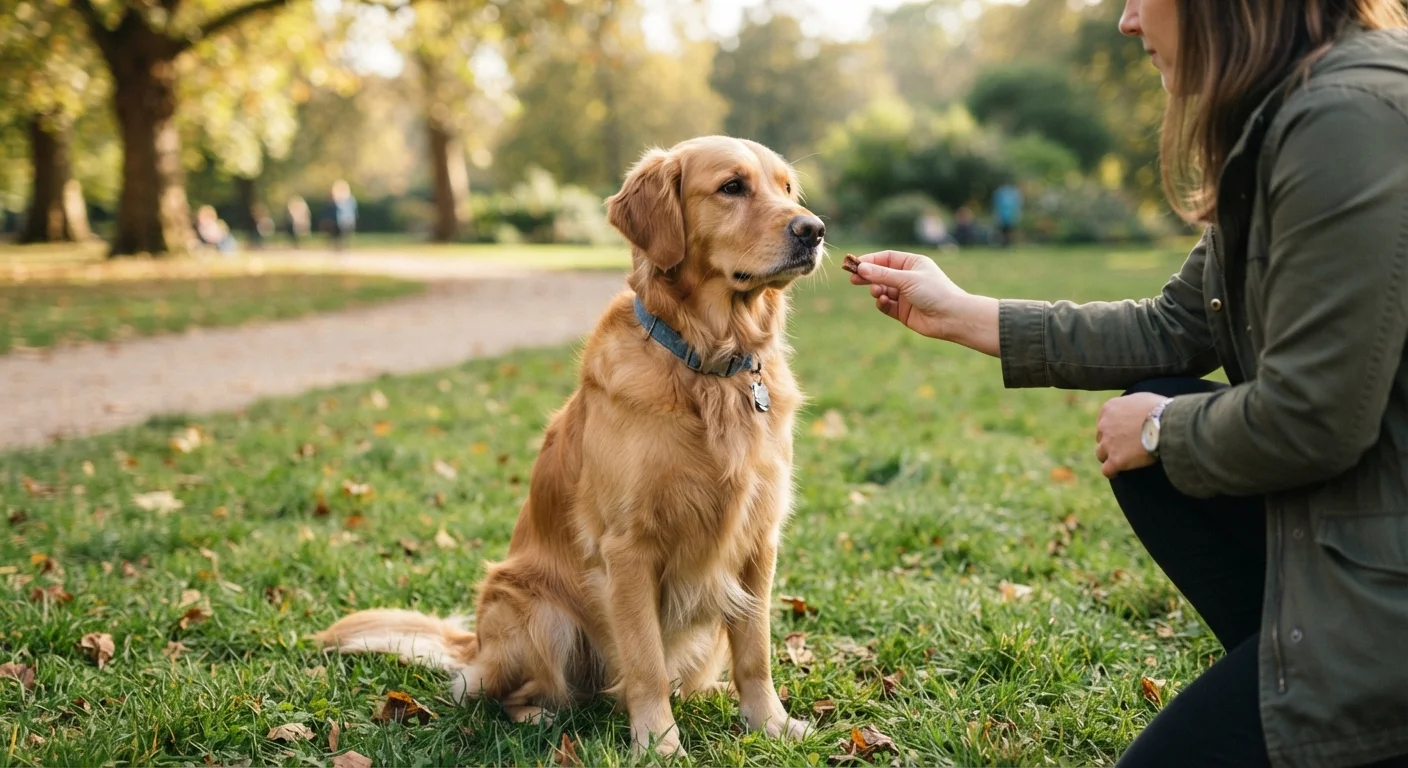
Luring uses a reward - usually food - held in the hand to physically guide the pet into position. The classic example is moving a treat from a dog's nose up and back over the head to produce a sit. Luring is fast and beginner-friendly, which is why it dominates early obedience classes. The critical discipline is fading the lure quickly - within a few successful repetitions - and transitioning to a hand signal or verbal cue. Pets trained with a persistent lure often fail to perform without one present.
Shaping
Shaping builds a target behavior by reinforcing successive approximations - small steps that move incrementally toward the final goal. If you want a dog to place both paws on a platform, you might first reward looking at the platform, then approaching it, then touching it with one paw, and so on. Shaping demands patience and sharp observation but produces behaviors that are often more durable and generalizable than those taught through luring. It is also useful for behaviors that are difficult or impossible to physically guide a pet into.
Capturing
Capturing means marking and rewarding a behavior the pet produces spontaneously - without any prompt or guidance. If your dog naturally stretches into a bow every morning, you can capture it by marking the moment it happens and pairing a cue over repeated opportunities. Capturing works best for behaviors the pet already performs regularly, and it tends to produce enthusiastic, fluent responses because the pet is offering the behavior of its own accord.
Start with One Method, Then Layer
If you are new to structured training, begin with luring to get the behavior established quickly, then introduce a marker to sharpen timing as you fade the lure. Shaping and capturing can be added as your observation skills grow. Trying all four at once without a clear plan tends to muddy the communication rather than clarify it.
Choosing Based on Behavior Type and Training Stage
Method selection often hinges on two questions: Is this behavior new or already in the pet's repertoire? And does it involve a simple posture or a complex sequence?
- New, simple behaviors: Luring gets you there fastest. Use it for sits, downs, and spins, but fade the lure promptly.
- New, complex behaviors: Shaping allows you to break the behavior into learnable pieces without overwhelming the pet.
- Naturally occurring behaviors: Capturing is the most efficient route, preserving the pet's initiative and enthusiasm.
- Any behavior requiring precision: Layer marker training on top of whichever method you use to sharpen the feedback loop.
In practice, the methods are not mutually exclusive. A trainer might lure an initial position, switch to shaping for refinement, and use a marker throughout to communicate clearly. Once the foundation is solid, session structure becomes the next lever - see Structuring Training Sessions That Actually Stick for guidance on length, timing, and building retention.
Common Mistakes and How to Avoid Them
Each method has a characteristic error pattern worth knowing before you start:
- Marker training: Late marking
- Marking even one second after the behavior tells the pet a different action earned the reward. Practice marking a moving object - a bouncing ball, for example - before applying it to your pet.
- Luring: Lure dependency
- If the food stays in the guiding hand session after session, the pet learns to follow the food rather than respond to a cue. Fade the lure to an empty hand signal within three to five successful repetitions.
- Shaping: Criteria jumps
- Moving to the next approximation before the current one is fluent causes frustration and regression. Raise only one criterion at a time and drop back a step if the pet's success rate falls below roughly 80 percent.
- Capturing: Missing the moment
- Capturing requires you to have a marker and reward ready whenever the pet might offer the target behavior. Setting up predictable situations - morning stretch spot, familiar yawn trigger - improves your odds.
This article is for general educational purposes and is not a substitute for guidance from a certified professional trainer or veterinary behaviorist, particularly for pets with fear, aggression, or anxiety concerns.
The content provided on our blog site traverses numerous categories, offering readers valuable and practical information. Readers can use the editorial team’s research and data to gain more insights into their topics of interest. However, they are requested not to treat the articles as conclusive. The website team cannot be held responsible for differences in data or inaccuracies found across other platforms. Please also note that the site might also miss out on various schemes and offers available that the readers may find more beneficial than the ones we cover.