

Why Sticker Price Alone Misleads You
The price tag on a product only tells you one thing: what you hand over at the register. It says nothing about how much product you're getting, how long it will last, or how many times you'll use it before it's gone. That gap between what you pay and what you actually get is where smart shoppers find - or lose - real money.
Retailers know that shoppers respond to round numbers, familiar packaging, and the illusion of a deal. A larger package with a higher price feels more expensive, even when it's actually cheaper per unit. A premium item feels wasteful, even when it outlasts three cheaper alternatives. These intuitions aren't wrong - they're just incomplete. Two straightforward calculations close the gap.
This is also foundational to spending more intentionally across every category of your budget - from groceries to household goods to car supplies.
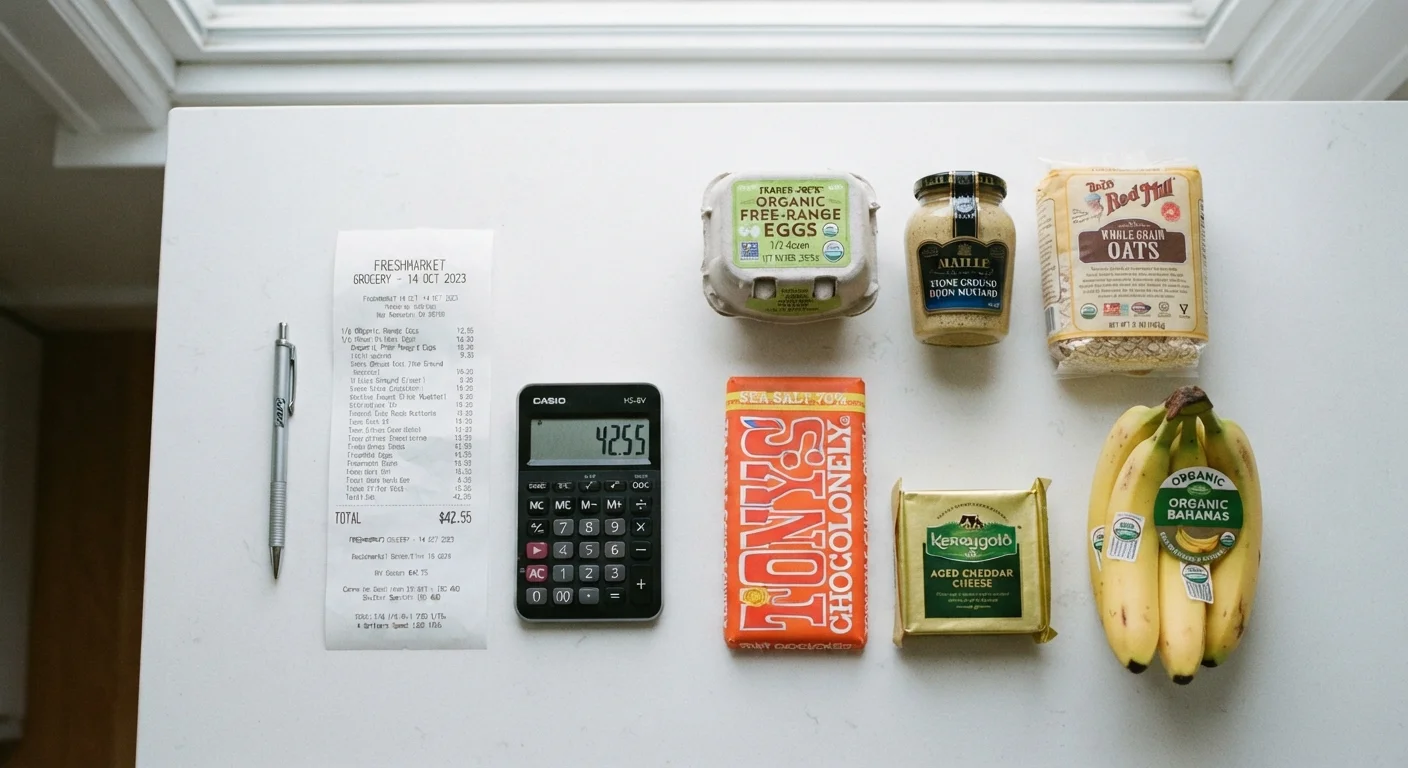
What you will need
The Two Calculations That Matter Most
Unit Pricing
Formula: Total price ÷ Total units (ounces, count, sheets, etc.) = Price per unit
Example: A 32 oz bottle of dish soap costs $4.80. A 16 oz bottle costs $2.79. Divide each: the larger bottle costs $0.15/oz, the smaller costs $0.17/oz. The larger bottle is cheaper per ounce - but only by verifying the math, not by eyeballing.
Many US grocery stores are legally required to display unit prices on shelf tags. When they're available, use them directly. When they're missing or you're shopping online, divide the total price by the quantity or weight listed on the packaging.
Cost-Per-Use
Formula: Purchase price ÷ Estimated number of uses = Cost per use
Example: A $12 sponge mop that lasts 18 months with weekly use gives you roughly 78 uses - about $0.15 per use. A $4 sponge mop that needs replacing every 3 months gives you roughly 13 uses per cycle, or about $0.31 per use. The cheaper item costs more than twice as much per use.
Cost-per-use is especially powerful for clothing, footwear, kitchen tools, and personal care items - anywhere durability varies significantly between options. It pairs well with the quality vs. price framework when you're deciding whether spending more upfront makes financial sense.
Use Your Phone's Calculator Consistently
The math here is genuinely simple division, but most people skip it because it feels like friction. Make it automatic: whenever you're deciding between two size options or two quality tiers, pull out the calculator before putting anything in the cart. Within a few weeks, estimating value this way becomes second nature and takes less than 30 seconds.
How to Apply These Calculations While Shopping
Identify what unit makes sense to compare
Before you divide anything, decide which unit is meaningful for this product. For food and beverages, that's typically ounces, grams, or servings. For paper products, it's sheets or rolls. For cleaning products, it might be ounces or loads. For durable goods, it's total uses or months of expected life.
Comparing price per ounce between a liquid detergent and a powder detergent only works if both measure the same effective output - check whether the labels define a "load" differently before treating them as equivalent.
Calculate the unit price for each option
Divide the total price by the number of units on the label. Do this for each item you're comparing and write the results down or keep them visible on your phone screen.
- $6.40 for 40 oz = $0.16/oz
- $3.50 for 18 oz = $0.194/oz
The first option is cheaper per ounce. But before deciding, move to the next step - unit price alone doesn't account for how you'll actually use the product.
Estimate your realistic number of uses for durable items
For items you'll use repeatedly - cookware, shoes, tools, grooming products - estimate how many times you'll use the item before replacing it. Be honest rather than optimistic. A gym bag you use twice a week for two years gives you roughly 200 uses. One you use sporadically for six months before it falls apart gives you perhaps 30.
If you're unsure about durability, check consumer review aggregators for pattern data, or look at manufacturer warranty length as a rough proxy for expected lifespan.
Calculate and compare cost-per-use
Divide the purchase price by your estimated uses for each option. Compare the results directly.
- Option A: $45 ÷ 150 uses = $0.30/use
- Option B: $18 ÷ 40 uses = $0.45/use
Option A costs more upfront but delivers more value per use. Whether that trade-off works for your budget depends on cash flow - paying $45 today may not be feasible even if it's cheaper long-term. Both the math and your current financial situation matter.
Factor in any hidden costs that affect the true price
Unit price and cost-per-use assume you've captured the full purchase cost. Make sure you have. For subscriptions or refillable products, add the ongoing cost of refills. For items requiring accessories or consumables, fold those in. For online purchases, include shipping if it's not free.
The same principle applies beyond the grocery store - hidden costs can quietly inflate a travel budget just as they inflate the apparent value of a bulk deal. And if you want to go deeper on how retailers structure prices to influence perception, reading a price tag critically is worth your time.
Once the habit forms, these calculations take under 60 seconds. The goal isn't to analyze every purchase obsessively - it's to apply the math when a decision actually matters: big-ticket items, repeat purchases, or anything where two options look superficially similar but aren't.
For purchases where even comparison shopping is difficult, the framework for evaluating deals without side-by-side price data can help you fill in the gaps. And if you're tracking how these habits affect your monthly spending, the budgeting basics hub offers practical tools to see the cumulative impact.
This article is for general informational and educational purposes only. It does not constitute personalized financial advice. Consider consulting a qualified financial professional for guidance specific to your situation.
The content provided on our blog site traverses numerous categories, offering readers valuable and practical information. Readers can use the editorial team’s research and data to gain more insights into their topics of interest. However, they are requested not to treat the articles as conclusive. The website team cannot be held responsible for differences in data or inaccuracies found across other platforms. Please also note that the site might also miss out on various schemes and offers available that the readers may find more beneficial than the ones we cover.