

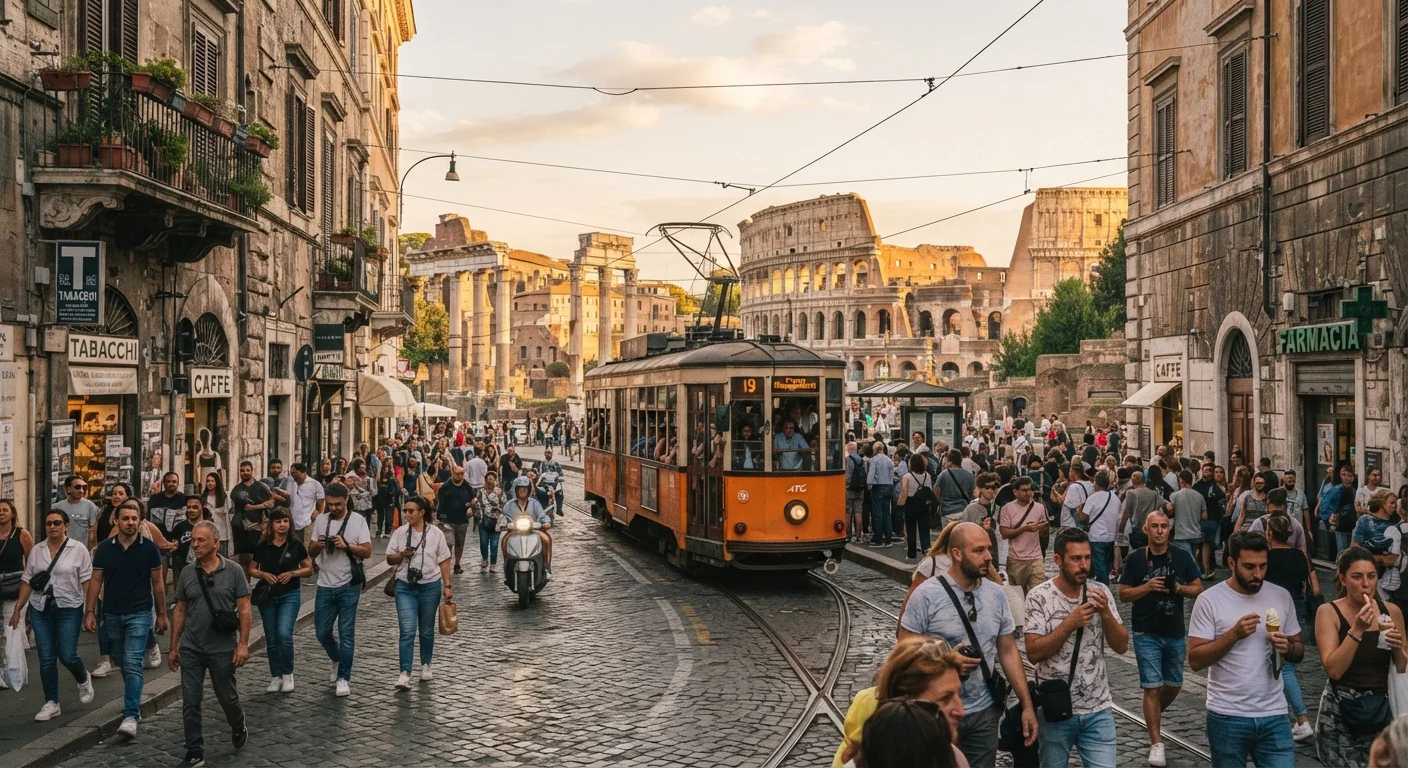
Why Rome's Transit System Rewards Planning
Rome was not designed for automobiles. Its streets follow ancient foot paths, aqueduct routes, and medieval expansions - meaning they are narrow, irregular, and frequently one-way or pedestrian-only. Add cobblestones, scooters, and ZTL restrictions (see the important callout below), and driving becomes more obstacle than convenience for most visitors.
Driving in Central Rome Is Restricted
Much of central Rome is a ZTL (Zona a Traffico Limitato) - a restricted traffic zone monitored by cameras. Rental cars driven into these areas without a permit trigger automatic fines that are often forwarded to the renter weeks later. If you have a rental car, park it outside the ZTL and use transit for the historic center.
The good news is that ATAC's integrated network - Metro, bus, and tram - covers the city well once you understand how the pieces fit together. The challenge is that no single mode serves all the places tourists want to go, so effective navigation requires knowing which tool to use when. For broader strategies on stretching your travel budget while you're at it, see underused money-saving strategies for travelers.
What you will need
Before you start, gather what you need:
ATAC Integrated Transit Ticket
Covers a single journey across Metro, bus, and tram within a 100-minute window from first validation.
24-Hour or 48-Hour Travel Pass
Unlimited rides on all ATAC lines for a fixed period - useful if you plan more than three transit trips per day.
Offline Maps App
Navigating Rome's winding centro storico streets reliably, even without a data connection.
Roma Pass (transit component)
Includes unlimited transit rides alongside museum entry benefits - evaluate whether the museum inclusions justify the cost for your itinerary.
Step-by-Step: Getting Around Rome by Transit and Foot
Buy Tickets Before You Board
Ticket machines are available at Metro stations, many tabacchi (tobacco shops), and newsstands throughout the city. Buying on board is not an option on most lines. Stock up at the start of each day so a closed kiosk never strands you.
Understand the network before your first day
Rome's public transit is operated by ATAC and consists of the Metro (two primary lines, A and B, plus a shorter Line C), a bus network covering the entire city, and six tram lines concentrated in the eastern and Trastevere districts. No single mode covers everything - the network works as a system. Spend 10 minutes before arrival reviewing a transit map on the ATAC website or a cached offline version. Identify which Metro stop is closest to your accommodation and note which bus or tram lines serve your main destinations.
Purchase and load up on tickets
Single-ride tickets (valid for 100 minutes from first validation, covering unlimited bus/tram transfers but only one Metro entry) are sold at Metro station machines, tabacchi shops, and some newsstands. Multi-day passes are also available from the same sources. Contactless card payment works at most machines, but always carry a backup in cash. Consider your daily transit needs: if you plan three or more paid rides in a day, a 24-hour pass is typically more economical than individual tickets.
Navigate the Metro for longer cross-city trips
The Metro is fastest for longer distances - particularly the Termini-to-Ottaviano (Vatican) or Termini-to-Spagna (Spanish Steps) corridors on Line A. Trains run frequently during peak hours. Platforms can be crowded and pickpocketing is a documented concern on Rome's Metro; keep bags in front of you and stay aware of your surroundings. Metro coverage does not reach many neighborhoods in the historic center, so treat it as a long-distance connector rather than a primary exploration tool.
Use buses and trams to fill the Metro's gaps
Buses penetrate the centro storico where the Metro cannot, making them essential for reaching areas like Campo de' Fiori, Piazza Navona, or the Jewish Ghetto. Key routes vary, but the 40 and 64 Express lines have historically served the Vatican corridor from Termini. Trams are generally more predictable than buses because they run on fixed rails; the 8 line connecting Largo Argentina to Trastevere is particularly useful. Use a real-time transit app to check current delays - bus schedules in practice diverge from posted times, especially midday.
Walk strategically between major landmarks
The historic center is compact enough that walking is often faster than waiting for transit. The Pantheon, Piazza Navona, Campo de' Fiori, and Largo Argentina are all within a 10-15 minute walk of each other. From the Colosseum, the Roman Forum and Palatine Hill are adjacent on foot. Plan your itinerary geographically - grouping nearby sites together - rather than bouncing across the city. Cobblestone surfaces are uneven; prioritize comfort over style in footwear. Be aware that some piazzas and alleys are not clearly labeled, so offline navigation is valuable. For a repeatable approach to getting your bearings in any unfamiliar neighborhood, see our city orientation framework.
Know when taxis and ride-shares make sense
Licensed taxis in Rome are white and metered; fares should start from the official tariff posted inside the vehicle. Ride-sharing apps also operate in Rome. Both options are most useful late at night when transit frequency drops, or when carrying heavy luggage. During daytime in central Rome, traffic congestion often makes taxis slower and considerably more expensive than transit or walking. If you do use a taxi, confirm the meter is running at the start of the ride.
Always Validate - Even With a Pass
Rome's transit inspectors conduct random checks and issue fines on the spot to passengers without a validated ticket. Tapping or stamping your ticket at the yellow validators immediately before or upon boarding is mandatory every single ride, including with day passes. 'I didn't know' is not a recognized defense.
This article provides general travel information based on publicly available transit details. Routes, fares, and schedules are subject to change. Verify current information with ATAC or official Rome tourism sources before your trip.
The content provided on our blog site traverses numerous categories, offering readers valuable and practical information. Readers can use the editorial team’s research and data to gain more insights into their topics of interest. However, they are requested not to treat the articles as conclusive. The website team cannot be held responsible for differences in data or inaccuracies found across other platforms. Please also note that the site might also miss out on various schemes and offers available that the readers may find more beneficial than the ones we cover.