

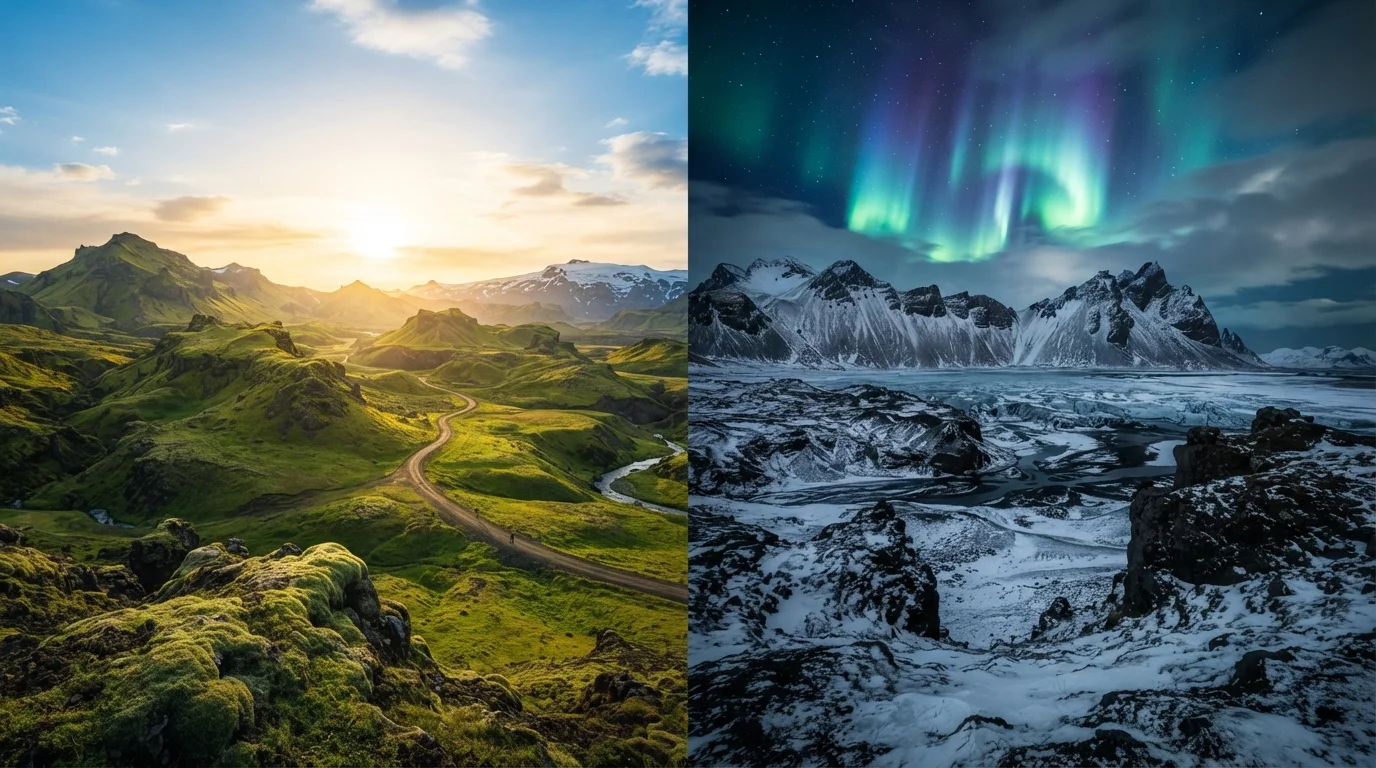
Option A
Iceland in Summer
The accessible, adventure-packed season with nearly endless daylight.
Best for: Hikers, road-trippers, and first-time visitors who want maximum accessibility and long daylight hours.
Option B
Iceland in Winter
The dramatic, stripped-back season defined by aurora chasing and ice caves.
Best for: Travelers who prioritize northern lights, glacier cave access, and fewer crowds at lower accommodation rates.
What Summer Actually Looks Like on the Ground
Iceland's summer season - broadly June through August - is defined by the midnight sun. In Reykjavik, the sun barely dips below the horizon around the summer solstice, and further north, it doesn't set at all. For travelers, this means you can hike at 10 p.m. in full daylight, photograph waterfalls without fighting shadow, and pack more activity into each day than almost anywhere else on earth.
The tradeoff is volume. Summer is peak season, and Iceland's most visited sites - Seljalandsfoss, the Blue Lagoon area, the Jökulsárlón glacier lagoon - draw dense crowds. The Ring Road becomes genuinely busy. Accommodation in popular areas books out months in advance, and prices reflect the demand. This is the season when Iceland's infrastructure feels most stretched.
The highland interior opens up in summer, giving access to destinations like Landmannalaugar and the Þórsmörk valley that simply don't exist for most visitors the rest of the year. If wilderness hiking is your priority, summer is functionally the only viable window. Planning ahead around peak season becomes essential - the crowds and costs are real, not exaggerated.
| Criterion | Iceland in Summer | Iceland in Winter |
|---|---|---|
| Daylight hours | 20-24 hours near solstice | 4-6 hours near solstice |
| Northern lights visibility | Not possible (too bright) | Good potential on clear nights |
| Glacier ice cave tours | Not available | Available Nov-Mar |
| Highland road access | Open late June-September | Closed entirely |
| Visitor volume | Peak season - very busy | Lower - but growing |
| Typical accommodation cost | Higher (peak pricing) | Generally lower off-peak |
| Road conditions | Mostly accessible | Frequently hazardous; 4WD often required |
| Average temperatures (Reykjavik) | 50-60°F (10-15°C) | 28-37°F (-2 to 3°C) |
What Winter Actually Demands from You
Iceland in winter - roughly November through March - is a different kind of experience entirely. Daylight is scarce, averaging around four to five hours near the solstice. Roads close or become hazardous. The weather is genuinely unpredictable in ways that can derail itineraries.
But the darkness is also the point. Long nights create the conditions for northern lights visibility, and Iceland's position just below the Arctic Circle gives it some of the world's most accessible aurora viewing. That said, the lights are never guaranteed - cloud cover, solar activity, and timing all play a role. Travelers who come expecting a nightly show and leave disappointed are common.
Winter also unlocks glacier ice cave access, which is one of Iceland's most distinctive experiences. These tours operate only when the ice is stable, typically between November and March, and they book out quickly despite the season's lower visitor numbers overall. The dramatic contrast of blue ice and filtered winter light makes these caves a legitimate draw.
~2.3M
Annual visitors to Iceland (pre-pandemic peak)
Iceland Tourism figures showed visitor numbers approaching 2.3 million before 2020, with summer months accounting for a disproportionate share of arrivals.
4-5 hrs
Daylight near winter solstice in Reykjavik
The Icelandic Meteorological Office documents sunrise and sunset times showing fewer than five hours of daylight around December 21 in Reykjavik.
Nov-Mar
Glacier ice cave tour season window
Tour operators across the Vatnajökull region consistently limit crystal ice cave access to winter months when ice thickness and stability allow safe entry.
Winter travel rewards flexibility and preparation. Rental agencies typically require four-wheel-drive vehicles in winter conditions, and the Icelandic Road and Coastal Administration (Samgöngustofa) provides real-time road condition updates that serious winter travelers check daily. Verify all safety and entry conditions with official Icelandic sources before travel, as conditions change rapidly.
Making the Call: What Matters Most to You
Neither season is objectively superior - they're genuinely different destinations shaped by light, temperature, and access. The practical question is what you're actually going there to do.
Summer suits travelers who want to move freely, hike extensively, and pack in variety across the full country. It costs more and requires earlier planning, but it delivers the widest range of accessible experiences. Winter suits travelers with specific goals - northern lights, ice caves, a quieter version of the country - who are comfortable building itinerary buffer for weather disruptions.
Shoulder Season: Worth Considering
Late September and early October offer a middle path - some chance of northern lights, trails still accessible at lower elevations, and post-peak pricing. May brings wildflowers and longer days without full summer pricing. Neither window guarantees the best of both seasons, but both can represent genuinely good value for flexible travelers. See our guide to peak season tradeoffs for a fuller breakdown of timing strategies.
One often-overlooked option is shoulder season: late April through May, or September through October. These windows can offer partial access to summer activities while avoiding peak pricing and crowds - though they come with their own unpredictability. If that timing interests you, the tradeoffs are worth understanding before committing.
The content provided on our blog site traverses numerous categories, offering readers valuable and practical information. Readers can use the editorial team’s research and data to gain more insights into their topics of interest. However, they are requested not to treat the articles as conclusive. The website team cannot be held responsible for differences in data or inaccuracies found across other platforms. Please also note that the site might also miss out on various schemes and offers available that the readers may find more beneficial than the ones we cover.