

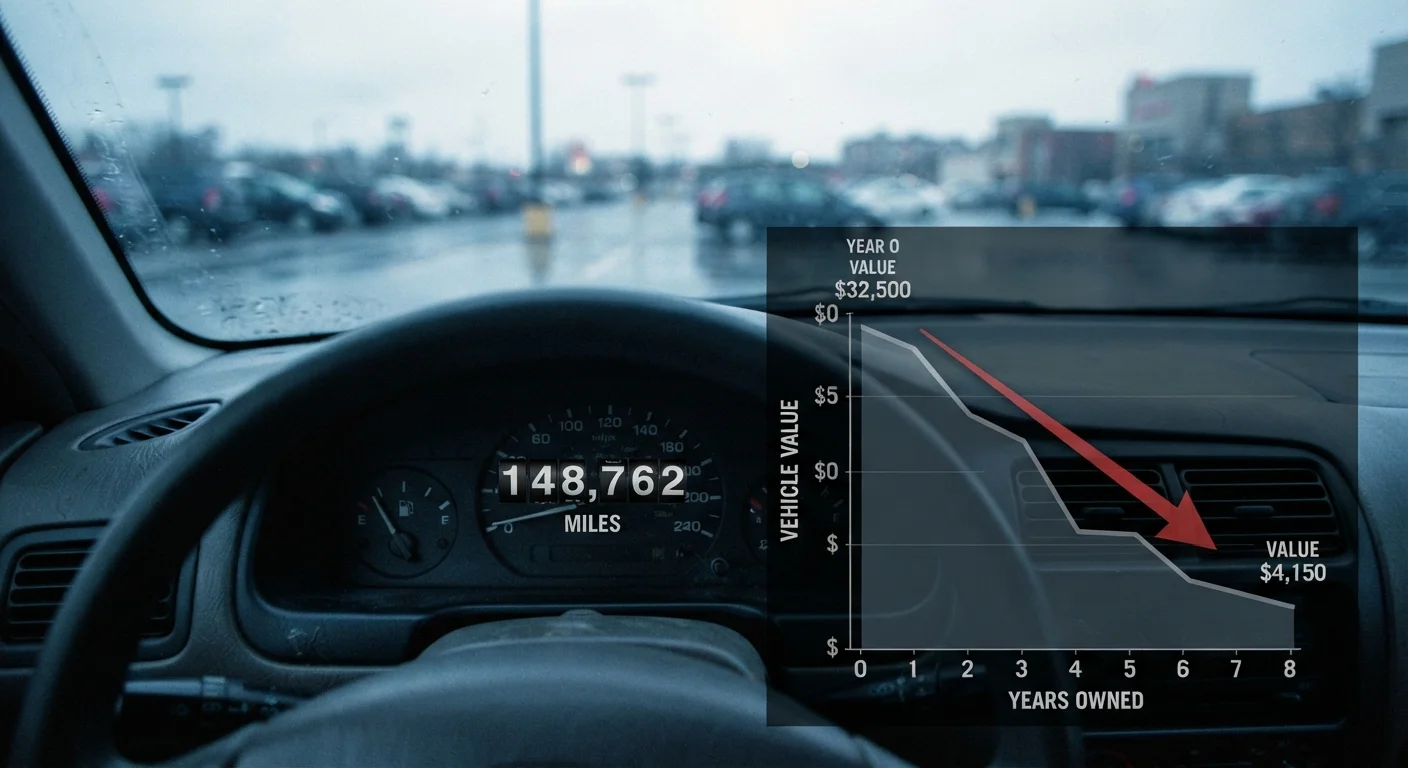
How Depreciation Works - and Why It Hits So Hard Early
Depreciation is not a flat, steady decline. It curves sharply downward in a vehicle's early life. Industry data consistently shows that new vehicles shed around 15-25% of their value in the first year. By the end of year five, total accumulated depreciation can reach 50-60% of the original purchase price.
The reason for this front-loaded curve comes down to buyer perception. A one-year-old car competes directly with new models - but it can no longer be sold as new. Supply, demand, and the "new car premium" all collapse at once the moment a vehicle changes hands. After that initial shock, the rate of loss typically slows, though it never fully stops.
Understanding this curve is foundational to making smarter ownership decisions. As part of the true cost of owning a car, depreciation is often the line item that surprises drivers most - because unlike fuel or insurance, it doesn't show up as a monthly bill.
~20%
Average first-year new car value loss
Industry estimates consistently place first-year depreciation for new vehicles at roughly 15-25% of the original purchase price.
~50%
Value lost by year five on average
Data from vehicle valuation sources suggests most new cars lose around half their original value within five years of purchase.
$0
Monthly depreciation bill you will ever receive
Depreciation is a silent cost - it reduces net worth without appearing on any statement, making it easy to overlook in a budget.
The Factors That Accelerate - or Slow - Your Car's Value Loss
Not all vehicles depreciate at the same rate. Several variables determine how quickly market value erodes:
- Mileage: Above-average annual mileage compresses resale value faster than almost any other factor. Each mile adds wear and signals a shorter remaining lifespan to future buyers.
- Condition: Visible damage, worn interiors, and deferred maintenance all drag resale value down. A clean vehicle with documented service history consistently commands a premium.
- Segment and demand: Trucks and SUVs in high demand tend to hold value better than passenger sedans in the same price bracket, largely because supply-demand dynamics favor them.
- Color and trim: Neutral colors (white, silver, grey, black) and popular trim configurations attract more buyers and therefore depreciate more slowly than unusual color choices or stripped-down base models.
- Brand reputation for reliability: Vehicles associated with lower long-term ownership costs tend to retain value better because the used-car market prices in expected repair costs.
- Fuel type and technology shifts: As market demand evolves - particularly around electric and hybrid vehicles - the resale dynamics for certain powertrains can shift in ways that are difficult to predict at the time of purchase.
Keeping a vehicle in good condition isn't just about safety and reliability - it's a direct financial lever. Routine maintenance preserves both mechanical life and resale value simultaneously.
Practical Strategies for Cost-Savvy Drivers
You can't eliminate depreciation, but you can structure your decisions to minimize its impact on your finances.
Buy used at the right age
Purchasing a vehicle that is two to four years old allows you to sidestep the steepest portion of the depreciation curve. The first owner absorbs the sharpest drop; you buy in after that loss has already occurred. This is one of the clearest financial advantages of the used-car market - a topic explored in depth in a new vs. used car financial comparison.
Consider total cost, not just monthly payment
A low monthly payment can obscure high depreciation if it is achieved by stretching the loan term. Longer loans mean you may owe more than the car is worth for an extended period - a condition called being "underwater" or having negative equity. This is one of the financial blind spots covered in where car owners lose money without realizing it.
Keep the vehicle longer
Once a vehicle is paid off, the absence of a monthly payment dramatically lowers annual ownership cost - even accounting for higher potential maintenance. The financial case for this approach is straightforward: depreciation has already occurred, and each additional mile driven spreads that sunk cost further. Long-term vehicle ownership past 100,000 miles can be one of the best financial moves available to a cost-conscious driver.
Keep Your Service Records - It Pays Off
A documented maintenance history is one of the most reliable ways to protect resale value. Buyers and dealers factor service records into their appraisals because they reduce uncertainty about the vehicle's condition. Store receipts digitally or in a dedicated folder in the glovebox so they're ready when you sell or trade in.
Depreciation in Context: What It Means for Your Overall Car Budget
Depreciation rarely appears as a line item in a household budget, which is exactly why it tends to be underestimated. Unlike insurance or fuel, it doesn't generate a monthly bill - but it represents real money that leaves your hands every year you own the vehicle.
For planning purposes, it helps to treat depreciation as an annual cost: divide the expected total value loss over your planned ownership period by the number of years. That figure, combined with insurance, fuel, maintenance, and financing costs, gives you a realistic picture of what a vehicle truly costs annually.
Familiarizing yourself with key terms - including residual value, trade-in value, and equity position - gives you a stronger foundation for any ownership or purchase decision. The car ownership cost glossary covers these and 27 other terms in plain language.
Depreciation is a built-in reality of vehicle ownership. The goal isn't to avoid it - it's to understand it well enough to make decisions that keep more money in your pocket over time.
Frequently Asked Questions
A new vehicle can lose 10-20% of its purchase price the moment it leaves the dealership lot, simply because it transitions from "new" to "used" status. Within the first year, total depreciation commonly reaches 15-25% of the original price. The exact amount depends on the vehicle segment, demand, and market conditions.
Vehicles with strong resale demand - often trucks, certain SUVs, and models with a reputation for reliability and low ownership costs - historically depreciate more slowly than average. However, past depreciation trends do not guarantee future resale values, as market conditions change. Checking published residual value data for specific segments can give a general indication.
Leasing transfers the risk of residual value to the leasing company, so you aren't exposed to an unexpected drop in resale value at the end of the term. However, lease payments are partly calculated based on projected depreciation, so you are still effectively paying for value loss - it is just structured differently than a purchase.
Higher mileage accelerates depreciation because it signals more wear and a shorter remaining useful life to prospective buyers. Vehicles driven significantly above average annual mileage - typically estimated at around 12,000-15,000 miles per year in the US - often see steeper value declines than lower-mileage counterparts of the same age.
You cannot stop depreciation, but consistent maintenance, keeping service records, avoiding excessive mileage, and maintaining the vehicle's cosmetic condition all help preserve resale value. Choosing popular colors and widely demanded trims at the time of purchase also reduces the rate of decline.
If you drive a vehicle until it is no longer economically viable to repair, depreciation has less day-to-day financial impact on you directly. However, it still affects your total cost of ownership calculation and may influence decisions around insurance coverage levels and whether to trade in versus sell privately.
The content provided on our blog site traverses numerous categories, offering readers valuable and practical information. Readers can use the editorial team’s research and data to gain more insights into their topics of interest. However, they are requested not to treat the articles as conclusive. The website team cannot be held responsible for differences in data or inaccuracies found across other platforms. Please also note that the site might also miss out on various schemes and offers available that the readers may find more beneficial than the ones we cover.