

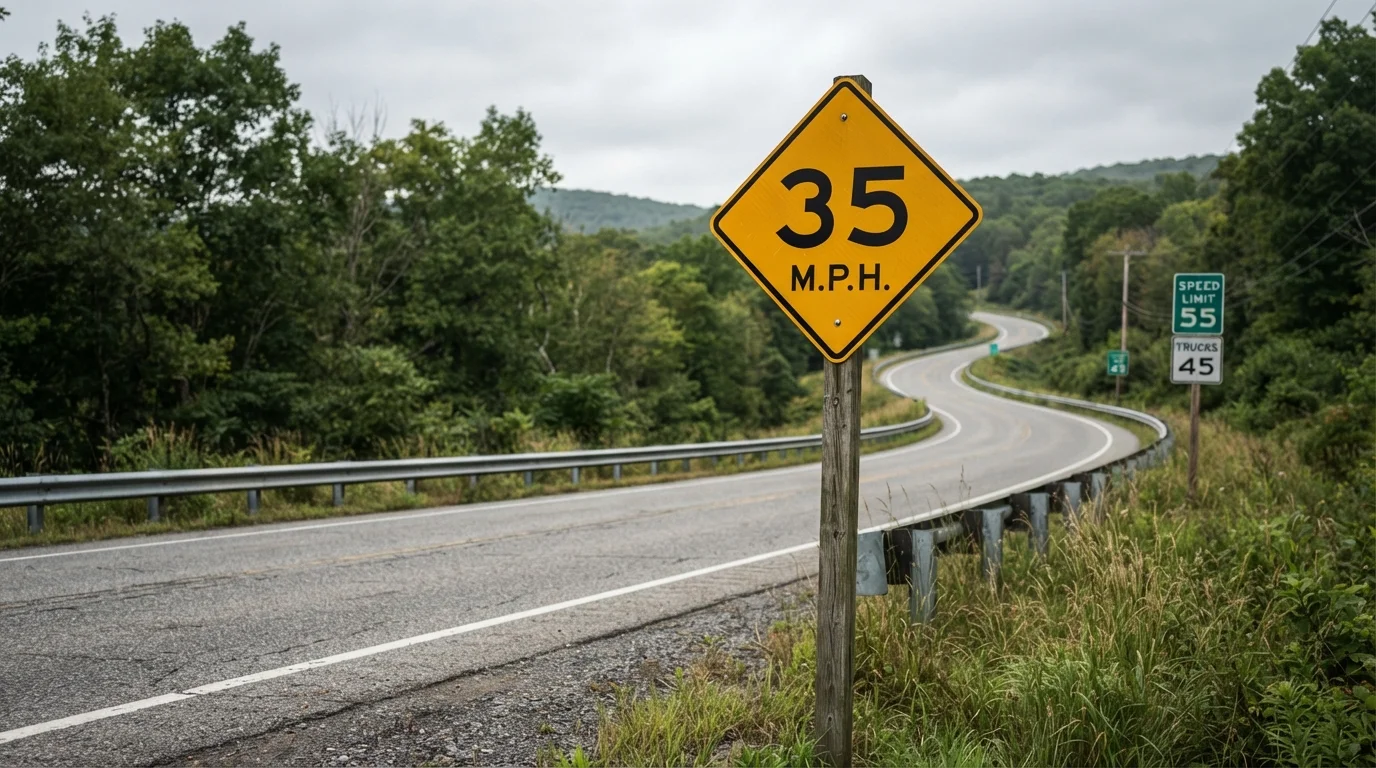
Regulatory Speed Limit Signs: The Legal Cap
The white rectangular sign with black numerals is the most familiar speed marking on American roads. It is a regulatory sign, meaning it carries the full force of traffic law. Driving above a posted regulatory limit exposes a driver to a speeding citation regardless of traffic conditions, visibility, or personal judgment about what feels safe.
Regulatory limits are established through engineering studies, public safety analysis, and state or local legislation. They apply to all vehicles unless a secondary sign specifies otherwise - for example, a lower limit for trucks or trailers. On urban streets, limits are often set by statute at a default value (commonly 25 mph) even when no sign is present, so the absence of a sign does not mean speed is unrestricted.
Exceeding a regulatory limit - even slightly - can affect legal liability in a collision. It's worth understanding that driving at or below the posted limit does not automatically make a speed safe; conditions like wet pavement, low visibility, or heavy pedestrian traffic can make the legal limit dangerously fast for the situation. Urban and highway driving environments each carry their own speed dynamics that regulatory signs alone don't fully capture.
29%
Speeding's share of all US traffic fatalities
According to the National Highway Traffic Safety Administration (NHTSA), speeding was a factor in approximately 29% of all traffic fatalities in a recent reporting year.
~40%
Drivers who exceed posted limits on interstates
Federal Highway Administration observational studies have found that a substantial share of vehicles on US interstates routinely travel above the posted regulatory speed limit.
11,000+
Speeding-related fatalities annually in the US
NHTSA data consistently places annual speeding-involved traffic deaths above 11,000, underscoring why regulatory speed limits exist as safety-driven legal requirements.
Advisory Speed Signs: Engineering Recommendations, Not Hard Caps
Yellow diamond-shaped signs with a speed number - often reading something like CURVE - 35 MPH - are advisory speed signs. Their color and shape already signal the difference: yellow means warning, not regulation. These signs communicate the speed at which highway engineers determined a specific roadway feature can be negotiated safely under normal conditions.
Advisory signs appear most often before:
- Sharp curves or bends
- Freeway on-ramps and off-ramps
- Steep downgrades
- Narrow bridge approaches
- Intersection sight-distance restrictions
The number on an advisory sign is derived from a ball-bank indicator study - a standardized engineering process that measures lateral forces a vehicle experiences while navigating the feature. The result is not arbitrary; it reflects real physics about where tire grip and vehicle stability begin to be challenged for a typical passenger car under dry conditions.
That last qualifier matters. Wet, icy, or debris-covered pavement dramatically lowers the safe speed below the advisory figure. An advisory sign reading 40 mph on a dry summer day may mean 25 mph is the prudent choice during winter rain. Exceeding an advisory speed is not automatically a violation, but it can be used as evidence of negligence in a civil claim if a crash occurs.
“Advisory speed signs are not arbitrary numbers - they represent the output of a formal engineering process designed to communicate where the road itself becomes the hazard, not driver behavior alone.”
— Federal Highway Administration, Publisher of the Manual on Uniform Traffic Control Devices (MUTCD)
Minimum Speed Signs: The Legal Floor
Less familiar to many drivers, minimum speed signs share the same white rectangular format as standard speed limit signs but are labeled accordingly. They establish the slowest speed at which a vehicle may legally travel on that segment of road during normal conditions.
Minimum speed postings are most common on:
- High-speed interstate highways
- Long bridges and tunnels with limited stopping options
- Freeway sections where very slow vehicles create rear-end collision risk
The legal rationale is straightforward: a vehicle traveling significantly slower than surrounding traffic disrupts the flow and forces abrupt lane changes or braking - both crash risk factors. Most states allow exceptions for mechanical emergencies, but a driver who routinely crawls well below a posted minimum can be cited.
If your vehicle cannot maintain highway speeds safely - due to a mechanical problem, overloading, or towing capacity - the safest course is to exit the highway, address the issue, and avoid routes with minimum speed requirements until the situation is resolved.
How These Sign Types Work Together in Practice
On any given highway stretch, a driver may encounter all three sign types within a short distance. Understanding how they interact prevents confusion and supports safer decision-making.
Consider a freeway interchange: the main highway posts a 65 mph regulatory limit. As the off-ramp curves downward, a yellow diamond advisory sign reads 30 mph. At the base of the ramp where it feeds into a surface street, the new regulatory limit drops to 45 mph. If the on-ramp to the same highway has a minimum speed sign reading 40 mph, that floor activates once a driver enters the acceleration lane.
Each sign is doing a distinct job:
- Regulatory (white rectangle)
- Sets the enforceable maximum or minimum. Violating it risks a citation.
- Advisory (yellow diamond)
- Warns of a specific hazard ahead with an engineering-tested safe speed. Not a hard cap, but legally and physically meaningful.
- Minimum speed (white rectangle, labeled)
- Sets the enforceable floor where slow traffic is a demonstrated hazard.
Road sign literacy connects directly to other areas of traffic law that catch drivers off guard. For a broader look at how legal rules interact on the road, see our piece on right-of-way rules drivers commonly misread.
Treat Advisory Speeds as Weather-Adjusted Ceilings
The mph on a yellow advisory sign assumes dry pavement and a vehicle in good condition. In rain, snow, or fog, reduce that figure meaningfully - there is no posted sign that accounts for every condition. When in doubt, slow down before the curve, not during it, where braking can destabilize a vehicle mid-turn.
Frequently Asked Questions
An advisory speed sign itself is not a hard legal cap, so simply driving above it is not automatically a violation. However, if conditions cause a loss of control or an officer judges your speed unsafe for the circumstances, you can be cited under general reckless or unsafe driving statutes. Advisory signs are best treated as strongly worded recommendations backed by engineering data.
Minimum speed signs use the same white rectangular format as standard speed limit signs, but the text reads 'MINIMUM SPEED' followed by the number. They are most commonly found on high-speed highways and bridges where very slow vehicles create a collision hazard for faster-moving traffic.
In most states, advisory speed signs do not set a legally binding limit on their own. They communicate the speed at which engineers determined the feature - a curve, merge, or ramp - can be navigated safely under normal conditions. Exceeding them in hazardous weather or while impaired can, however, factor into an enforcement or liability determination.
Driving consistently below a posted minimum speed can result in a citation in states that enforce such signs. Beyond the legal risk, traveling far slower than surrounding traffic is a recognized crash factor on high-speed roadways. If you must travel slowly due to a vehicle issue, use hazard lights and exit the roadway as soon as it is safe.
Yes, posted speed limits in school zones and construction zones are separate regulatory signs and carry full legal force, often with doubled fines. These limits apply during specified hours or when workers are present, as indicated on the signs. See our guide on <a href="/car-ownership-guide/driver-safety-rules/school-zones-construction-zones-and-emergency-vehicles-special-rules-every-driver-needs">special zone rules</a> for a detailed breakdown.
Lane-specific speed limits are uncommon but do exist on certain multi-lane roads, particularly for trucks or slower vehicles in right-hand lanes. Always observe signs posted for your specific lane rather than assuming the general road limit applies universally to all traffic.
The content provided on our blog site traverses numerous categories, offering readers valuable and practical information. Readers can use the editorial team’s research and data to gain more insights into their topics of interest. However, they are requested not to treat the articles as conclusive. The website team cannot be held responsible for differences in data or inaccuracies found across other platforms. Please also note that the site might also miss out on various schemes and offers available that the readers may find more beneficial than the ones we cover.