

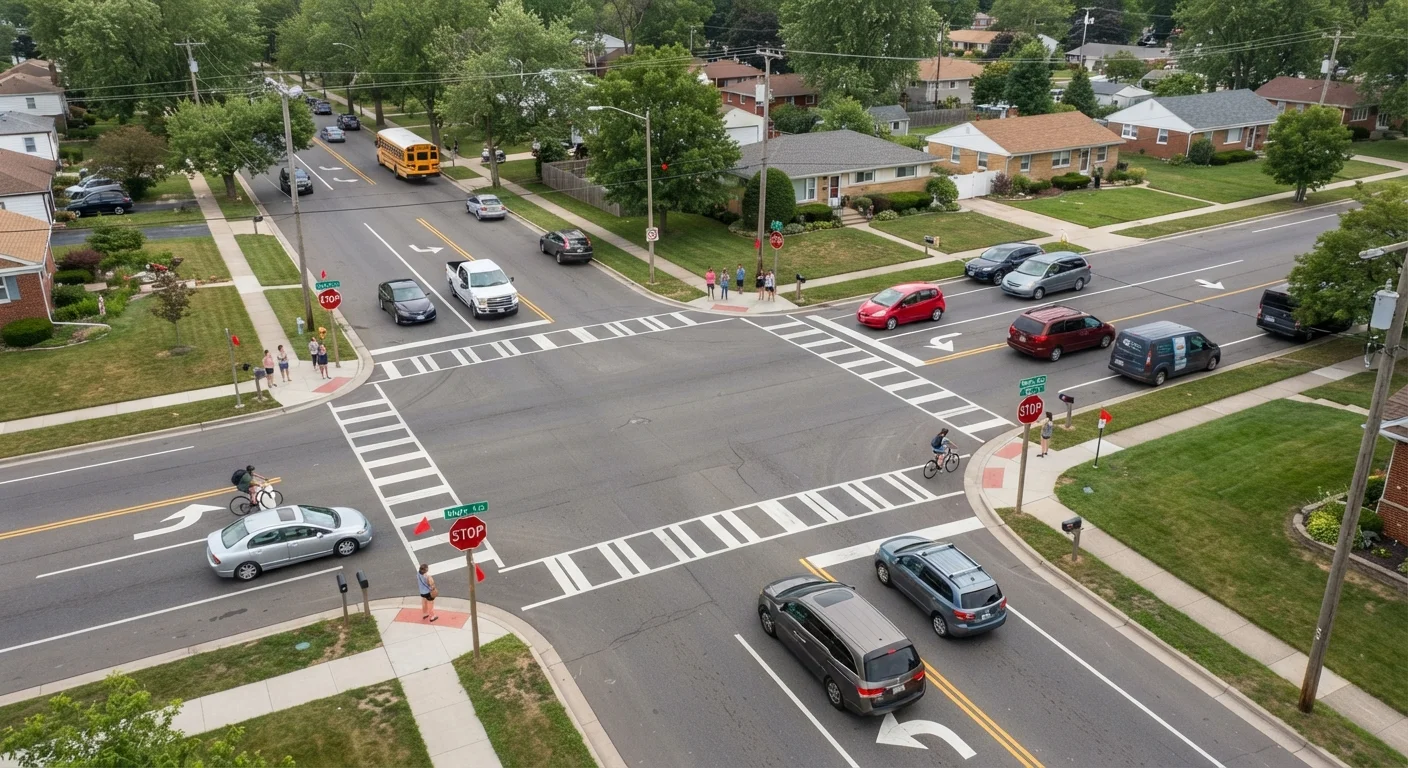
Why Right-of-Way Confusion Is So Dangerous
Right-of-way rules don't grant anyone an absolute legal permission slip to proceed-they determine who must yield in a given situation. That distinction matters enormously. When two drivers each believe they have the right to go, the result is a conflict that road design alone can't resolve. According to the Federal Highway Administration, intersection-related crashes account for roughly 40% of all traffic fatalities in the United States. Most of these involve a failure to yield.
What makes this worse is that misreading the rules often feels like correct behavior in the moment. Drivers act on habits, social cues, and half-remembered rules from their licensing test-none of which reliably reflect the law. See our guide to dangerous driving assumptions for a broader look at where mental shortcuts cause crashes.
Myth
If another driver waves you through, you're legally covered if something goes wrong.
Fact
A hand gesture from another driver carries no legal weight. Right-of-way is defined by traffic law, not by social courtesy.
This is one of the most persistently dangerous misconceptions on the road. When a stopped driver gestures for you to proceed, they can only vouch for their own vehicle-they cannot see around it. Pedestrians, cyclists, or vehicles in adjacent lanes may still be in your path. If you proceed based on a wave and cause a crash, the fault analysis focuses on your actions, not the other driver's invitation.
The practical rule: accept a courtesy wave as a social acknowledgment, not a legal clearance. Verify the intersection is actually clear before proceeding.
Myth
At a four-way stop, the biggest or fastest-moving vehicle goes first.
Fact
The driver who arrived first has the right-of-way. When two vehicles arrive simultaneously, the driver on the left yields to the driver on the right.
Vehicle size, momentum, and assertiveness have no standing under traffic law at an all-way stop. Arrival sequence is the governing principle. When two vehicles reach the intersection at the same time, the tie-breaker is positional: the driver on the left yields to the driver on the right.
Where it gets complicated: three or four cars arriving at nearly the same time. In that case, the same rule applies sequentially. If you're uncertain, make eye contact, signal your intent clearly with your position, and wait for unambiguous confirmation before moving. Hesitation here is safer than assumption.
Myth
When a lane ends and you need to merge, you have the right-of-way because you were in the lane first.
Fact
The merging driver must yield to vehicles already traveling in the lane being merged into, regardless of who was there first.
This confusion generates significant highway friction, including aggressive driving responses. The lane-ending vehicle does not inherit priority simply because it existed earlier in the journey. Traffic already established in the through lane has right-of-way. The merging driver is responsible for finding a safe gap.
The exception that confuses people: the zipper merge. In a zipper merge, drivers are encouraged-by law in some states-to use the full length of a closing lane and alternate entry at the merge point. But even there, the merge itself requires coordination, not a unilateral claim of right-of-way.
Myth
Pedestrians only have the right-of-way if they're in a marked crosswalk with a walk signal.
Fact
In most US states, pedestrians have the right-of-way in both marked and unmarked crosswalks, even without a traffic signal present.
An unmarked crosswalk exists legally at virtually every intersection where sidewalks meet a roadway, even if no painted lines are visible. Drivers are required to yield to pedestrians crossing within these boundaries in the vast majority of states, signal or no signal.
Beyond crosswalks, drivers must also yield to pedestrians crossing at corners when those pedestrians have begun crossing with reasonable expectation of safety. The practical implication: when a pedestrian steps off the curb with clear intent to cross, you're generally required to stop-not just slow down. Check your state's specific pedestrian statutes, as wording varies, but the general obligation to yield is nearly universal.
Myth
In a roundabout, you take turns just like a four-way stop-one car from each entry at a time.
Fact
Entering drivers must always yield to vehicles already circulating inside the roundabout. There is no turn-taking protocol.
Roundabouts operate on a yield-on-entry model, not a rotation model. The vehicle inside the circle has continuous right-of-way. An entering driver waits for a gap in circulating traffic before proceeding-exactly as they would when entering a highway from an on-ramp.
The turn-taking instinct comes from four-way stop conditioning and causes drivers to pull out prematurely, creating direct conflict with circulating vehicles. When approaching a roundabout, slow to the yield line, assess the gap in the flow of traffic already inside, and enter only when the path is clear.
The Rules in Context: Intersections, Merges, and Special Situations
Understanding right-of-way isn't just about memorizing rules-it's about applying them calmly under pressure. The scenarios below cover the situations where drivers most commonly get it wrong.
~40%
Intersection-related share of US traffic fatalities
The Federal Highway Administration estimates that roughly 40% of all traffic fatalities in the US are intersection-related, with failure to yield among the most common contributing factors.
3 in 10
Drivers who misapply four-way stop rules
A AAA Foundation for Traffic Safety survey found that a significant share of drivers either misunderstand or are uncertain about right-of-way rules at all-way stop intersections.
Roundabouts deserve special attention because they're still unfamiliar to many US drivers. The core rule is simple: yield to circulating traffic before entering. There's no taking turns, no waving someone in. The vehicle already inside the circle has priority, full stop. For a side-by-side comparison of how intersection rules shift between city streets and highway on-ramps, see our article on urban vs. highway driving rules.
Special zones carry their own yield obligations. Emergency vehicles with active lights and sirens require drivers to pull to the right and stop-not slow down, not move left. Rules for school zones and construction zones layer additional legal weight on top of standard right-of-way obligations. The special-zone rules breakdown covers those specific requirements in detail.
Having the Right-of-Way Doesn't Make You Safe
Right-of-way rules define legal responsibility-they don't protect you from physical harm. If another driver fails to yield, waiting for your legal turn can still result in a collision. The law determines fault after the fact; it can't prevent impact in the moment. Defensive driving means accounting for the possibility that other drivers will misread the rules, even when you have the clear legal right to proceed.
When a right-of-way dispute escalates into a confrontation, the situation can become dangerous quickly. If another driver responds aggressively to a yield conflict, the priority is de-escalation, not proving who was right. Our road rage de-escalation guide explains how these incidents unfold and how to exit them safely.
The content provided on our blog site traverses numerous categories, offering readers valuable and practical information. Readers can use the editorial team’s research and data to gain more insights into their topics of interest. However, they are requested not to treat the articles as conclusive. The website team cannot be held responsible for differences in data or inaccuracies found across other platforms. Please also note that the site might also miss out on various schemes and offers available that the readers may find more beneficial than the ones we cover.