

Why Every State Mandates Auto Insurance
Auto insurance laws exist because vehicle accidents create real financial harm - to victims, to property, and to public systems. Every U.S. state requires drivers to demonstrate they can pay for damages they cause. The most common way to satisfy this requirement is by carrying liability insurance.
Liability coverage pays for injuries and property damage you cause to others in an at-fault accident. It does not cover your own vehicle or injuries. Most states use a split-limit format, such as 25/50/10, meaning:
- $25,000 per person for bodily injury
- $50,000 per accident for bodily injury
- $10,000 for property damage
A few states use a combined single limit instead. New Hampshire is the notable outlier - it does not mandate insurance but requires drivers to prove financial responsibility if they cause an accident. Virginia recently moved to require insurance after previously allowing an uninsured motorist fee as an alternative.
Understanding these distinctions matters because coverage that's legal in your state may be inadequate if you travel or relocate. For a broader look at the financial terminology around car ownership, see our Car Ownership Cost Glossary.
49 of 50
U.S. states with mandatory auto insurance laws
New Hampshire is the only state that does not require insurance but still holds drivers financially responsible for damages they cause.
1-3 years
Typical SR-22 requirement duration
Most states mandate SR-22 filing for one to three years following a qualifying violation, with the period resetting if coverage lapses.
~14%
Estimated share of U.S. drivers without insurance
According to the Insurance Research Council, roughly 1 in 7 drivers on U.S. roads carries no auto insurance - a key reason mandatory coverage laws exist.
What SR-22 Filing Actually Means
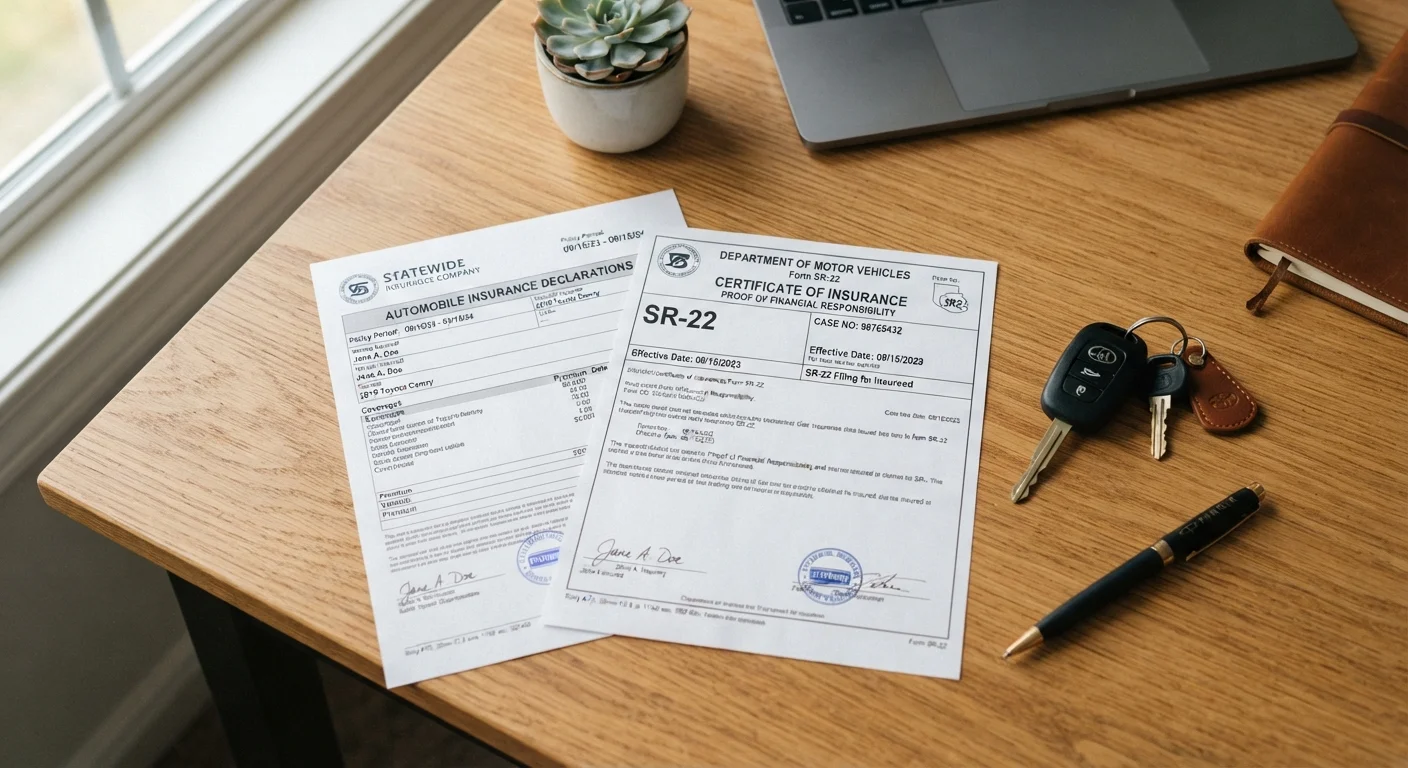
An SR-22 isn't a type of insurance - it's a form your insurer files with your state DMV certifying that you carry at least the minimum required coverage. Think of it as a monitoring mechanism: the state now requires ongoing proof of insurance, not just at registration time.
SR-22 requirements are triggered by specific violations, which vary by state but commonly include:
- DUI or DWI conviction
- Driving without valid insurance
- Reckless driving
- At-fault accidents while uninsured
- Excessive license points or a suspended/revoked license
Once ordered by a court or the DMV, you must contact an insurer that offers SR-22 filing. Not every company does. Your insurer then submits the certificate electronically to the state. If your policy lapses or is cancelled at any point, the insurer is required to notify the DMV - triggering an automatic license suspension in most states.
Tracking how violations and points interact with your license status is covered in our guide to points systems and license suspension.
Maintain Continuous Coverage During SR-22 Period
Even a brief lapse in your insurance policy during an SR-22 requirement period can have serious consequences - your insurer is legally required to notify the DMV, which typically triggers an automatic license suspension. Set up autopay or calendar reminders well before your renewal date to ensure there's no gap in coverage.
How SR-22 Affects Your Coverage and Costs
The SR-22 filing fee itself is usually modest - often $15 to $50 as a one-time charge from your insurer. The real cost impact comes from the violation that triggered the requirement. A DUI, for example, significantly increases premiums because it signals higher risk to underwriters.
SR-22 periods typically run one to three years from the date of conviction or license reinstatement, depending on state law and the severity of the offense. During this window, maintaining continuous, uninterrupted coverage is non-negotiable. A single lapse can reset the requirement period and reinstate suspension.
Drivers subject to SR-22 requirements should also review their full policy carefully. Understanding what your liability limits actually cover - and where gaps exist - is especially important when your driving record is already under scrutiny. Our guide on how to read a car insurance policy explains the key terms and structures to look for.
This article provides general information about auto insurance laws and SR-22 requirements for educational purposes only. Insurance regulations vary by state and individual circumstances. Consult a licensed insurance professional and your state's DMV for guidance specific to your situation.
Frequently Asked Questions
Every state sets its own minimum liability coverage requirements, typically expressed as three numbers (e.g., 25/50/25) representing bodily injury per person, bodily injury per accident, and property damage. These minimums vary widely between states. Consulting your state's DMV website gives you the exact figures for where you're licensed.
Drivers who have been convicted of serious violations - such as DUI/DWI, driving without insurance, reckless driving, or accumulating too many points - are commonly required to file an SR-22. A court or state DMV typically issues the order, not the insurer.
Most states require SR-22 filing for one to three years, though some offenses carry longer requirements. The clock usually restarts if you allow coverage to lapse during the required period, so maintaining continuous insurance is essential.
The SR-22 filing itself typically carries a modest one-time fee from your insurer. However, the underlying violation that triggered the SR-22 requirement - such as a DUI or at-fault accident - will likely raise your premiums significantly. Rates vary by insurer and state.
If your insurer cancels your policy or the SR-22 lapses during the required period, they are legally obligated to notify your state's DMV. This typically results in immediate license suspension and may reset the SR-22 requirement period.
An FR-44 is used in Florida and Virginia in place of an SR-22. It functions similarly but requires higher liability coverage limits than the state minimum - often double. Only drivers with DUI-related offenses in those states are typically subject to FR-44 requirements.
The content provided on our blog site traverses numerous categories, offering readers valuable and practical information. Readers can use the editorial team’s research and data to gain more insights into their topics of interest. However, they are requested not to treat the articles as conclusive. The website team cannot be held responsible for differences in data or inaccuracies found across other platforms. Please also note that the site might also miss out on various schemes and offers available that the readers may find more beneficial than the ones we cover.