

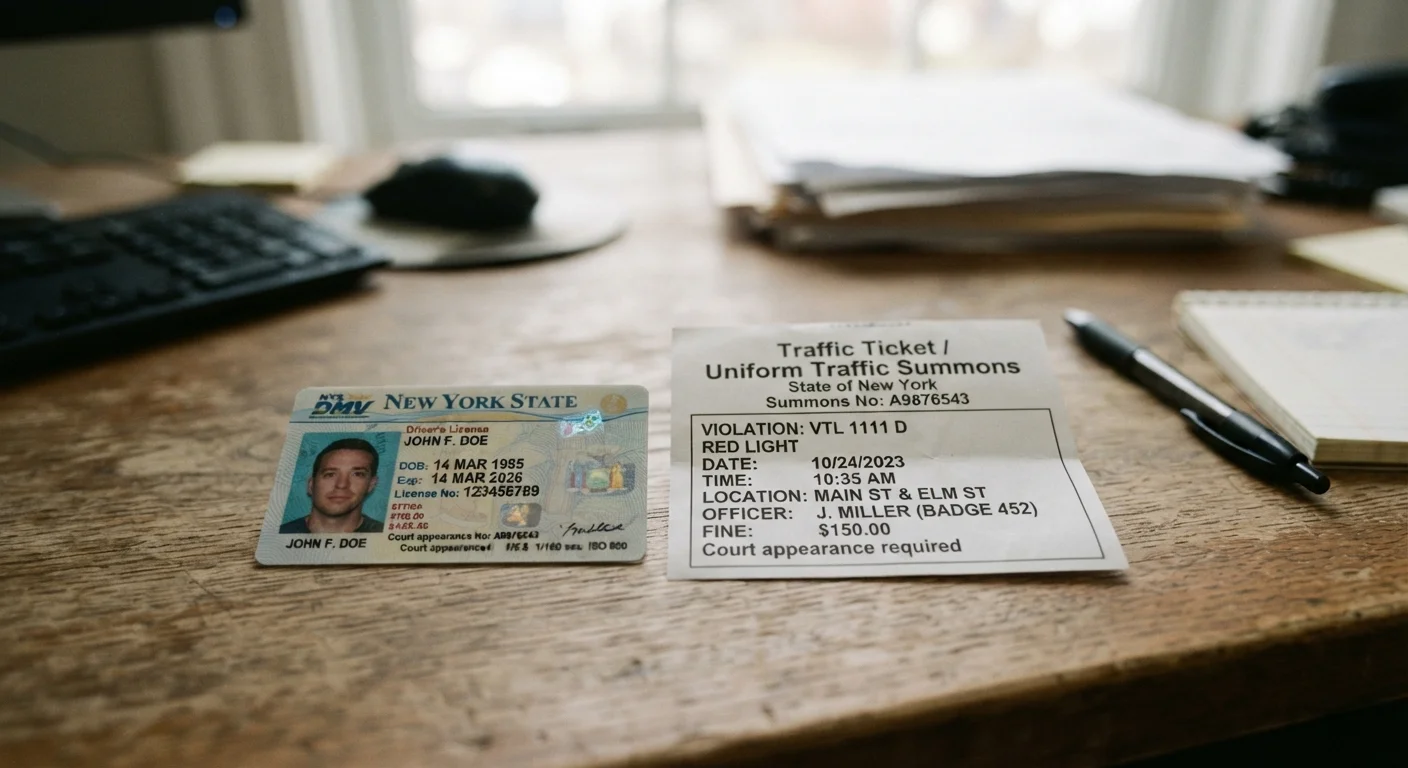
How Points Systems Work
Most U.S. states assign a numerical point value to traffic violations - the more serious the offense, the higher the points. When a driver is convicted of a moving violation, those points are added to their driving record maintained by the state's department of motor vehicles (DMV) or equivalent agency.
| States using a formal points system | Approximately 44 states (Varies; a few states track violations without formal numeric points) |
| Typical suspension threshold | 12-15 points within 12-24 months (Varies by state; check your state DMV for exact thresholds) |
| Common point window | 12 to 24 months (rolling) (Most states use a rolling period, not a calendar year) |
| How long violations stay on record | 3 to 7 years for most moving violations (Serious offenses (DUI) may remain longer; varies by state) |
| Interstate violation sharing | Most states share data under the Driver License Compact (Out-of-state convictions typically appear on home-state records) |
| Defensive driving course benefit | May reduce points by 2-4 in participating states (Usually limited to once per year or every few years; state-specific) |
Point values are not uniform across states. A minor speeding infraction might carry 1-2 points in one state and 3-4 in another. Serious offenses - such as reckless driving, street racing, or driving under the influence (DUI) - typically carry the highest point totals, sometimes triggering immediate suspension on their own. A handful of states, including Hawaii, Kansas, Louisiana, and Oregon, do not use a traditional point system but instead track violations differently through their licensing records.
It's important to understand that points attach to a conviction, not a citation. Paying a fine without contesting a ticket is generally treated as a guilty plea and results in a conviction. Drivers who successfully complete a traffic diversion program - where permitted by state law - may avoid the conviction and the associated points.
Suspension Thresholds and Progressive Penalties
States set thresholds at which accumulated points trigger action by the DMV. A common structure is a warning letter at a lower threshold, a mandatory hearing at an intermediate level, and automatic suspension when the cap is reached. For example, some states suspend a license when a driver accumulates 12 points within a 12-month rolling period.
Moving Violation
A traffic offense committed while a vehicle is in motion, such as speeding, running a red light, or improper lane changes. Moving violations typically generate points on a driving record when a conviction results.
Points System
A state-administered method of tracking driver behavior by assigning numerical values to traffic convictions. Accumulating too many points within a set time period can trigger license suspension or revocation.
License Suspension
A temporary withdrawal of driving privileges by the state, usually for a defined period. A suspended driver must meet reinstatement conditions - such as paying fees or waiting out the suspension - before driving legally again.
License Revocation
A more serious action than suspension; revocation permanently cancels a driver's license. To regain driving privileges, the driver must typically reapply and may be subject to additional requirements.
Rolling Window
The period of time over which a state counts accumulated points toward suspension thresholds. Violations that fall outside the rolling window (commonly 12 to 24 months) no longer count toward the active total.
SR-22
A certificate of financial responsibility that some states require high-risk drivers to file through their insurer, proving they carry the state's minimum required auto insurance. It is not a type of insurance policy itself.
Most states use a rolling window - often 12 to 24 months - to count active points. Older points may expire or be reduced once that window passes. This means a driver who received points several years ago and committed no further violations may find their record substantially cleared.
The length of a suspension depends on the offense and how many prior suspensions a driver has accumulated. A first suspension might last 30 to 90 days; repeat offenses can result in longer suspensions or even revocation, which requires a full reapplication process. Violations in school or construction zones often carry enhanced penalties - see our guide to special zone rules for details on how these interact with state point systems.
Some states allow drivers to reduce points through voluntary completion of an approved defensive driving course. This is typically a one-time-per-year or once-every-few-years option and does not erase a conviction from the underlying record.
How Driving Records Are Maintained and Used
Your driving record is an official government document maintained by your state's DMV. It logs convictions for moving violations, license actions (suspensions, revocations, restrictions), and in many states, at-fault accident involvement. Records are generally accessible to you, your insurer, and certain employers - particularly those whose workers drive as part of their job.
Insurance companies routinely check driving records at policy renewal. Points on your record signal elevated risk and commonly lead to premium increases. The impact varies by insurer and state regulation, but a single serious violation can affect your rates for three to five years depending on the offense and state rules. This is also where SR-22 filing may become relevant - drivers required to file an SR-22 after a serious violation must maintain that documentation to keep their license valid. Our article on mandatory insurance laws and SR-22 filing explains the requirements in depth.
Under the Driver License Compact (DLC) and the Non-Resident Violator Compact, most states share violation data with each other. A conviction in another state will generally appear on your home state record and may carry the equivalent points your home state assigns to that offense. This means out-of-state violations rarely disappear simply because they occurred elsewhere.
Distracted driving convictions are increasingly common on driving records. Because state laws vary significantly on what qualifies, it's worth reviewing our state-by-state distracted driving breakdown to understand what conduct is treated as a violation in your state.
This article provides general educational information about driver licensing systems in the United States. Rules vary by state and change over time. Always verify current thresholds, point values, and procedures with your state's DMV or a qualified legal professional.
The content provided on our blog site traverses numerous categories, offering readers valuable and practical information. Readers can use the editorial team’s research and data to gain more insights into their topics of interest. However, they are requested not to treat the articles as conclusive. The website team cannot be held responsible for differences in data or inaccuracies found across other platforms. Please also note that the site might also miss out on various schemes and offers available that the readers may find more beneficial than the ones we cover.