

Our Verdict
Current research does not crown a clear winner between intermittent fasting and regular meal timing. Both can support health goals when paired with a nutritious overall diet; the approach most likely to succeed is the one a person can maintain long-term without compromising dietary quality or wellbeing.
| Best for | Recommended |
|---|---|
| Those who find skipping breakfast or condensed eating windows manageable | Intermittent Fasting |
| Those who prefer structured, evenly spaced meals for steady energy and appetite control | Regular Meal Timing |
| People with blood sugar regulation concerns or on medication affecting food timing | Regular Meal Timing (with professional guidance) |
| Anyone prioritising long-term simplicity and diet quality over scheduling | Whichever pattern supports better food choices and consistent adherence |
How Each Approach Is Defined
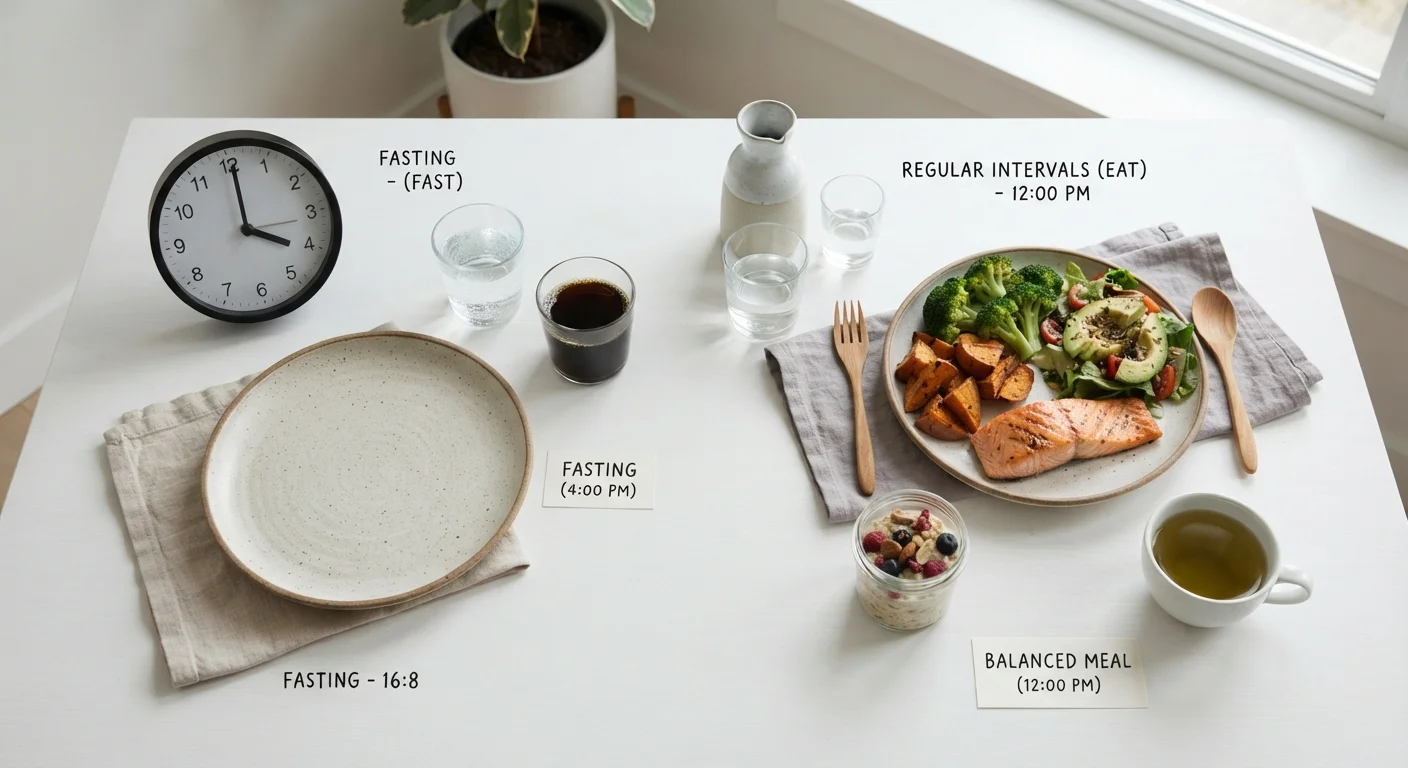
Before comparing evidence, it helps to be precise about terminology. Intermittent fasting (IF) is an umbrella term for eating patterns that cycle between defined periods of eating and not eating. Common protocols include time-restricted eating (TRE) - typically a 16:8 window, meaning 16 hours fasting, 8 hours eating - as well as alternate-day fasting and the 5:2 approach (normal eating five days, significant calorie restriction two days).
Regular meal timing refers to consuming meals at consistent, evenly distributed intervals throughout the day - often three main meals with or without snacks - without deliberate fasting windows beyond an overnight break. This mirrors many conventional dietary guidelines and is the baseline comparison in most studies.
A key nuance researchers flag: many IF protocols reduce overall calorie intake simply by shrinking the eating window, making it difficult to isolate whether benefits stem from timing itself or from caloric restriction. This design challenge runs through much of the literature.
What the Research Actually Finds
Clinical trials comparing IF to continuous calorie restriction consistently find comparable outcomes for weight loss over periods of 6-12 months when calorie intake is matched. A frequently cited 2020 NEJM review by Wilkinson and colleagues noted that IF produces modest improvements in weight and some cardiometabolic markers, but cautioned that most studies are short-term and involve relatively small samples.
~1-3 kg
Typical additional weight loss from IF vs. standard diet
Meta-analyses generally find intermittent fasting produces modest, not dramatic, weight differences versus continuous restriction when calories are matched.
~27%
Proportion of US adults who skip breakfast regularly
CDC and NHANES survey data suggest a substantial share of American adults already practice informal time-restricted eating without labeling it as such.
< 12 months
Typical duration of most IF clinical trials
Most published randomized controlled trials on intermittent fasting run for under one year, limiting conclusions about long-term outcomes and safety.
For metabolic health, some TRE trials have recorded improvements in insulin sensitivity, blood pressure, and triglycerides - but effect sizes are modest and results are inconsistent across studies. A 2022 randomized trial published in The New England Journal of Medicine found no significant advantage of a 16:8 TRE protocol over unrestricted eating when total calories and protein were controlled, suggesting timing alone may not be the primary driver.
Regular meal timing research draws on circadian biology: eating in alignment with daylight hours and keeping consistent meal times appears to support metabolic regulation. Studies in shift workers, for instance, demonstrate that irregular meal timing correlates with worse glycemic control and higher cardiovascular risk - though these are observational and confounded by lifestyle factors.
See how these findings compare across key criteria in the table below.
| Intermittent Fasting | Regular Meal Timing | |
|---|---|---|
| Weight loss outcomes | Comparable to calorie restriction when calories matched | Comparable when diet quality is controlled |
| Metabolic marker improvements | Modest, inconsistent across studies | Supported by circadian alignment research |
| Ease of adherence | Varies; simpler for some, difficult for others | Integrates well with social and work routines |
| Hunger and energy stability | Can increase hunger during fasting periods | More even energy distribution through the day |
| Evidence quality | Mostly short-term, small-sample RCTs | Large observational studies plus circadian biology research |
| Suitability for special populations | Limited evidence; caution advised | Generally compatible; consult provider for medical needs |
Practical Factors That Affect Adherence
Evidence consistently shows that the eating pattern a person actually sticks to produces better outcomes than a theoretically superior one they abandon. Intermittent fasting appeals to those who prefer fewer decision points around food, but it can increase hunger, irritability, and difficulty concentrating for others - particularly in early adoption phases.
Regular meal timing distributes energy intake more evenly, which some people find supports steadier mood and concentration. It also integrates more easily into social eating norms, family schedules, and workplace routines in the US context.
Focus on Food Quality First
Before optimising meal timing, consider whether the foods within your eating window are nutritionally dense. Research suggests that dietary composition - adequate protein, fiber, micronutrients, and limited ultra-processed foods - has a larger measurable impact on health outcomes than the specific hours you eat. Timing adjustments are easier to evaluate once a solid dietary foundation is in place.
Diet quality remains the most robust predictor of long-term health outcomes regardless of timing pattern. A well-timed diet of predominantly ultra-processed food is unlikely to outperform a nutritionally rich diet eaten flexibly. For a deeper look at food quality evidence, see what the research shows about whole vs. processed foods and nutrition patterns with the strongest research support.
Who Should Be Cautious
While IF is generally safe for healthy adults in short-term studies, several groups warrant additional caution. People with a history of disordered eating may find prolonged fasting windows counterproductive or harmful. Those with type 1 or type 2 diabetes, or who take medications timed around meals, face particular risks from shifting eating windows without medical supervision.
Pregnant and breastfeeding individuals, children, adolescents, and older adults with specific nutritional needs should not adopt significant meal timing changes without consulting a qualified healthcare professional. The evidence base for these populations is limited, and the stakes are higher.
Exercise timing can intersect with meal timing in meaningful ways as well - for context on how workout schedules interact with energy availability, common beliefs about morning vs. evening workouts is worth reviewing.
This article is for general informational purposes only and does not constitute medical or dietary advice. Always consult a qualified healthcare professional before making changes to your eating pattern, especially if you have an existing health condition or take medication.
The content provided on our blog site traverses numerous categories, offering readers valuable and practical information. Readers can use the editorial team’s research and data to gain more insights into their topics of interest. However, they are requested not to treat the articles as conclusive. The website team cannot be held responsible for differences in data or inaccuracies found across other platforms. Please also note that the site might also miss out on various schemes and offers available that the readers may find more beneficial than the ones we cover.