

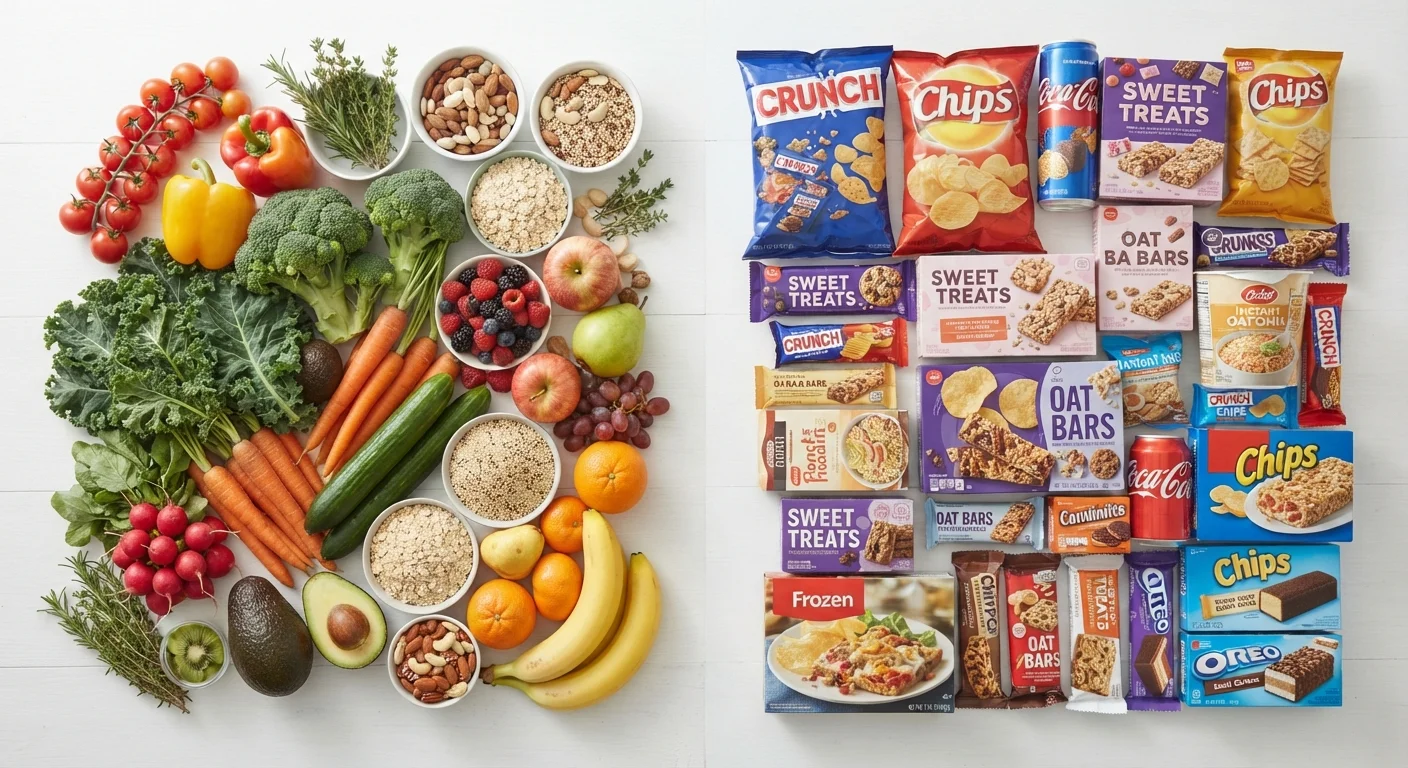
Option A
Whole Foods
Minimally altered, nutritionally dense foods as close to their natural state as possible.
Best for: Individuals seeking sustained nutritional density, fiber, and micronutrient richness from their daily diet.
Option B
Processed Foods
A broad spectrum of foods altered through industrial methods - from mildly to heavily modified.
Best for: Understanding the wide variation within this category is essential before drawing blanket health conclusions.
Defining the Terms: What Actually Counts as 'Processed'?
The word "processed" covers enormous ground. Freezing peas is processing. So is manufacturing a cheese-flavored snack from corn flour, palm oil, artificial flavors, and emulsifiers. Treating these the same leads to confusion.
The most widely used research framework is the NOVA classification, developed by researchers at the University of São Paulo. NOVA divides foods into four groups: Group 1 covers unprocessed or minimally processed foods (fresh fruit, plain oats, plain meat); Group 2 covers processed culinary ingredients (oils, flours, salt); Group 3 covers processed foods (canned beans, cheese, cured meats); and Group 4 covers ultra-processed foods (UPF) - industrially formulated products containing cosmetic additives, flavor enhancers, and ingredients rarely found in home kitchens.
Most research showing health harms from "processed foods" is specifically tracking Group 4 ultra-processed foods. This distinction matters significantly when interpreting headlines.
| Criterion | Whole Foods | Ultra-Processed Foods |
|---|---|---|
| NOVA Classification | Group 1 (unprocessed/minimally processed) | Group 4 (industrially formulated) |
| Fiber Content | Naturally high; intact food matrix | Typically low; matrix disrupted |
| Micronutrient Density | High; broad micronutrient range | Often low; may add synthetic nutrients |
| Added Sugar | Absent or negligible | Frequently high |
| Satiety Signaling | Supports natural fullness cues | May undermine satiety regulation |
| Cardiovascular Risk (observational) | Associated with lower risk | Associated with elevated risk |
| Cost Per Serving | Variable; staples are affordable | Often cheaper per calorie, not per nutrient |
| Convenience | Requires more preparation | Ready-to-consume; shelf-stable |
What Population Studies Show
The evidence linking ultra-processed food consumption to adverse health outcomes has grown substantially over the past decade. Large prospective cohort studies - including the NutriNet-Santé study in France and analyses of UK Biobank data - have found associations between high UPF intake and elevated risks of cardiovascular disease, type 2 diabetes, colorectal cancer, and all-cause mortality.
A 2024 umbrella review published in The BMJ synthesized evidence from over 40 meta-analyses and found consistent associations between UPF consumption and multiple adverse health outcomes, with greater certainty for cardiovascular mortality and type 2 diabetes. The authors noted these were largely observational findings and that causality has not been definitively established.
57%
Share of US calories from ultra-processed foods
Analysis of National Health and Nutrition Examination Survey (NHANES) data found ultra-processed foods accounted for approximately 57% of energy intake among US adults.
+29%
Higher all-cause mortality risk with high UPF intake
A 2019 JAMA Internal Medicine study of Spanish adults found the highest UPF consumption quartile was associated with a 29% higher risk of all-cause mortality.
~500 kcal/day
Extra calories consumed on ultra-processed diet
A randomized controlled trial by Hall et al. (2019, NIH) found participants spontaneously consumed around 500 more calories per day on an ultra-processed diet vs. an unprocessed one.
Whole food-rich dietary patterns - such as those emphasizing vegetables, legumes, whole grains, fruit, and minimally processed proteins - are associated with lower inflammatory markers and better cardiometabolic profiles across populations. For context on what these dietary patterns look like in practice, see our article on nutrition patterns with the strongest research support.
Nutritional Mechanics: Why the Difference Exists
Whole foods tend to be nutritionally superior across several dimensions. They provide dietary fiber that feeds gut microbiota and slows glucose absorption; phytochemicals with antioxidant and anti-inflammatory properties; and a broader range of micronutrients that work synergistically. The food matrix - the physical structure of the food - also matters: intact cell walls in whole grains, for example, slow digestion in ways that refined flour does not.
Ultra-processed foods are often engineered for palatability in ways that may undermine satiety signaling. Research by the NIH (a randomized controlled trial by Hall et al., 2019) found that participants on an ultra-processed diet consumed significantly more calories per day and gained weight compared to those on an unprocessed diet, even when both diets were matched for offered nutrients - suggesting the food matrix and formulation affect intake independent of macro content.
One nuance worth noting: not all processing degrades nutrition. Freezing vegetables at peak ripeness preserves most micronutrients. Fortification adds nutrients to foods that would otherwise lack them. Fermentation creates beneficial compounds. The problem lies specifically with heavy industrial reformulation, not processing as a category. For more on added sugar - a key marker of ultra-processing - see what the research says about added sugar.
Practical Implications for US Shoppers
Despite the evidence favoring whole foods, cost and accessibility concerns are real. Ultra-processed foods are heavily marketed, convenient, and often cheaper per calorie. However, the idea that healthy eating is necessarily expensive deserves scrutiny. Dried lentils, canned beans, frozen spinach, oats, and eggs are among the most cost-effective foods available in US grocery stores - and all qualify as minimally processed or whole foods.
A practical approach is to identify high-frequency, high-volume foods in one's diet and assess where substitutions make sense. Replacing a daily ultra-processed snack with whole food alternatives - without overhauling an entire diet at once - is a realistic, evidence-aligned starting point. Common traps to avoid are covered in detail in our piece on where people go wrong when trying to eat healthier.
For readers evaluating protein sources in the context of a more whole-foods diet, plant-based vs. animal protein nutritional differences offers a research-grounded comparison without the ideological baggage.
This article is for general informational and educational purposes only and does not constitute medical or dietary advice. Consult a registered dietitian or qualified healthcare professional for guidance tailored to your individual health circumstances.
The content provided on our blog site traverses numerous categories, offering readers valuable and practical information. Readers can use the editorial team’s research and data to gain more insights into their topics of interest. However, they are requested not to treat the articles as conclusive. The website team cannot be held responsible for differences in data or inaccuracies found across other platforms. Please also note that the site might also miss out on various schemes and offers available that the readers may find more beneficial than the ones we cover.