

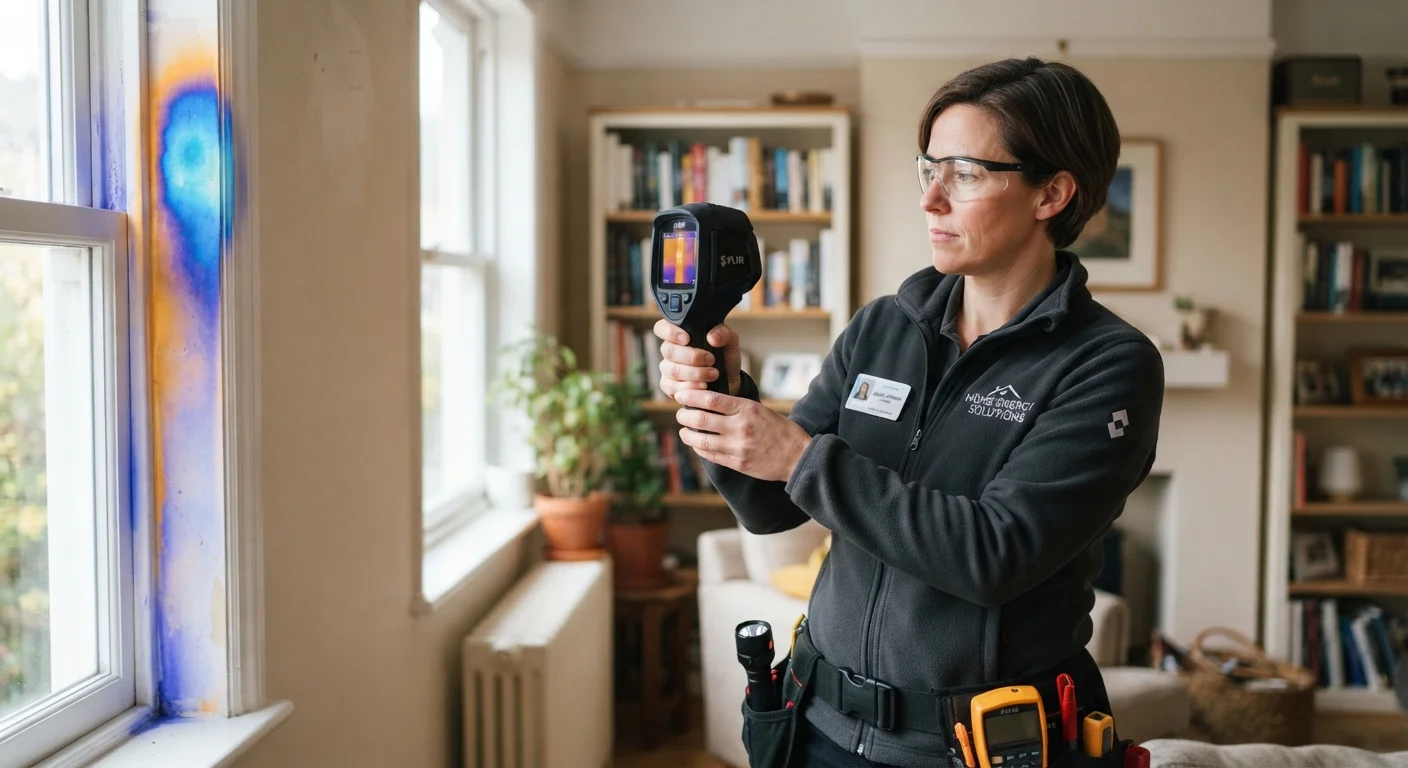
What an Auditor Actually Does When They Arrive
When a certified energy auditor arrives at your home, they begin with a walkthrough and a conversation. They'll ask about your utility bills, comfort complaints - rooms that are always cold, floors that feel drafty - and the age of major systems like your furnace, water heater, and air conditioner. This context shapes which areas they'll examine most closely.
From there, the auditor conducts a blower door test. A large fan is mounted in an exterior doorframe and used to depressurize the home. By measuring how quickly air infiltrates from outside, the auditor can calculate the overall air leakage rate. During this test, they use a smoke pencil or their hand to pinpoint exactly where air is sneaking in - around recessed light fixtures, at the sill plate, through attic hatches, and behind electrical outlets on exterior walls.
Many auditors also use a thermal imaging (infrared) camera. With the blower door running, cooler outside air flowing in makes hidden gaps visually obvious as temperature differences on the camera's screen. Insulation voids in walls and ceilings - which are invisible to the eye - show up clearly as cold patches in winter or warm spots in summer.
Systems and Spaces the Auditor Evaluates
The audit is not limited to walls and windows. A thorough assessor will check every major energy-consuming system and building component:
- Attic insulation and air sealing: The attic is typically the single biggest source of heat loss in older homes. Auditors measure insulation depth and check for bypasses - gaps where conditioned air escapes into the attic.
- HVAC equipment and ductwork: They examine the age, condition, and efficiency rating of your heating and cooling equipment. Duct leakage is often tested separately, since leaky ducts in unconditioned spaces can waste a significant portion of your HVAC output.
- Water heater: Age, fuel type, and insulation wrap are noted. Tank water heaters older than ten to twelve years are often flagged as candidates for replacement.
- Windows and doors: The auditor checks for failed seals in double-pane glass, missing weatherstripping, and single-pane glazing.
- Lighting and appliances: A basic inventory of lighting type (LED vs. older incandescent or CFL) and the presence of Energy Star-rated appliances may be noted.
- Basement and crawlspace: Exposed floor joists, missing insulation under floors, and moisture issues are all reviewed.
25-40%
Typical heating/cooling energy lost through air leaks
According to the U.S. Department of Energy, air infiltration through leaks, gaps, and openings accounts for a substantial share of heating and cooling costs in most homes.
90%
Homes in the US that are under-insulated
The North American Insulation Manufacturers Association estimates that the vast majority of existing US homes have less insulation than current energy code standards recommend.
10-30%
Potential reduction in energy bills after weatherization
The U.S. Department of Energy cites this range as a general estimate for homeowners who implement comprehensive air sealing and insulation improvements following an energy audit.
Completing recommended upgrades from an audit pairs well with broader home upkeep. Our seasonal home maintenance checklist covers the ongoing tasks that keep audit improvements working effectively year-round.
Reading Your Audit Report and Deciding What to Do
At the end of the assessment, you receive a written report. A quality report includes a prioritized list of recommendations, estimated cost ranges for each improvement, and projected energy savings. Improvements are typically grouped by payback period - quick wins like air sealing and attic insulation often pay back within two to five years, while window replacement rarely makes financial sense on energy savings alone.
Check for Utility-Sponsored Audit Programs First
Before hiring a private auditor, contact your gas and electric utility providers. Many US utilities offer subsidized or free energy audits as part of demand-reduction programs. Some states also offer income-qualified weatherization assistance that covers both the audit and a portion of recommended upgrades. Starting here can substantially reduce your out-of-pocket cost.
Prioritizing based on the report is important because not every recommendation will suit your budget or situation. Air sealing and insulation almost always appear near the top because they address the root cause of energy loss rather than the symptom. HVAC upgrades make the most sense when aging equipment is already approaching end of life.
Keep in mind that deferring the improvements identified in an audit carries real cost. Our article on the real cost of deferred home maintenance explains how energy-related neglect compounds over time. Thinking of an audit similarly to a financial review - like an annual savings audit - can help you treat it as a planning tool rather than a one-time event.
Frequently Asked Questions
A professional whole-house audit generally takes two to four hours, depending on the size and age of the home. Larger or older homes with complex HVAC systems may take longer. A basic utility-sponsored audit can sometimes be completed in under an hour.
Costs typically range from around $150 to $600 for a comprehensive professional audit, though prices vary by region and auditor. Many utility companies offer subsidized or even free audits for their customers, so checking with your provider first is worthwhile.
An audit itself does not lower bills - acting on its recommendations does. Homeowners who implement high-priority upgrades such as air sealing and adding insulation commonly see meaningful reductions in heating and cooling costs, though specific savings depend on the home and local climate.
A DIY walk-through can identify obvious drafts, missing insulation, or aging equipment, but it cannot replicate a blower door test or thermal imaging scan. For a complete picture, a professional audit is more reliable and will find issues a homeowner is unlikely to spot alone.
Most weatherization upgrades - like adding attic insulation or caulking windows - do not require permits. However, larger work such as HVAC replacement or significant ductwork changes may require permits depending on your local jurisdiction. See our guide on <a href="/home-garden/home-improvement/permits-inspections-and-codes-what-every-diy-homeowner-needs-to-know">permits and inspections</a> for more detail.
Look for auditors certified by recognized bodies such as RESNET (Residential Energy Services Network) or BPI (Building Performance Institute). These credentials indicate the auditor has completed standardized training and follows established testing protocols.
The content provided on our blog site traverses numerous categories, offering readers valuable and practical information. Readers can use the editorial team’s research and data to gain more insights into their topics of interest. However, they are requested not to treat the articles as conclusive. The website team cannot be held responsible for differences in data or inaccuracies found across other platforms. Please also note that the site might also miss out on various schemes and offers available that the readers may find more beneficial than the ones we cover.