

Why Organization Vocabulary Matters
If you've ever read a home organization guide and stumbled over terms like "decanting," "flow," or "landing zone," you're not alone. These words carry specific meanings within popular organization systems - and misunderstanding them can lead to wasted effort or money spent on solutions that don't fit your actual needs.
This reference is designed as a plain-language lookup tool. Whether you're starting from zero or refining an existing system, familiarity with this vocabulary will help you evaluate methods critically and adapt them to your space and budget.
One-in, one-out rule
A maintenance practice where every new item brought into the home is offset by removing one existing item of the same category. It prevents gradual accumulation without requiring periodic purges.
Zone
A dedicated area of the home designated for a specific activity or category of items - such as a homework zone or a cooking prep zone. Zones reduce decision fatigue by giving everything a logical home based on use.
Command center
A centralized wall or surface - often near an entryway or kitchen - used to manage household logistics: calendars, mail, keys, and to-do lists. It functions as an information hub for the whole household.
Landing zone
A designated spot near an entry point where items like bags, keys, and shoes are temporarily placed upon arrival. Having a defined landing zone prevents clutter from spreading through the home.
Decanting
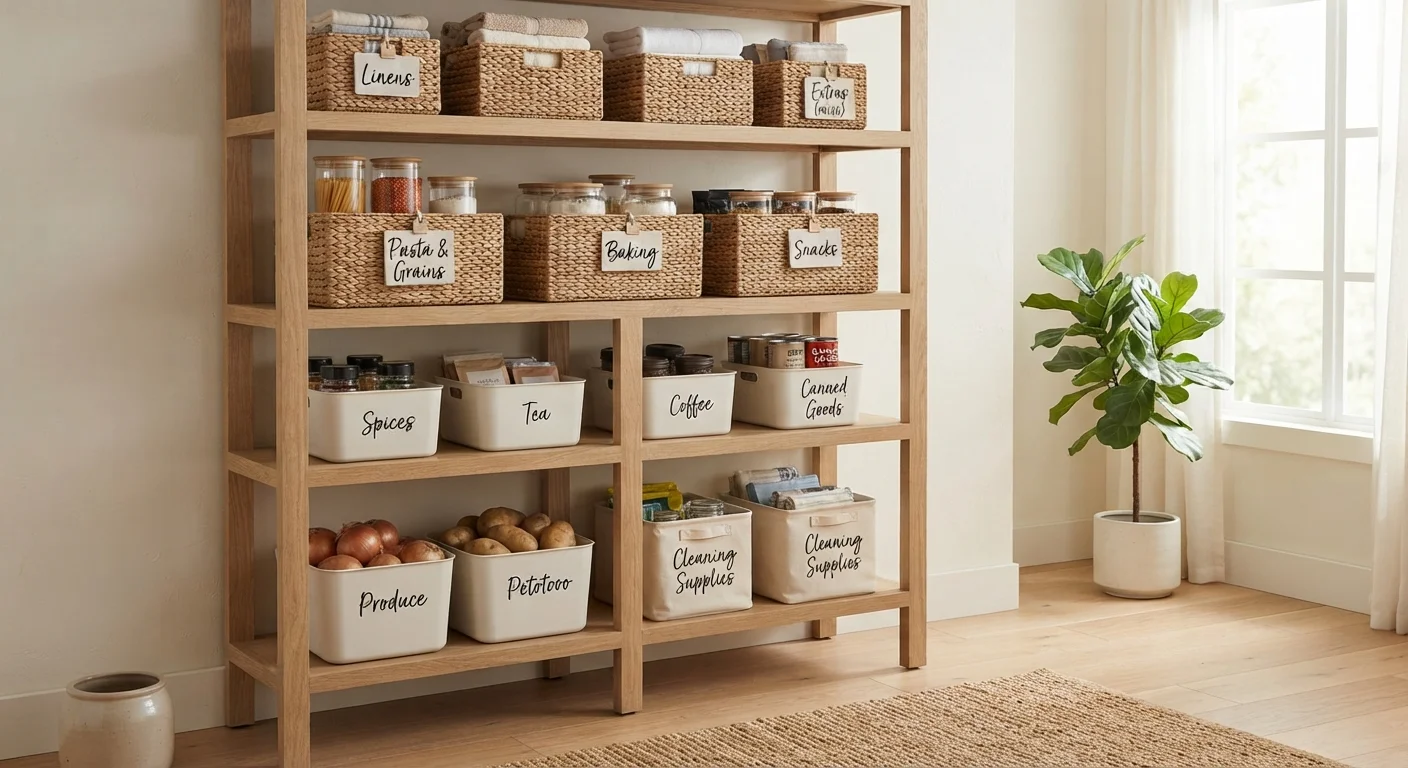
Transferring products - typically pantry items, cleaning supplies, or toiletries - from their original packaging into uniform containers. This is done primarily for visual consistency, though it does add a maintenance step.
Containerizing
Using bins, baskets, or boxes to group related items within a drawer, shelf, or cabinet. Unlike decanting, containerizing doesn't change the original packaging; it simply corrals similar items together.
Decluttering
The deliberate process of removing items from a space that are no longer used, needed, or valued. Decluttering is typically the first step in any organization system because organizing unused items is counterproductive.
Flow
The natural path a person moves through a room or task. Good organization design aligns storage with flow - for example, placing dish storage near the dishwasher so unloading requires minimal movement.
Capsule approach
A philosophy of owning a small, intentional collection of high-use items rather than a large variety. Borrowed from fashion, the capsule approach applies to any category: kitchen tools, linens, toys, or clothing.
Maintenance reset
A short, regular routine - often daily or weekly - to return a space to its organized baseline. Resets are distinct from deep organization sessions and typically take only minutes when done consistently.
Like with like
The organizing principle of storing similar items together rather than by room or by owner. All batteries go in one place, all tape in another - regardless of where in the house they were previously scattered.
Prime real estate
Storage locations that are easiest to access - eye level, front of a shelf, or top of a drawer. High-frequency items should occupy prime real estate; rarely used items go in harder-to-reach spots.
Core Concepts and System Terms
Home organization methods often build on a handful of foundational concepts. Understanding these terms helps you compare systems and decide which principles actually match how your household functions.
| Origin of 'one-in, one-out' | Behavioral psychology and minimalism movements, popularized in home organization since the early 2000s |
| Most common first step in organization systems | Decluttering - removing items before adding storage solutions |
| Command center typical placement | Near the primary home entry or in the kitchen |
| Maintenance reset frequency | Daily (5-10 minutes) or weekly, depending on household size and activity level |
| Containerizing vs. decanting | Containerizing groups items in their original packaging; decanting transfers them into uniform containers |
| Prime real estate principle | Eye-level and front-of-shelf storage is reserved for frequently used items |
Many of these concepts overlap intentionally. A command center, for instance, is usually built within a designated zone and relies on a clear landing zone nearby. Learning the vocabulary as a connected system - rather than isolated buzzwords - is more useful than memorizing definitions in isolation. For a deeper look at how zones work together, see our guide on the zone method.
Before purchasing storage products, it's worth understanding terms like decanting and containerizing - both of which can be done affordably or expensively depending on what you already own. The labeling trade-offs guide explores this tension in detail. For practical, room-specific application, refer to our room-by-room checklist.
The content provided on our blog site traverses numerous categories, offering readers valuable and practical information. Readers can use the editorial team’s research and data to gain more insights into their topics of interest. However, they are requested not to treat the articles as conclusive. The website team cannot be held responsible for differences in data or inaccuracies found across other platforms. Please also note that the site might also miss out on various schemes and offers available that the readers may find more beneficial than the ones we cover.