

Why Room Labels Fail Most Households
Most people organize by room: kitchen stuff goes in the kitchen, bedroom stuff goes in the bedroom. It feels logical, but it rarely reflects how a household actually operates. The dining table becomes a homework station, the living room couch becomes a folding-laundry surface, and the kitchen counter accumulates mail. When storage doesn't match behavior, clutter is the inevitable result.
The Zone Method cuts through that mismatch by starting with observation rather than assumption. Before assigning a single shelf or drawer, you map out the activities your household performs and where those activities naturally happen. That behavioral map becomes your organizing blueprint. If you're new to thinking about your home this way, our practical introduction to home organization covers the foundational concepts worth understanding first.
Zones Aren't the Same as Decluttering
The Zone Method is an organization strategy, not a decluttering method. Before defining zones, it helps to remove items you no longer use - otherwise you're simply reorganizing clutter. If you're unsure where to start, common decluttering myths can help you separate useful strategies from counterproductive ones.
How to Identify Your Household's Zones
Spend three to five days noticing - without changing - where activities actually occur. Where do you open mail? Where do shoes land when people walk in? Where does everyone congregate before bed? These patterns reveal your natural zones. Common household zones include:
- Entry / drop zone: Shoes, bags, keys, outerwear
- Meal prep zone: Everything used to cook, including frequently accessed pantry staples
- Dining zone: Placemats, serving pieces, napkins stored near the table
- Work or bill-paying zone: Stamps, envelopes, chargers, notebooks
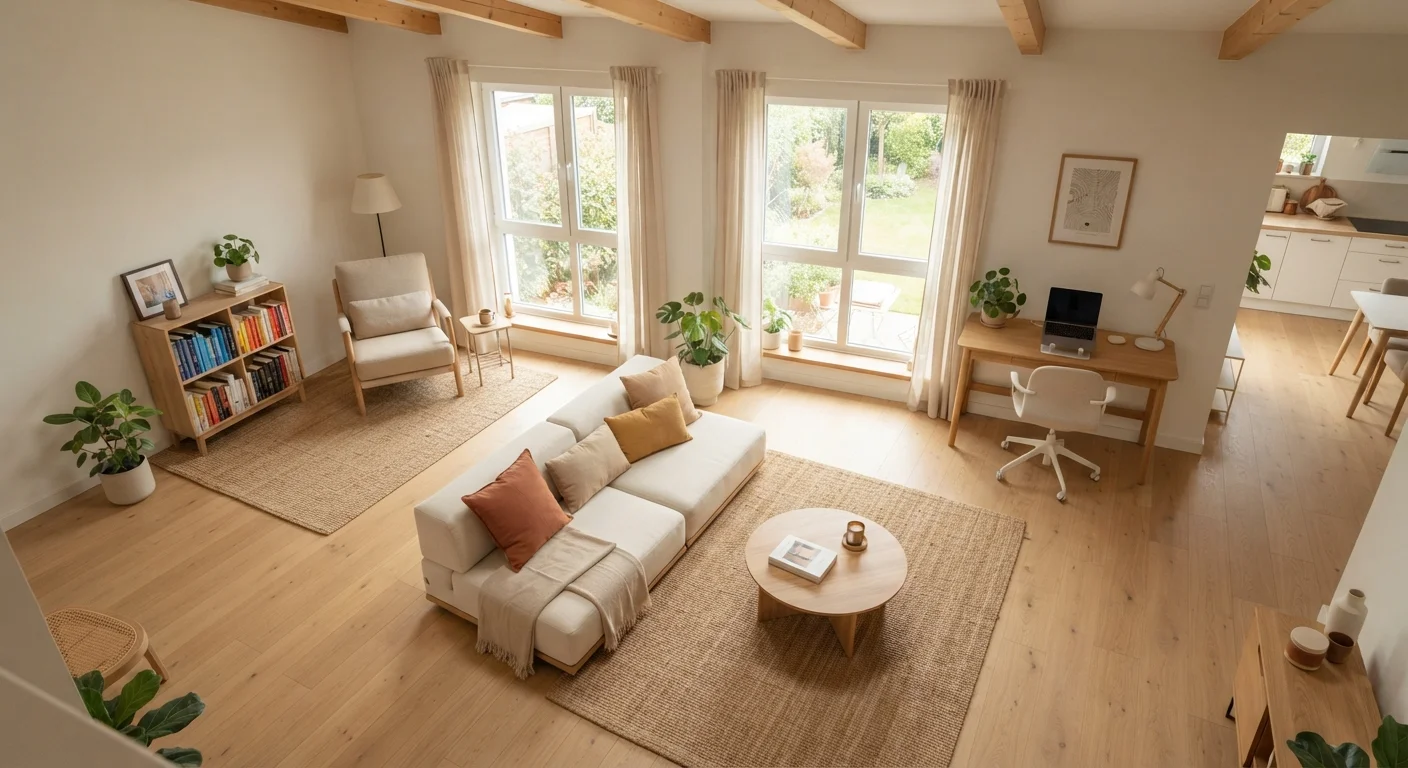
- Relaxation zone: Remotes, blankets, reading materials - within arm's reach of where you actually sit
- Homework or craft zone: Supplies at the height and location where the work happens
Notice that some zones may overlap physically. A kitchen island might serve both meal prep and homework. In that case, portable storage - a caddy that moves easily - defines the zone rather than a fixed shelf.
80%
Of clutter is items without a defined home
Professional organizers commonly cite that the majority of household clutter consists of items that were never assigned a consistent storage location.
30 min
Average time lost weekly searching for items
Studies on household friction suggest that families spend significant time each week locating misplaced everyday items that lack consistent storage.
2-3x
More likely to maintain systems matched to behavior
Behavioral organization research suggests people are significantly more likely to sustain storage habits when the system aligns with their existing routines rather than requiring new ones.
Setting Up Zones Without Spending Money
The most common organizing mistake is buying storage products before knowing what you need to store. Bins and baskets purchased in advance often don't fit the items or the space, and they become clutter themselves. The Zone Method requires no investment to start.
Begin by relocating items to match your observed zones. Move the charging cables to where devices are actually used. Move the scissors and tape to where packages are opened or crafts are done. Use painter's tape or a simple label on a shelf to mark zone boundaries during the trial period. After two weeks of testing, you'll know exactly what container size or storage type - if any - would genuinely help.
For areas where vertical or drawer storage would maximize a zone, our guide to vertical vs. drawer storage walks through which approach suits different activity types. And if paper is overrunning your work zone, paper clutter is a system problem explains a simple three-tray fix.
Test Before You Buy Any Storage Product
Live with your newly defined zones for at least two weeks before purchasing any bins, baskets, or shelving. Real use will reveal the exact dimensions and quantities you need. Buying first almost always results in containers that are the wrong size or unnecessary - adding cost and clutter rather than solving either.
Maintaining Zones as Life Changes
Zones are not permanent installations - they're living structures that should evolve with your household. A baby gear zone that makes perfect sense in year one is obsolete by year three. Seasonal shifts also affect zones: a gardening zone near the back door makes sense from spring through fall but can be compressed or relocated in winter.
Schedule a zone review every three to six months, ideally when seasons change or routines shift (a new school year, a job change, a new hobby). The review doesn't need to be exhaustive - just ask whether each zone still matches the activity it was designed for, and whether items stored there are actually being used in that spot.
For a thorough room-by-room reset that layers well with zone thinking, the room-by-room organization checklist provides a structured walkthrough. If you're curious how zone thinking compares to other organizing philosophies, minimalist vs. category-based organization offers an honest look at the trade-offs of each approach.
The Zone Method works because it respects how people actually behave rather than demanding behavior change to fit a storage system. When your home is organized around your real routines, maintaining order becomes a natural outcome - not a daily struggle.
Frequently Asked Questions
Most households function well with four to eight zones depending on family size and lifestyle. A single person may need only a cooking zone, a work zone, and a relaxation zone, while a family with children might add homework, crafts, and laundry zones. Start with the activities that cause the most clutter and build from there.
Yes - in fact, small spaces often benefit most from zone thinking because every square foot must work harder. A kitchen table can serve as both a dining zone and a homework zone with the right portable storage. The key is defining when each zone is "active" and resetting between uses.
Room-by-room organizing treats the physical space as the organizing unit; the Zone Method treats your behavior as the unit. A spare bedroom might contain three zones - guest sleeping, gift wrapping, and seasonal storage - rather than being organized generically as "bedroom stuff." This prevents mixed clutter from accumulating.
Label zones clearly and involve family members in deciding what belongs where. When everyone understands that the backpack zone lives by the front door because that's where bags are dropped, the logic is self-evident and easier to maintain. See our <a href="/home-garden/home-organization/teaching-kids-to-maintain-their-own-spaces">guide to teaching kids to maintain their own spaces</a> for age-appropriate strategies.
No purchases are required to start. Zones can be defined using painter's tape, furniture placement, or simply deciding that a shelf belongs to one purpose. Add storage containers only after you know exactly what the zone needs to hold - buying first is one of the most common organizing mistakes.
A well-designed zone requires almost no tidying because items naturally return to where they're used. If you're constantly moving things out of a zone or restocking it from other rooms, that's a signal the zone boundary needs adjustment or the items stored there don't match the activity.
The content provided on our blog site traverses numerous categories, offering readers valuable and practical information. Readers can use the editorial team’s research and data to gain more insights into their topics of interest. However, they are requested not to treat the articles as conclusive. The website team cannot be held responsible for differences in data or inaccuracies found across other platforms. Please also note that the site might also miss out on various schemes and offers available that the readers may find more beneficial than the ones we cover.