

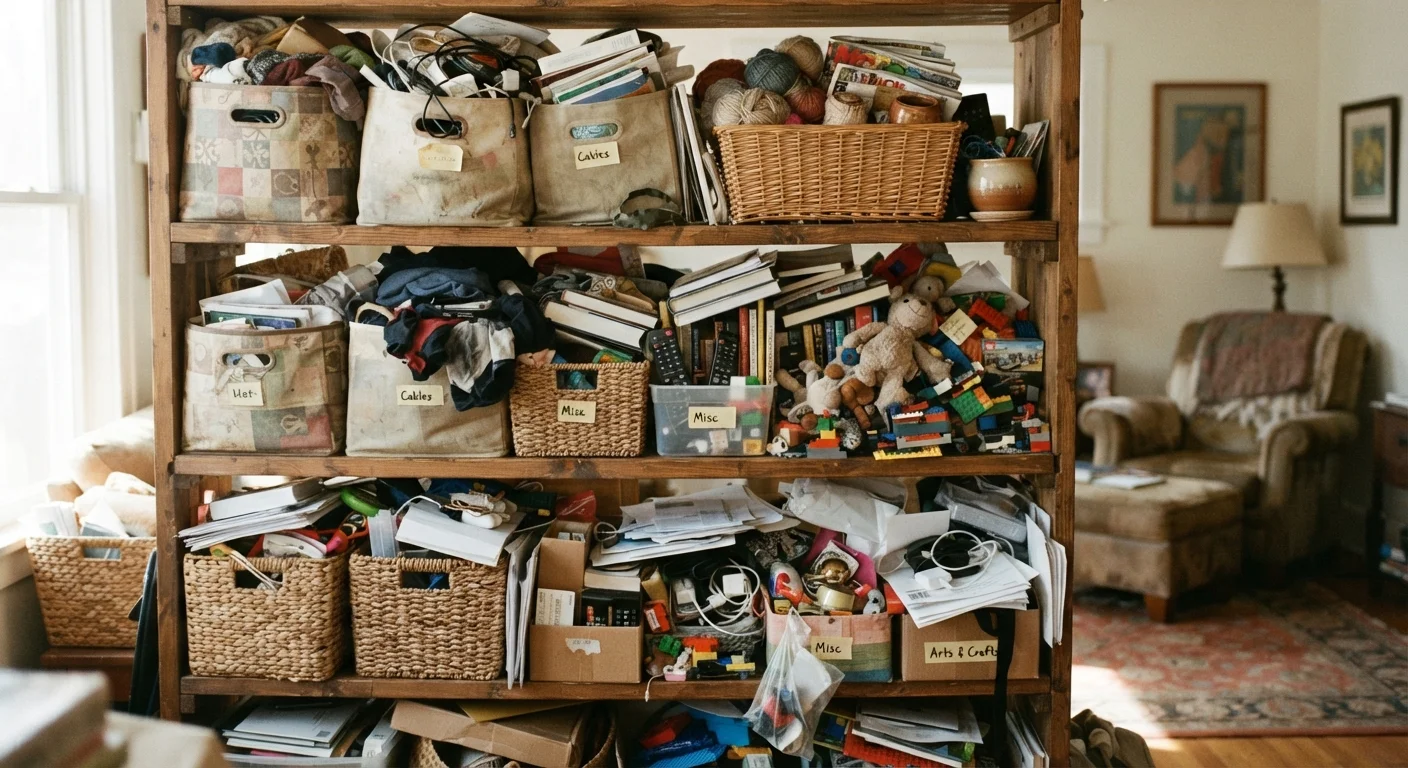
The Core Problem: You're Organizing Clutter, Not Fixing It
There's a deeply satisfying feeling that comes from rearranging a messy space - labeling bins, folding neatly, assigning every item a home. The problem is that without first removing what doesn't belong, you're not solving the clutter problem. You're just giving it better-looking packaging.
This is the fundamental reason reorganizing without decluttering always fails. The underlying cause - owning more than your space can sustainably hold - remains completely untouched. Six months later, the bins are overflowing, the labels no longer match what's inside, and the frustration cycle starts again.
If you're new to tackling this challenge, a practical introduction to home organization can help you understand the core concepts before you invest time and money in a system that's set up to fail.
Organization Systems Can't Fix Excess
No bin, basket, or label maker can compensate for owning more than your space can reasonably hold. Imposing structure on too many items just creates a tidier version of the same problem. Until the volume of belongings matches the available space, any organizational system will eventually collapse under its own weight.
Why Smart People Keep Making This Mistake
Reorganizing without purging first isn't a laziness problem - it's a perception problem. Sorting and containerizing items feels like productive work, because it is work. The visual result looks like progress. But that sense of accomplishment can actually prevent the harder and more necessary step: deciding what should leave.
There's also a common belief that the right system will finally make everything fit. In reality, no system compensates for sheer volume. This is one of the core ideas explored in decluttering myths that keep your home stuck - the idea that better bins or drawer dividers are the solution is one of the most persistent and costly misconceptions in home organization.
Buying Storage Before Sorting Is a Costly Trap
Purchasing bins, shelving units, or drawer dividers before knowing exactly what you're keeping is a common and expensive mistake. You'll either buy the wrong sizes, buy too many, or end up filling new containers with items you should have discarded. Always complete your sort and purge before spending a single dollar on storage products.
Understanding why you reach for a storage product instead of a donation bag is the first step toward breaking the cycle for good.
Mistakes That Lock You Into the Reorganizing Cycle
Most people who reorganize repeatedly without lasting results are making the same handful of errors - often without realizing it. Each mistake reinforces the others, making it harder to step back and see what's actually going wrong.
Jumping straight to buying storage containers before sorting belongings.
Why it happens: Buying bins feels productive and gives the appearance of progress without the harder emotional work of deciding what to keep.
Reorganizing a space category by category while ignoring overall volume.
Why it happens: Tackling one drawer or shelf at a time feels manageable, but it prevents you from seeing how much you truly own across an entire category.
Treating organizing as a permanent solution rather than a recurring practice.
Why it happens: The relief felt after a successful reorganization creates the false belief that the problem is permanently solved.
Keeping items out of guilt, sentiment, or hypothetical future use without designated limits.
Why it happens: Emotional attachment and 'just in case' thinking override practical assessment, leading to kept items that quietly refill any space just organized.
Reorganizing high-clutter areas while ignoring the inflow of new items.
Why it happens: Organization efforts focus entirely on what's already in the home, with no attention paid to the habits that keep adding new items to the same spaces.
It's worth noting that specific zones in the home - such as paper handling areas - carry their own version of this problem. Paper clutter is a system problem, not a willpower problem, and applying a sort-first approach to those areas can eliminate one of the most persistent household clutter sources.
Building a Sequence That Actually Holds
Sustainable home organization follows a strict sequence: sort first, discard second, organize third. Skipping or reversing any step in that order produces predictably temporary results.
Start by pulling everything out of the space you're working on. This is non-negotiable - partial sorts lead to partial clarity. Group like with like, then make decisions about what stays before a single item goes back in. Only after you've reduced the volume to what genuinely belongs in that space should you think about how to store it.
Once you've completed a full room, the room-by-room organization checklist can help you verify nothing was overlooked and keep the process systematic.
80%
Of clutter stems from disorganization, not lack of space
Professional organizers widely cite excess volume - not insufficient storage - as the primary driver of home clutter and failed organization systems.
3-6 months
Typical time before re-organization without decluttering fails
Anecdotal reports from home organization professionals suggest most systems set up without a prior purge visibly deteriorate within one season.
This sequence requires more effort upfront, but it's the only approach that creates an organization system calibrated to what you actually own - which is the only kind that lasts.
The content provided on our blog site traverses numerous categories, offering readers valuable and practical information. Readers can use the editorial team’s research and data to gain more insights into their topics of interest. However, they are requested not to treat the articles as conclusive. The website team cannot be held responsible for differences in data or inaccuracies found across other platforms. Please also note that the site might also miss out on various schemes and offers available that the readers may find more beneficial than the ones we cover.