

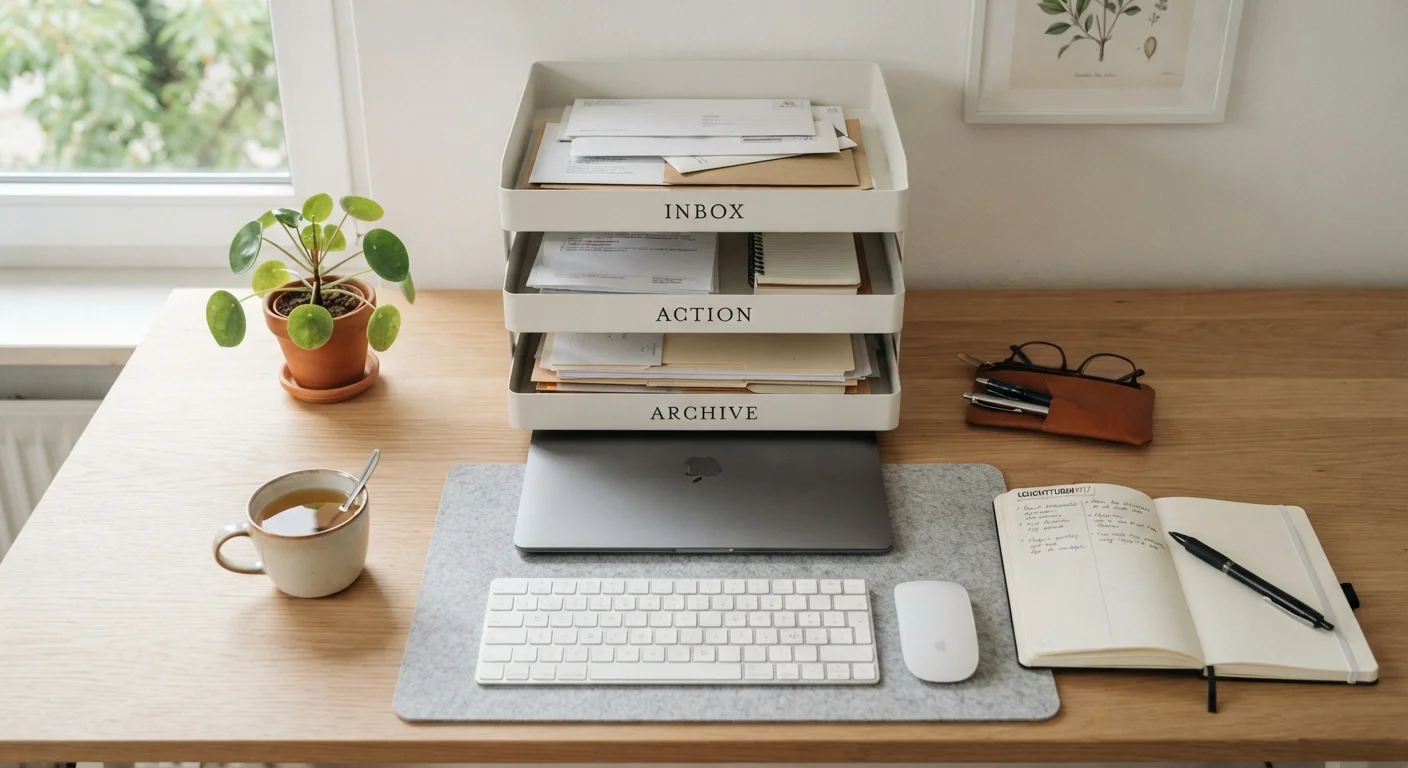
Why Paper Accumulates in the First Place
Every household receives a steady stream of paper: mail, school notices, receipts, instruction manuals, medical forms, and magazines. None of this is unusual. What causes the pile is the absence of a defined next step for each piece when it arrives.
When paper lands on a counter, it signals one of several unresolved decisions: Do I need to act on this? Where does it belong? Can it be thrown away? Without a system to answer those questions automatically, the brain defaults to deferral - setting the paper down temporarily, which becomes permanently. This is not a motivation failure. It is a decision-fatigue problem compounded by a missing workflow.
As common decluttering myths suggest, the instinct to buy more storage bins often replaces the harder work of building a process. More containers without a governing system simply give clutter a tidier appearance.
Paper Systems and Financial Documents
Certain financial and legal documents carry specific retention requirements that vary by document type and individual circumstances. For guidance on how long to keep tax records, insurance policies, or estate documents, consult a qualified tax professional or attorney rather than relying on general rules. This article provides organizational framing only - not legal or financial advice.
The Three-Tray Inbox System Explained
The simplest effective paper management system uses three labeled trays placed in a single, consistent location - ideally near the main entry point where mail arrives.
- Tray 1 - Inbox: Every piece of paper that enters the home lands here first, without exception. Nothing is pre-sorted or evaluated at the door.
- Tray 2 - Action: After reviewing the inbox (ideally once or twice per week), items requiring a response, payment, phone call, or decision move here. This tray should stay small - five items or fewer is a healthy working load.
- Tray 3 - Archive: Papers that need to be retained but require no action - paid bills, filed documents, warranty cards - stage here before being moved to permanent storage during a monthly file session.
Everything that does not qualify for Tray 2 or Tray 3 goes directly into the recycling bin or shredder. This is the most important step: refusing to keep paper that serves no purpose is what prevents backlogs from forming.
Keep Your Action Tray Small by Design
If your Action tray regularly holds more than five items, that is a signal that your processing frequency needs to increase - not that you need a bigger tray. A swelling Action pile recreates the same decision-fatigue loop as the original counter clutter. Aim to clear it completely at least once per week.
Building a Weekly Paper Processing Habit
A system is only as good as the habit that operates it. Schedule a fixed 15-minute slot each week - Sunday evening and Friday morning are common choices - to clear Tray 1. During this session, make three decisions for each piece of paper: act on it now, move it to Tray 2, or discard it.
Monthly, clear Tray 3 into a filing cabinet, binder, or a scanned digital folder. The physical act of filing closes the loop and prevents the archive tray from becoming a secondary pile.
This approach connects naturally to broader home organization principles. The zone method of home organization frames the paper station as its own functional zone - a dedicated area where paper is received, reviewed, and resolved rather than scattered across every surface in the house.
80%
Of filed papers are never referenced again
Organizational researchers and professional organizers commonly cite this estimate to illustrate that most paper retained 'just in case' serves no practical purpose after the moment of filing.
15 min
Typical weekly paper processing time with a system
Home organization specialists generally estimate that households with a functioning inbox system can fully process a week's incoming paper in 10-20 minutes.
41 lbs
Average junk mail received per US household annually
The US Postal Service and environmental organizations estimate that a typical American household receives approximately 41 pounds of junk mail per year, much of which is never opened.
Reducing Paper at the Source
The most efficient way to manage paper is to stop it from entering the home. Several practical steps reduce incoming volume meaningfully:
- Opt into paperless billing for utilities, credit cards, and bank statements - most providers support this through their online portals.
- Register with the DMA Choice service (offered through the Data & Marketing Association) to reduce unsolicited direct mail.
- Decline receipts when possible, or choose email receipts for deductible purchases.
- Cancel or digitize subscriptions for magazines and catalogs you no longer read regularly.
Reducing inflow is not about going entirely paperless - that is impractical for most households. It is about matching the volume of incoming paper to what your system can realistically process each week.
For a broader look at how to tackle physical clutter room by room alongside your paper system, the room-by-room organization checklist offers a structured starting point. And if you are tempted to reorganize before addressing what stays and what goes, reorganizing without decluttering first explains why that sequence consistently backfires.
Frequently Asked Questions
Tidying moves paper around but does not create a pathway for it to follow. Without a defined system - an inbox, an action step, and an archive - paper will reaccumulate in the same spots. The fix is a repeatable process, not repeated cleaning sessions.
Most households can sort a significant backlog in two to three focused sessions of 30-45 minutes each. The goal is not perfection - it is separating action items from archive candidates and recycling everything else. Start with the most recent papers first, since older documents are often no longer relevant.
Generally worth retaining: tax documents and supporting records (consult a tax professional for your specific retention timeline), insurance policies, property records, medical records, and legal documents like wills and contracts. Most promotional mail, paid utility bills, and expired warranties can be shredded or recycled.
For many households, yes. Scanning key documents and opting into electronic statements significantly reduces incoming paper volume. A smartphone camera and a free scanning app are sufficient for most home use cases. The key is creating organized digital folders with the same logic as a physical system.
Three is the practical minimum: one for incoming paper that has not been reviewed, one for items requiring action, and one for items to be filed or scanned. Adding more trays without a clear purpose for each tends to recreate the clutter problem in a different shape.
Yes - hanging folders, binders, or accordion files all work provided each one has a single, clearly defined purpose. The container matters less than the rule attached to it. Whatever system you choose should make the next step obvious without requiring additional decisions.
The content provided on our blog site traverses numerous categories, offering readers valuable and practical information. Readers can use the editorial team’s research and data to gain more insights into their topics of interest. However, they are requested not to treat the articles as conclusive. The website team cannot be held responsible for differences in data or inaccuracies found across other platforms. Please also note that the site might also miss out on various schemes and offers available that the readers may find more beneficial than the ones we cover.