

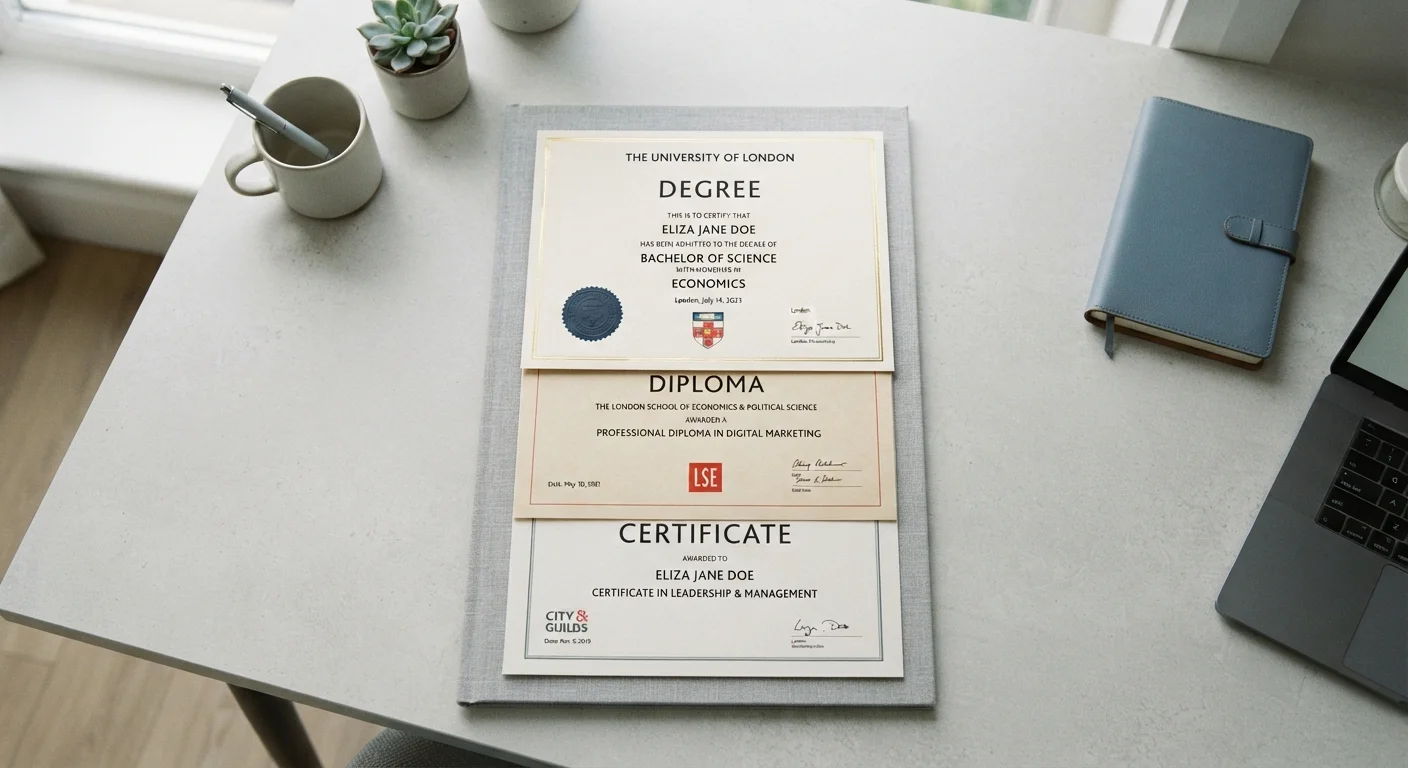
The Three Credential Types and What They Actually Mean
When a job posting says "degree required" or "certification preferred," those aren't interchangeable terms. Each credential type has a distinct structure, typical duration, and signal it sends to an employer reviewing a résumé.
Degrees
A degree - associate's, bachelor's, master's, or doctoral - is awarded by an accredited college or university upon completing a multi-year curriculum that combines a major field of study with general education requirements. A bachelor's degree typically takes four years of full-time study. Degrees signal academic breadth, critical thinking development, and the ability to sustain long-term academic commitment. For employers in fields like law, medicine, engineering, and education, degrees aren't optional - they're prerequisite for licensure.
Diplomas
A diploma usually comes from a vocational school, community college, or technical institute and reflects focused, applied training in a specific trade or profession. Programs run from several months to two years. Dental assisting, HVAC technology, and culinary arts are common diploma fields. Diplomas signal practical competency in a defined occupational area without the breadth of a degree. Employers in skilled trades frequently view diplomas as the appropriate - and sufficient - credential for entry-level roles.
Certificates
A certificate confirms completion of a shorter, targeted program focused on a specific skill or knowledge domain. Certificates can be issued by universities (credit-bearing), professional associations (industry credentials), or online platforms (non-credit). Duration ranges from a few hours to a year. The signal a certificate sends depends heavily on who issued it and whether the field recognizes it. See what online course certificates are actually worth to employers for a deeper look at how hiring managers evaluate digital credentials.
65%
Job postings requiring a degree or higher
According to Burning Glass Technologies labor market research, roughly 65% of job postings for middle-skill roles historically listed a bachelor's degree requirement, a phenomenon researchers call 'degree inflation.'
~$38,000
Median earnings premium for bachelor's degree holders
The U.S. Bureau of Labor Statistics reports that median weekly earnings for bachelor's degree holders are substantially higher than for those with only a high school diploma, though the gap varies widely by field.
4-12 months
Typical duration of a professional certificate program
Most industry-recognized certificate programs - from AWS to PMP - can be completed in under a year of part-time study, making them a time-efficient complement or alternative to longer degree programs.
How Employers Actually Read These Credentials
Hiring managers aren't evaluating credentials in a vacuum - they're filtering for signals that predict job performance, cultural fit, and role readiness. Each credential type communicates something different in that context.
A four-year degree tells an employer the candidate can absorb complex information across disciplines, meet long-term institutional expectations, and likely navigate bureaucratic or corporate environments. For management-track roles, this signals capacity - not just current knowledge. The career trade-offs between industry certifications and college degrees are real and vary significantly by sector.
A vocational diploma signals that the candidate is ready to do specific, applied work without requiring extensive onboarding into the technical fundamentals. In healthcare support roles and skilled trades, this is often exactly what employers want.
A certificate's reception is the most variable. An AWS cloud certification or a PMP (Project Management Professional) credential from PMI carries industry-wide recognition. A certificate from an unaccredited online provider with no assessment rigor carries almost none. The issuer and the assessment behind the credential determine the signal, not the document itself.
Verify Accreditation Before You Enroll
The single most important quality check for any credential is whether the issuing institution holds regional or national accreditation recognized by the U.S. Department of Education, or whether the certifying body is backed by a major industry association. Employers and licensing boards use accreditation status as their primary quality filter. You can verify institutional accreditation through the U.S. Department of Education's database at ope.ed.gov at no cost.
Choosing the Right Credential for Your Situation
The most cost-effective credential is the one that opens the specific door you're targeting - nothing more, nothing less. Overeducating for a role wastes time and money; undercredentialing for a gated profession closes options entirely.
Start by researching what employers in your target field actually list in job postings. If entry-level roles consistently list a bachelor's degree as required - not preferred - a certificate alone won't clear the filter. If postings say "or equivalent experience," certificates and demonstrated skills may be as persuasive as a degree. Understanding what employers actually mean by common job-posting language helps decode these signals accurately.
For readers considering both a full degree program and a focused certification path, the comparison of online degrees vs. professional certifications breaks down time, cost, and career impact side by side. If you're evaluating whether a graduate-level credential is worth the investment, this framework for evaluating graduate degrees offers a clear decision structure.
Before enrolling in any certificate program, apply the evaluation framework in this guide to evaluating certificate programs before you enroll - not all programs carry equal employer recognition, and institutional accreditation is the first thing to verify. Explore the broader Career Skills hub for additional guidance on building credentials that translate into real workplace value.
Frequently Asked Questions
No. A degree (associate's, bachelor's, or higher) requires a broader general education component alongside a major area of study. A diploma typically reflects a shorter, focused vocational or technical program without the general education requirements.
Both matter, but the weight each carries varies significantly by industry. Healthcare and law enforce strict credential requirements set by licensing boards. Tech and creative industries often prioritize demonstrated skills, making certificates more competitive with degrees.
In some roles and industries - particularly in IT, project management, and skilled trades - industry-recognized certificates can be as persuasive as a degree. However, for roles requiring licensure or senior leadership positions, a degree is typically still expected.
Institutional accreditation, industry backing, and the rigor of any assessment involved are the primary factors. A certificate from a regionally accredited college or a major professional association carries more weight than one from an unverified online platform.
Most employers conduct background checks that include education verification through the issuing institution or third-party services. Misrepresenting credentials - including inflating a certificate to appear as a degree - is considered fraud and grounds for termination.
Yes, in many cases. Post-degree certificates in specialized areas (data analytics, cybersecurity, project management) signal current, job-specific knowledge that a general degree may not demonstrate. They can meaningfully strengthen a résumé for a career pivot or promotion.
The content provided on our blog site traverses numerous categories, offering readers valuable and practical information. Readers can use the editorial team’s research and data to gain more insights into their topics of interest. However, they are requested not to treat the articles as conclusive. The website team cannot be held responsible for differences in data or inaccuracies found across other platforms. Please also note that the site might also miss out on various schemes and offers available that the readers may find more beneficial than the ones we cover.