

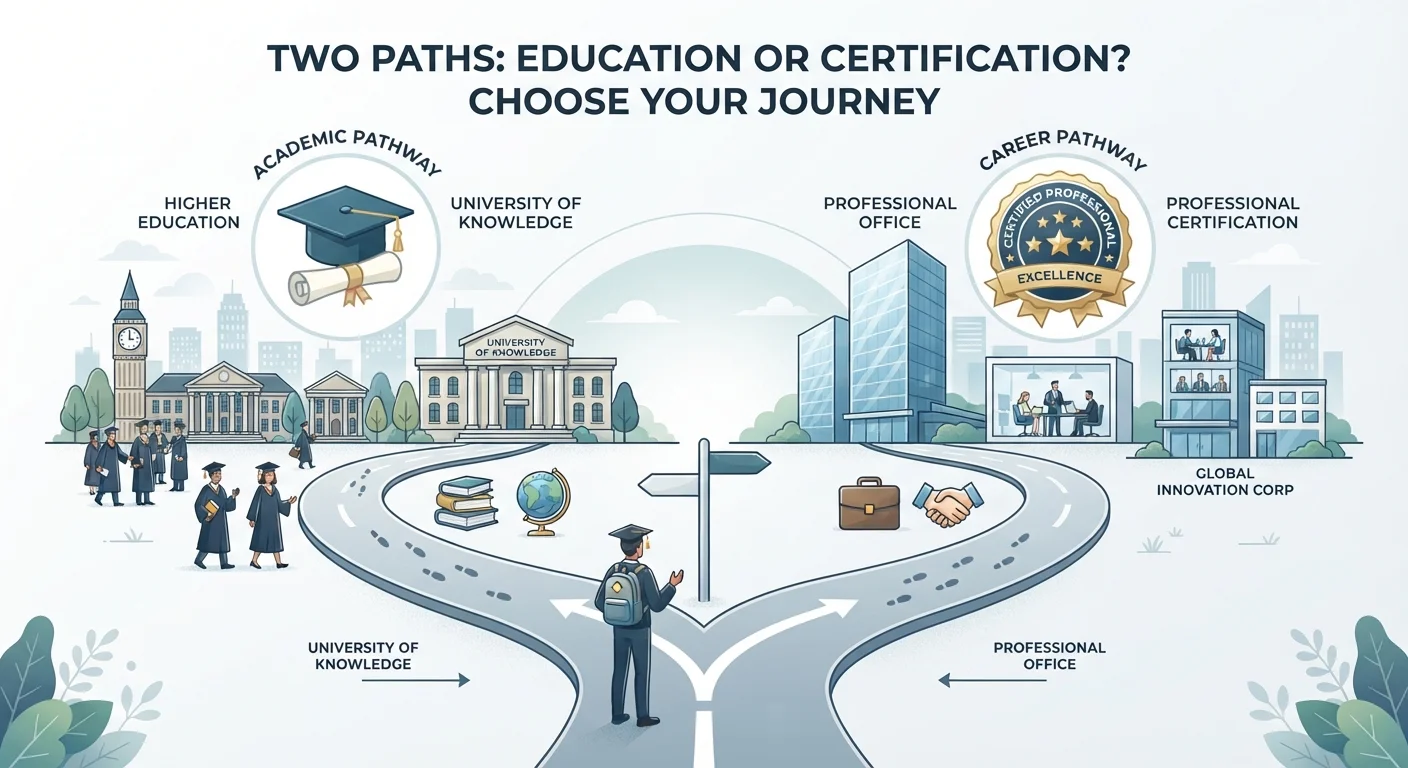
Option A
College Degree
The established, broadly recognized academic credential.
Best for: Careers that require foundational theory, regulated licensure, or employer gatekeeping tied to a four-year credential.
Option B
Industry Certification
The focused, skills-first credential for specific roles.
Best for: Tech, trades, and skilled professions where demonstrated competency and speed-to-employment matter most.
What Each Credential Actually Signals
A college degree and an industry certification are not competing versions of the same thing - they communicate fundamentally different messages to employers.
A four-year degree signals that a candidate completed a structured, multi-year curriculum covering both foundational theory and general academic skills. Employers in regulated or research-heavy fields use degree requirements partly as a proxy for this breadth, and partly because licensing bodies mandate it. For context on how degrees, diplomas, and certificates each read to hiring managers, see our guide on what each credential signals to employers.
An industry certification, by contrast, signals that a candidate has demonstrated proficiency in a defined, testable skill set - typically verified through a proctored exam or performance assessment. It makes a narrower, more concrete claim: this person can do this specific thing. That directness is its primary strength, and its primary limitation.
| Criterion | College Degree | Industry Certification |
|---|---|---|
| Typical cost | $40,000-$150,000+ total | $200-$5,000 per credential |
| Time to earn | 3-4 years minimum | Weeks to several months |
| Breadth of knowledge | Broad theoretical foundation | Narrow, role-specific skills |
| Employer recognition | Universal across most industries | Strong in tech, trades, and PM roles |
| Renewal requirement | None after completion | Often every 1-3 years |
| Suitability for regulated professions | Required by law in many fields | Generally not accepted as substitute |
| Career-change flexibility | Moderate - degree field matters | High - stackable across roles |
Cost, Time, and Opportunity Trade-offs
The practical gap between these paths is significant. The average annual cost of a four-year public university in the US runs into tens of thousands of dollars in tuition alone, with total costs - including living expenses - commonly exceeding $100,000 for an in-state student over four years. Industry certifications, depending on the field, generally range from a few hundred to a few thousand dollars, including exam fees and study materials.
Time is the less-discussed trade-off. A degree demands three to four years minimum. Most industry certifications can be earned in weeks to months with focused study. For someone already working, that timeline difference is often the deciding factor.
~$38,270
Average annual in-state tuition and fees at public four-year colleges
According to College Board's Trends in College Pricing report, this figure covers tuition and fees but not room, board, or other living expenses.
65%
IT hiring managers who value certifications as much as degrees
CompTIA's annual IT industry workforce report has consistently found that a majority of IT hiring managers weight certifications alongside or above four-year degrees for technical roles.
6-12 months
Typical preparation time for major IT certifications
Vendor and industry estimates for credentials such as CompTIA Security+ or AWS Certified Solutions Architect suggest most candidates prepare within this window while working.
That said, time-to-credential alone isn't a useful metric if the credential doesn't open the door you're targeting. Before enrolling in any certificate program, it's worth applying a structured evaluation - our article on evaluating a certificate program before you enroll offers a practical framework for that.
Where Each Credential Carries More Weight
Labor market outcomes vary significantly by field, and the credential that carries weight in one sector may be nearly invisible in another.
Degrees retain dominant gating power in:
- Healthcare and medicine (MD, RN, PA programs require accredited degrees)
- Law (JD required for bar admission)
- Engineering (PE licensure routes almost universally require an accredited engineering degree)
- K-12 and higher education (state licensure tied to degrees)
- Finance and accounting at management levels (CPA requires specific credit hours alongside the exam)
Certifications carry comparable or superior hiring weight in:
- Information technology and cybersecurity (CompTIA, CISSP, AWS, Microsoft)
- Project management (PMP is widely preferred over a general business degree in many hiring contexts)
- Skilled trades (electrician, HVAC, plumbing - where apprenticeship and state licensure certifications matter most)
- Digital marketing and data analytics (Google, HubSpot, and similar vendor certifications are actively screened for)
For a field-by-field breakdown of typical education requirements and earnings, see Mapping Education Paths to Career Outcomes.
Making the Decision for Your Situation
The most useful framing isn't "degree vs. certification" in the abstract - it's asking what the specific employers you're targeting actually require and reward. Job postings, industry salary surveys, and informational interviews with people working in your target role are more reliable guides than general assumptions about credential prestige.
A few practical principles hold across most fields:
- Check for hard requirements first. If the job legally requires a licensed degree, no certification substitutes. Confirm this before committing either way.
- Treat certifications as additive, not always alternative. For many roles, the strongest candidates hold a degree and relevant certifications. Neither replaces the other entirely.
- Account for recertification costs. Many industry certifications require renewal every one to three years, adding ongoing costs that a degree does not.
- Weigh your current position. If you already hold a degree and are specializing, a targeted certification often delivers faster ROI than a second degree. For a deeper analysis of when advanced credentials pay off, see when an MBA, Master's, or professional certification pays off.
Explore the full Education Paths hub for structured guidance across degree programs, trade schools, and alternative credentials.
This article is for general informational and educational purposes only. Career outcomes vary based on individual circumstances, labor market conditions, and employer requirements. Consult qualified career advisers and review current job market data when making education and career decisions.
The content provided on our blog site traverses numerous categories, offering readers valuable and practical information. Readers can use the editorial team’s research and data to gain more insights into their topics of interest. However, they are requested not to treat the articles as conclusive. The website team cannot be held responsible for differences in data or inaccuracies found across other platforms. Please also note that the site might also miss out on various schemes and offers available that the readers may find more beneficial than the ones we cover.