

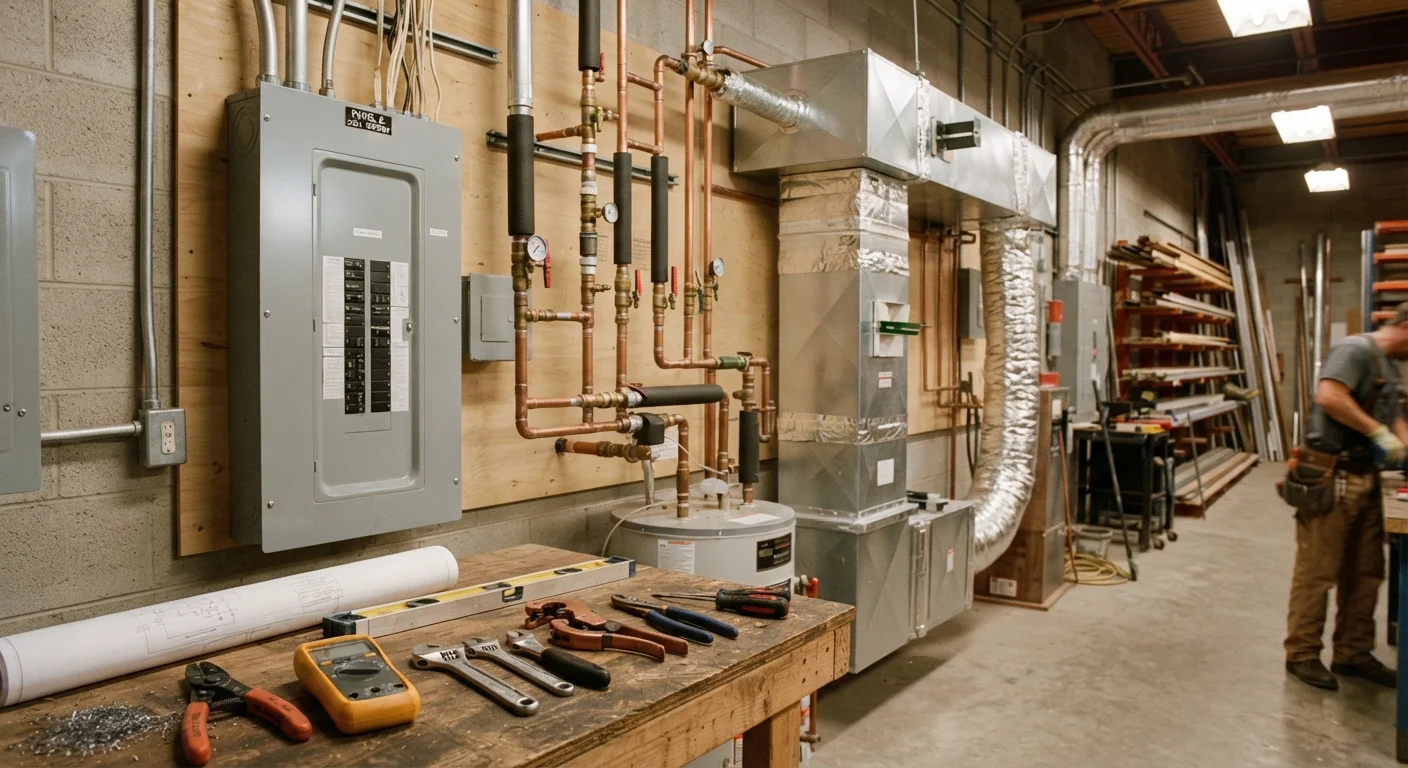
How Skilled Trades Education Is Structured
Unlike four-year degree programs, skilled trades education is built around a learn-while-you-earn model. Most pathways combine classroom instruction with hands-on field hours - a structure designed to ensure that graduates are job-ready on day one. The three primary entry routes are registered apprenticeships, trade or vocational schools, and union-sponsored training programs.
| Apprenticeship Duration (typical) | 3-5 years depending on trade (U.S. Department of Labor) |
| Registered Apprenticeships in U.S. | Over 593,000 active apprentices (DOL Office of Apprenticeship, 2023) |
| Median Electrician Wage | $61,590/year (BLS Occupational Outlook Handbook, 2023) |
| Median Plumber Wage | $61,550/year (BLS Occupational Outlook Handbook, 2023) |
| HVAC Job Growth Outlook | 6% (2022-2032, faster than average) (BLS Occupational Outlook Handbook) |
| Trade School Program Length | 6 months to 2 years (varies by trade) |
| Apprentice Starting Wage (typical) | 40-50% of journeyperson rate (U.S. Department of Labor) |
Each route differs in cost, time commitment, and the credentials it produces. For a broader comparison of these models against traditional college, see the trade school vs. four-year college breakdown.
Registered Apprenticeships
Registered Apprenticeships (RAs) are formal programs overseen by the U.S. Department of Labor or a State Apprenticeship Agency. Apprentices earn wages from the start - typically 40-50% of a journeyperson's rate, rising incrementally - while completing 144+ hours of related technical instruction per year. Programs typically run 3-5 years depending on the trade.
Trade and Vocational Schools
Private and community-college trade programs offer accelerated training - often 6 to 24 months - in a classroom-lab environment. Costs vary considerably: community college certificate programs can run a few thousand dollars, while private trade schools may charge $15,000-$30,000 or more. Graduates still need employer-sponsored field hours to pursue licensure, so this route is often a complement to, rather than a replacement for, apprenticeship.
Union Training Centers
Unions such as the International Brotherhood of Electrical Workers (IBEW) and the United Association of Plumbers and Pipefitters operate their own Joint Apprenticeship Training Committees (JATCs). These programs are generally tuition-free to accepted participants and combine wage-paying work with classroom study. Acceptance is competitive and often requires passing aptitude tests and a waiting period.
Trade-by-Trade Path Overview
While the general structure is similar, each trade has its own licensing ladder, typical program length, and wage trajectory. The table below summarizes key details based on publicly available Bureau of Labor Statistics and Department of Labor data.
Registered Apprenticeship
A formal, employer-driven training program recognized by the U.S. Department of Labor or a state agency. It combines paid on-the-job learning with related technical instruction and leads to a nationally recognized credential.
Journeyperson License
A state-issued credential confirming that a tradesperson has completed their apprenticeship and met the required hours and examination standards to work independently in their trade.
JATC (Joint Apprenticeship Training Committee)
A committee co-managed by union representatives and employers that administers union-sponsored apprenticeship programs, sets curriculum, and oversees apprentice progress.
EPA 608 Certification
A federally required certification for HVAC technicians who work with refrigerants. It is issued under Section 608 of the Clean Air Act and must be obtained before handling regulated refrigerants.
OJT (On-the-Job Training)
Hands-on skill development performed in a real work setting under the supervision of an experienced tradesperson. OJT hours are typically required for licensure in most trades.
Master License
The highest tier of state licensure in trades such as electrical and plumbing, usually requiring additional years of journeyperson experience plus a more rigorous examination. Often required to pull permits or operate independently.
| Trade | Typical Program Length | Key Credential | Median Annual Wage (BLS, 2023) |
|---|---|---|---|
| Electrician | 4-5 year apprenticeship | Journeyman / Master Electrician License | ~$61,590 |
| Plumber | 4-5 year apprenticeship | Journeyman / Master Plumber License | ~$61,550 |
| HVAC Technician | 6 months-2 years (school) + OJT | EPA 608 Certification; state license varies | ~$57,300 |
| Construction Manager / Supervisor | 4-5 year apprenticeship or associate's degree | State license (varies); OSHA 30 common | ~$104,900 (managers); ~$56,000 (laborers) |
Wage data sourced from the U.S. Bureau of Labor Statistics Occupational Outlook Handbook. Figures are national medians and vary significantly by region, employer, and experience level.
Licensing requirements differ by state. Always verify current requirements with your state licensing board before enrolling in a program.
For a field-by-field view of how these trades compare to other career paths, the education paths to career outcomes reference provides a useful cross-sector overview.
Evaluating Cost and Return on Investment
The financial case for skilled trades education is often compelling relative to four-year degrees, but costs and outcomes are not uniform. Key factors to weigh include:
- Tuition and fees: Registered apprenticeships and union programs typically carry no tuition. Community college certificates are the next most affordable option. Private trade school programs vary widely - scrutinize program outcomes and job placement rates before committing.
- Opportunity cost: Even tuition-free apprenticeships require a multi-year time commitment. Apprentice wages are lower than journeyperson wages during training.
- Licensure costs: Exam fees, application fees, and continuing education requirements add ongoing costs after initial training.
- Geographic variation: Wages and demand for specific trades vary considerably by region. Urban markets and states with strong construction activity often command significantly higher pay.
Verify Licensing Requirements Before You Enroll
Electrician, plumbing, and HVAC licensing requirements vary significantly from state to state - and sometimes by municipality. What counts as an approved training program in one state may not satisfy licensing criteria in another. Before selecting any program, confirm current requirements directly with your state licensing board. The U.S. Department of Labor's ApprenticeshipUSA website is a reliable starting point for finding registered programs by trade and location.
Adult learners considering a trade pivot will find practical guidance in our article on education planning for adult learners, which covers realistic timelines and cost strategies for those re-entering training mid-career.
If budget is a primary concern, upskilling on a budget outlines free and low-cost credential paths that can complement or precede a formal apprenticeship application.
The content provided on our blog site traverses numerous categories, offering readers valuable and practical information. Readers can use the editorial team’s research and data to gain more insights into their topics of interest. However, they are requested not to treat the articles as conclusive. The website team cannot be held responsible for differences in data or inaccuracies found across other platforms. Please also note that the site might also miss out on various schemes and offers available that the readers may find more beneficial than the ones we cover.