

How to Use This Reference
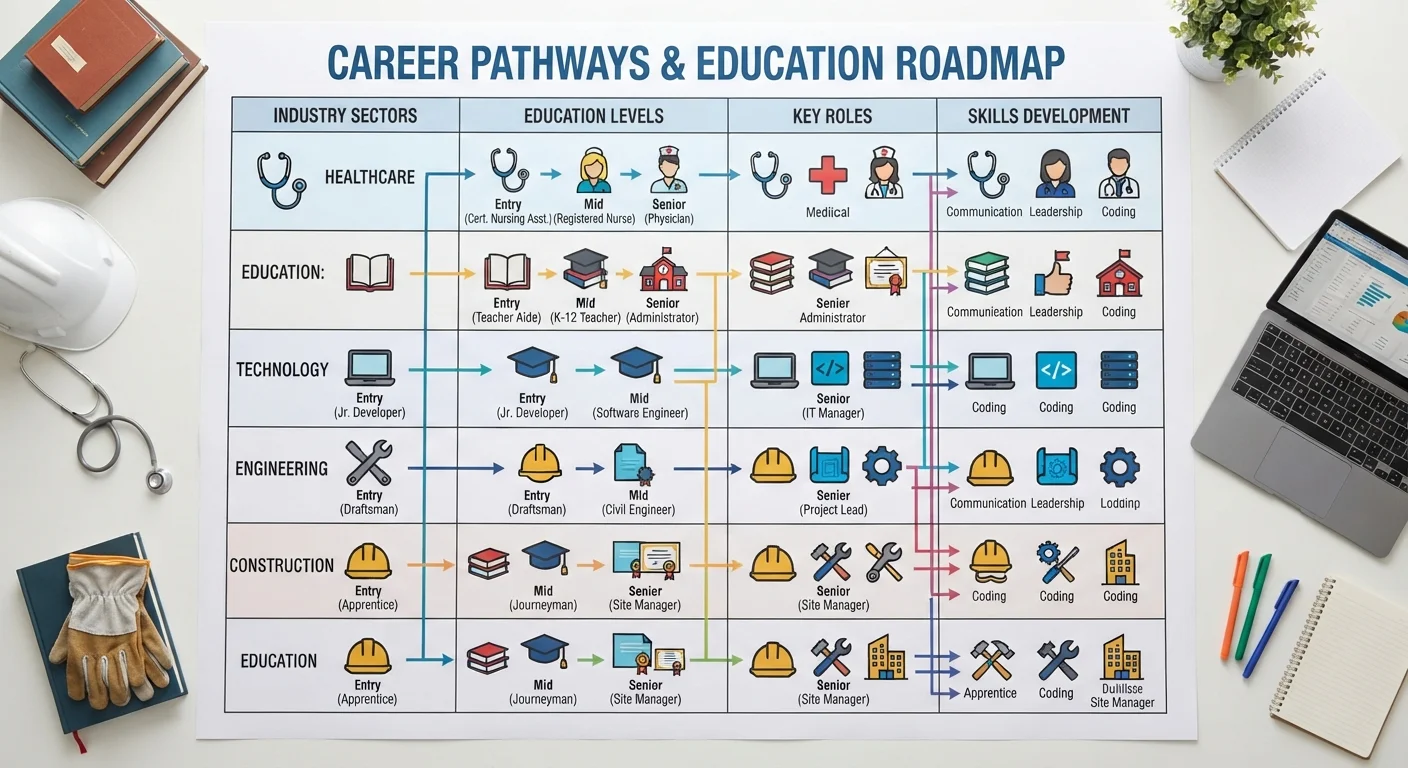
This guide provides a field-by-field snapshot of typical education requirements, estimated costs, and median earnings across major US career sectors. It is designed for readers evaluating whether a four-year degree, a trade credential, a professional certification, or an alternative learning path makes sense for a specific career goal.
All salary figures cited are drawn from publicly available Bureau of Labor Statistics (BLS) Occupational Outlook Handbook data. Education costs are general ranges and vary significantly by institution, state, and funding source. Use this as a starting framework - then verify current figures with official sources before committing to a program.
For a broader cost-benefit comparison between credential types, see how degrees and certifications compare across industries.
| Median weekly earnings, bachelor's degree holders | ~$1,493 (Bureau of Labor Statistics, 2023) |
| Median weekly earnings, high school diploma only | ~$899 (Bureau of Labor Statistics, 2023) |
| Median weekly earnings, associate degree holders | ~$1,058 (Bureau of Labor Statistics, 2023) |
| Average trade school program length | 6 months - 2 years (National Center for Education Statistics) |
| Typical apprenticeship duration | 1 - 5 years (U.S. Department of Labor) |
| Fields where certifications commonly substitute for degrees | IT, cybersecurity, cloud computing, project management |
Field-by-Field Education and Earnings Overview
Healthcare
Healthcare spans a wide earnings and education range. Registered nurses (RNs) typically need at least an associate degree in nursing (ADN) or a Bachelor of Science in Nursing (BSN), with median annual pay around $81,000 (BLS). Physician assistants and nurse practitioners require master's-level credentials and earn substantially more. Medical assistants and phlebotomists often enter the field through short certificate programs (under one year) with median pay in the $37,000-$42,000 range. Physicians and surgeons require a medical degree plus residency - a path that typically takes 11 or more years post-secondary.
Healthcare Credentials Are Strictly Regulated
Unlike tech or business roles, most clinical healthcare positions require state licensure that cannot be bypassed with a portfolio or alternative credential. Before enrolling in any healthcare program, verify that it is accredited by the relevant body (such as ACEN or CCNE for nursing) and that its graduates are eligible to sit for required licensure exams in your state. Accreditation status directly affects your ability to work legally in the field.
Technology
Tech is one of the few fields where employer-recognized certifications and portfolio-based credentials have substantially displaced degree requirements at the entry level. Software developers report a median salary around $124,000 (BLS), and while many hold bachelor's degrees in computer science, a significant share entered through coding bootcamps, self-study, or associate programs. Cloud and cybersecurity roles frequently require vendor certifications (such as those from CompTIA or cloud providers) in addition to or instead of degrees. Low-cost upskilling paths are especially viable in tech.
Skilled Trades
Electricians, plumbers, HVAC technicians, and construction managers typically enter through apprenticeships (3-5 years), trade school programs (6 months-2 years), or union-sponsored training. Median pay for electricians is approximately $61,000; plumbers earn around $61,000 as well, with experienced journeypeople earning considerably more. Startup costs are low compared to four-year degrees. For a detailed breakdown, see skilled trades education paths.
Business and Management
Entry-level business roles often accept bachelor's degrees in any discipline, though business, finance, and accounting majors have structured pathways. An MBA can accelerate advancement into management but carries significant tuition costs ($30,000-$120,000+ depending on program type). Financial analysts report a median salary around $96,000; accountants and auditors, around $79,000 (BLS). CPAs require passing a licensure exam plus education and experience requirements that vary by state.
Education
K-12 teachers in public schools are required to hold a bachelor's degree and a state-issued teaching license in all 50 states. Median annual pay for elementary teachers is approximately $61,000; high school teachers, around $62,000 (BLS). Postsecondary instructors typically need a master's or doctoral degree in their discipline. Alternative certification routes exist in many states for career changers.
Apprenticeship
A structured work-based learning program that combines on-the-job training with related technical instruction, typically lasting 1-5 years and resulting in a nationally recognized credential.
Licensure
A mandatory government-issued authorization required to legally practice in regulated professions such as nursing, teaching, or law. Requirements vary by state.
Industry Certification
A credential issued by a professional association or vendor that validates specific skills or knowledge. Unlike degrees, certifications are typically renewed periodically and focused on a defined skill area.
Median Annual Wage
The salary at which half of workers in an occupation earn more and half earn less. Published by the Bureau of Labor Statistics (BLS), it is a standard benchmark for comparing earnings across fields.
Associate Degree
A two-year undergraduate credential typically awarded by community colleges. It can serve as a terminal degree for some career paths or as a transfer pathway toward a bachelor's degree.
The content provided on our blog site traverses numerous categories, offering readers valuable and practical information. Readers can use the editorial team’s research and data to gain more insights into their topics of interest. However, they are requested not to treat the articles as conclusive. The website team cannot be held responsible for differences in data or inaccuracies found across other platforms. Please also note that the site might also miss out on various schemes and offers available that the readers may find more beneficial than the ones we cover.