

Option A
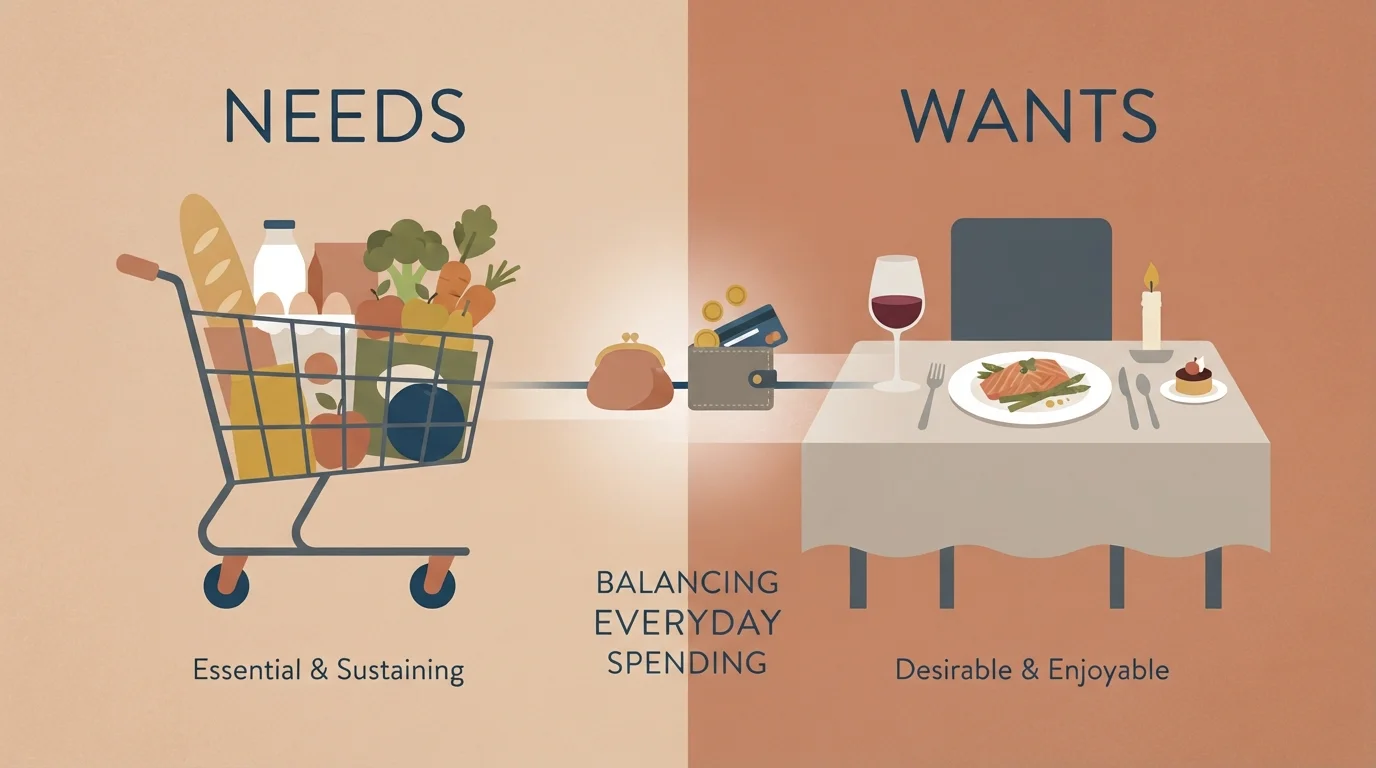
Needs
The non-negotiable foundation of financial survival.
Best for: Covering baseline expenses that sustain health, safety, and the ability to earn income.
Option B
Wants
The discretionary layer that defines quality of life.
Best for: Spending that goes beyond bare survival and reflects personal values, comfort, and enjoyment.
The Appeal - and the Problem - with Needs vs. Wants
The needs-versus-wants framework has anchored personal finance advice for decades. The pitch is intuitive: separate essential spending from discretionary spending, protect the former, reduce the latter, and financial health will follow. Frameworks like the 50/30/20 rule - explored in detail in our comparison of popular budgeting methods - build directly on this split.
The problem isn't that the concept is wrong. It's that reality is messier. A $60 monthly internet plan: need or want? For a remote worker, it's as essential as rent. For a retiree with library access nearby, it might genuinely be optional. The label depends entirely on the person's life, not an abstract rule.
When budgeting advice treats every purchase as cleanly sortable, it sets people up for frustration - or worse, it encourages financial shame for spending that is actually reasonable given their circumstances.
| Criterion | Needs | Wants |
|---|---|---|
| Definition | Required for survival, health, or earning income | Enhances comfort, enjoyment, or lifestyle |
| Examples (clear cases) | Rent, utilities, prescription medication | Luxury subscriptions, dining out, vacations |
| Context-dependence | High - income and life situation matter greatly | High - same purchase may be a need for someone else |
| Risk of mislabeling | Cutting a true need causes real hardship | Keeping a true want crowds out savings goals |
| Role in a healthy budget | Protected baseline; funded first | Intentional allocation after needs are covered |
| Gray zone examples | Internet access, reliable car, work clothing | Gym membership, streaming, social dining |
| Best budgeting treatment | Identify the lowest viable cost to meet the need | Prioritize by personal value, not social expectation |
Where the Line Gets Genuinely Blurry
Several spending categories resist easy classification, and pretending otherwise does readers a disservice.
Transportation
A car payment is often labeled a want. But for someone commuting 45 minutes to a job in a city with no meaningful public transit, a reliable vehicle is functionally a need. The same expense, different verdict - because context determines necessity.
Food
Groceries are obviously a need. But the type of groceries matters. Fresh produce, dietary-specific foods for a health condition, or ready-made meals purchased by a single parent working two jobs - these aren't equivalent to weekend restaurant splurges, even though budgeting apps often dump them into the same "food" bucket. Our article on spending categories that budgets get wrong explores how this lumping silently undermines otherwise solid plans.
Mental health and social connection
A streaming subscription, a gym membership, or a weekly dinner out with friends may look like wants on paper. But social isolation and chronic stress carry real costs - financial and otherwise. Spending that meaningfully supports wellbeing isn't automatically frivolous.
~33%
US adults with no emergency savings
Bankrate's annual emergency savings survey has consistently found roughly a third of American adults have no emergency fund, highlighting how blurred spending priorities affect financial resilience.
50/30/20
Classic needs-wants-savings split
The 50/30/20 rule, popularized in budgeting literature, allocates 50% to needs, 30% to wants, and 20% to savings - a guideline that assumes clean categorization most real budgets cannot achieve.
4 in 10
Americans who would struggle with a $400 emergency
Federal Reserve survey data has shown roughly 4 in 10 US adults would have difficulty covering a $400 unexpected expense, underscoring the stakes of miscategorizing needs as wants and cutting them.
A More Useful Mental Model
Rather than forcing every purchase into a binary, a more practical approach asks three questions:
- What happens if I don't spend this? If the consequence is genuine hardship - lost income, health risk, housing instability - it's a need. If the consequence is disappointment or inconvenience, it's likely a want.
- Does this spending reflect my actual values? Wants are not the enemy of financial health. Intentional wants - those aligned with what you genuinely care about - are a legitimate part of a functional budget. Unexamined wants, spent out of habit or social pressure, are where the real leakage happens.
- Is there a lower-cost version that meets the same underlying need? Sometimes the need is real but the specific purchase is not the only path to meeting it. This is where thinking through price versus quality tradeoffs becomes genuinely useful rather than just a guilt exercise.
This approach is especially relevant if you are budgeting on a tight income, where the stakes of miscategorization are higher and the margin for error is smaller.
Putting It Into Practice Without the Guilt
The goal of any budgeting framework is better decisions - not perfect categorization. If the needs-versus-wants label helps you spot a subscription you forgot you had or a habit purchase you don't actually enjoy, it's done its job. If it makes you feel bad for spending money on things that genuinely matter to you, it's working against you.
A more durable habit is periodic spending review: look at the past 30 days, identify which purchases you would make again without hesitation, which you regret, and which you barely noticed. That honest audit usually reveals more actionable insight than any labeling system. The real tradeoffs of strict budgeting are worth understanding before committing to a rigid approach.
The needs-versus-wants framework is a starting point, not a verdict. Use it to prompt reflection, not to impose judgment on spending that reasonable people in your situation would make.
This article is for general informational purposes only and does not constitute personalized financial advice. Consider consulting a qualified financial professional for guidance specific to your situation.
The content provided on our blog site traverses numerous categories, offering readers valuable and practical information. Readers can use the editorial team’s research and data to gain more insights into their topics of interest. However, they are requested not to treat the articles as conclusive. The website team cannot be held responsible for differences in data or inaccuracies found across other platforms. Please also note that the site might also miss out on various schemes and offers available that the readers may find more beneficial than the ones we cover.