

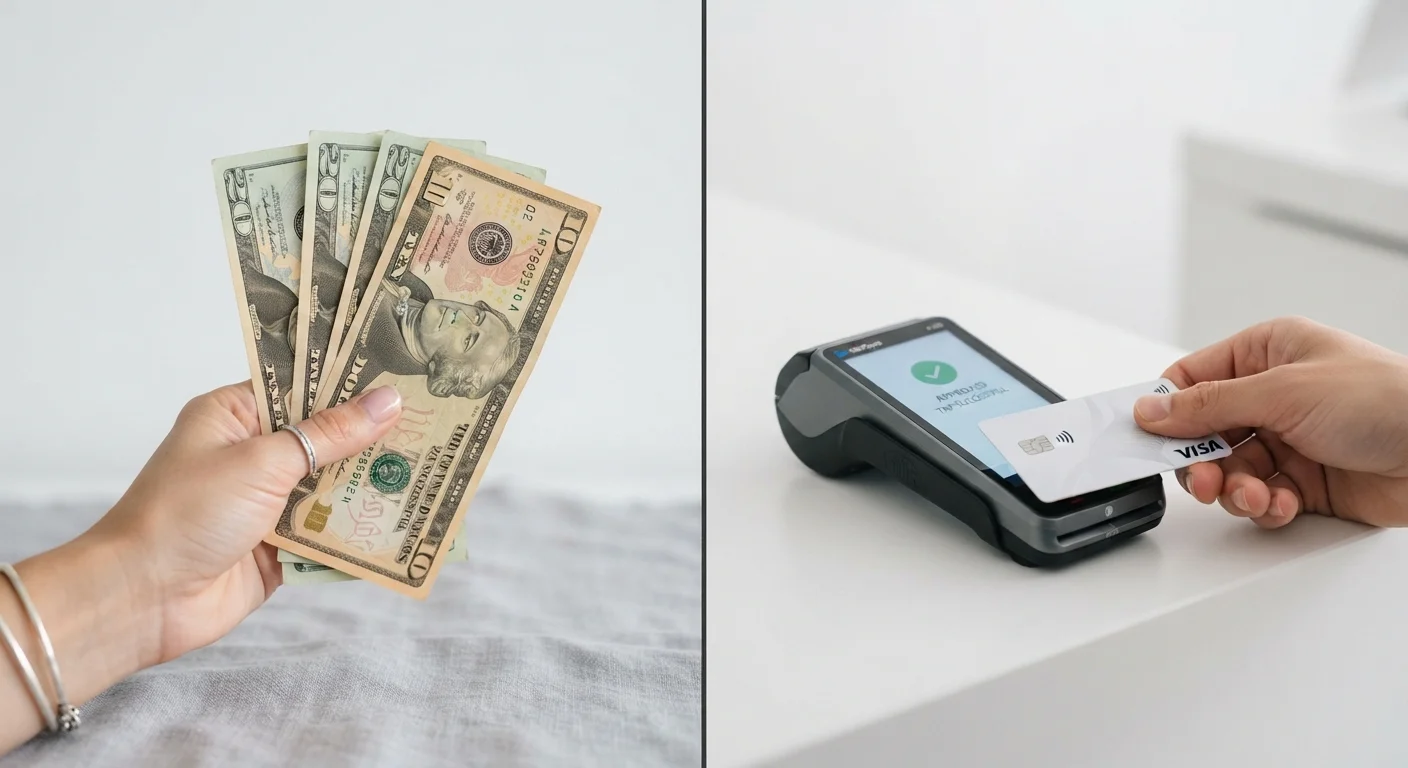
Option A
Cash
The tangible, friction-based spending method.
Best for: Shoppers who want a physical, built-in spending limit and a stronger psychological brake on impulse purchases.
Option B
Card (Credit or Debit)
The convenient, rewards-eligible digital alternative.
Best for: Organized spenders who track purchases closely and want to benefit from protections, rewards, or credit-building opportunities.
The Psychology of Paying: Why Method Matters
Most people assume a dollar is a dollar regardless of how it's handed over. Behavioral research suggests otherwise. Studies in consumer psychology - including work frequently cited from MIT and Carnegie Mellon - have found that the act of paying with cash triggers a measurable emotional response, sometimes called the "pain of paying." Swiping a card, by contrast, creates more psychological distance from the transaction, which can make spending feel less real in the moment.
This isn't a character flaw - it's how human brains respond to abstract versus concrete representations of money. When you hand over a $50 bill, your brain registers the loss directly. When you tap a card, that same $50 feels more like a future concern. Understanding this dynamic is the first step to working with it, rather than against it. For a deeper look at the cognitive patterns behind spending, see the psychology behind why we overspend.
| Criterion | Cash | Card (Credit or Debit) |
|---|---|---|
| Spending psychology | Higher pain of paying; natural brake | Lower friction; easier to overspend |
| Fraud protection | None - lost cash is gone | Strong federal protections; dispute rights |
| Spending records | Manual tracking only | Automatic transaction history |
| Rewards or benefits | None | Cashback, points, travel miles possible |
| Hard spending limit | Yes - what's in your wallet | No - credit line or overdraft risk |
| Credit building | No impact on credit history | Responsible use builds credit profile |
| Merchant acceptance | Near universal; no tech needed | Very wide; occasional minimums apply |
Practical Trade-Offs: Security, Convenience, and Cost
Beyond psychology, cash and cards differ meaningfully in practical terms. Cash is anonymous, accepted almost everywhere, and imposes no transaction fees for the payer at most merchants. But it offers zero recourse if lost or stolen, no purchase protection, and no record-keeping beyond what you manually track yourself.
Cards - both credit and debit - generate automatic transaction records, which makes budget review straightforward. Credit cards in particular carry strong federal consumer protections under the Fair Credit Billing Act, including the right to dispute unauthorized charges. Many also offer extended warranties and purchase protection on qualifying purchases. The trade-off is temptation: the ease of card spending can erode discipline unless supported by consistent tracking habits.
~83%
US transactions now non-cash
According to the Federal Reserve's Diary of Consumer Payment Choice, cash accounted for roughly 17% of all US transactions in a recent survey year, with cards and digital payments dominating.
$0
Max liability for unauthorized credit card charges
Under the Fair Credit Billing Act, consumers who report unauthorized credit card charges promptly have zero liability, a protection that does not extend to lost cash.
Higher tips
Tipping tendency with cards vs. cash
Multiple hospitality studies have found that customers paying by card tend to leave larger tips on average than those paying with cash, consistent with reduced pain-of-paying effects.
It's also worth noting that carrying large amounts of cash has its own risks, especially when traveling. If international spending is on your radar, it may be worth reading about travel cards vs. cash-back cards for trip spending to understand which approach fits your travel style.
Building a Strategy That Works for You
The most effective approach for many households isn't a binary choice - it's a deliberate split. Using cash for high-risk discretionary categories (like restaurants, bars, or impulse shopping) provides a behavioral guardrail, while using a card for fixed, planned expenses (like utilities, subscriptions, or groceries with a set weekly budget) lets you capture rewards and maintain records without much added risk.
This kind of hybrid strategy complements formal budgeting methods. Whether you prefer envelopes of physical cash or a digital app, the goal is the same: intentional spending. For a comparison of those two approaches, see cash budgeting vs. digital tracking apps. And if you want a broader framework for getting more value from every dollar, the complete guide to spending wisely is a useful resource to bookmark.
Debit Cards Occupy a Middle Ground
Debit cards pull directly from your checking account, which provides more real-money awareness than credit but less than physical cash. They typically offer fewer consumer protections than credit cards - the Electronic Fund Transfer Act governs debit disputes with different timelines and liability rules than the Fair Credit Billing Act. If you carry a debit card for convenience, understanding those differences is worthwhile before relying on it for large or high-risk purchases.
Ultimately, the right payment method is the one that keeps your spending aligned with your actual priorities - not the one that earns the most points or feels the most convenient in the moment. Honest self-assessment about your habits matters more than any general rule.
This article is for general informational purposes only and does not constitute personalized financial advice. For guidance specific to your situation, consult a qualified financial professional.
The content provided on our blog site traverses numerous categories, offering readers valuable and practical information. Readers can use the editorial team’s research and data to gain more insights into their topics of interest. However, they are requested not to treat the articles as conclusive. The website team cannot be held responsible for differences in data or inaccuracies found across other platforms. Please also note that the site might also miss out on various schemes and offers available that the readers may find more beneficial than the ones we cover.