

Why Subscription Spending Is So Hard to See Clearly
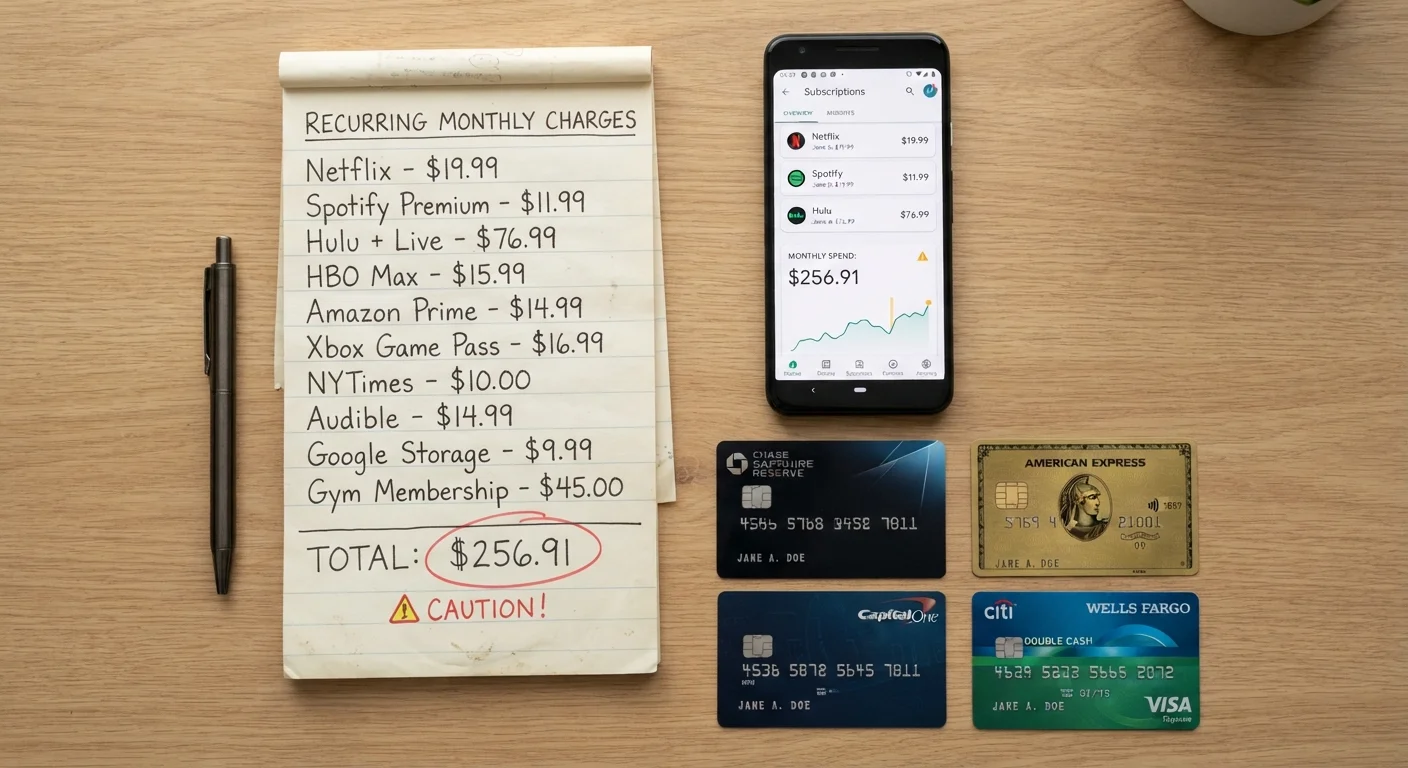
Subscription spending has a compounding invisibility problem. Each individual charge is small enough to pass unnoticed, but the cumulative total can be surprisingly large. Research from West Monroe Partners found that consumers routinely underestimate their monthly subscription spending - sometimes by a factor of two or more - because the charges are spread across billing cycles, payment methods, and email accounts.
The business model is engineered with this dynamic in mind. Auto-renewal removes any active decision to keep paying. Low monthly prices reduce urgency to cancel. And cancellation flows are frequently designed with extra steps, confirmation screens, and retention offers - friction intended to make stopping harder than starting.
Understanding this context isn't about cynicism. It's about knowing what you're up against so you can build habits that keep your spending intentional. For a broader look at how small recurring costs accumulate in other areas of life, see budgeting basics for practical frameworks you can apply immediately.
This Is General Financial Information
The guidance in this article is educational and does not constitute personalized financial advice. Every household's situation is different. For decisions specific to your finances, consult a qualified financial adviser or credit counselor.
The Most Common Subscription Mistakes - and How to Fix Them
The mistakes below aren't signs of carelessness. They're predictable responses to how subscription services are structured. Recognizing the pattern is the first step to breaking it.
Failing to track subscriptions in one centralized place.
Why it happens: Most people sign up for services at different times, across different devices and email accounts, so charges scatter across multiple cards and inboxes with no single view.
Letting free trials convert to paid plans without a decision point.
Why it happens: Free trials are structured to require an upfront payment method and minimal effort to cancel, so inertia does the work for the service provider.
Paying for overlapping services that cover the same need.
Why it happens: Adding a new service often feels justified in the moment - a better UI, an exclusive title, a bundled offer - without consciously retiring the one it replaces.
Evaluating subscriptions by sticker price rather than cost-per-use.
Why it happens: A $15-per-month fee sounds modest in isolation, but if you used a fitness app twice in three months, you effectively paid $22.50 per session - more than a drop-in gym class.
Ignoring annual plans that auto-renew at full price.
Why it happens: Annual subscriptions bill infrequently, so they fall off the radar between charge dates - and the lump-sum renewal can be a jarring surprise.
Sharing account credentials instead of using official household or family plans.
Why it happens: Password-sharing feels like a free workaround, but it exposes your account credentials and can violate terms of service, risking account suspension.
Subscription creep also appears in less obvious places. Hidden costs of online learning - including software subscriptions and platform fees - follow the same accumulation logic and deserve the same scrutiny.
Building a Sustainable Subscription Audit Habit
A one-time purge of subscriptions is useful, but the more durable move is building a recurring review into your financial routine. Consider a quarterly cadence: pull up your bank and credit card statements, reconcile every recurring charge against your master list, and apply a simple test to each one - did I use this enough to justify the cost?
~$219/mo
Average US household subscription spend
A 2022 survey by C+R Research found US consumers spent an average of roughly $219 per month on subscriptions, though many estimated they spent far less.
2x
How much consumers underestimate subscription costs
Research by West Monroe Partners found consumers consistently underestimate their monthly subscription spending by approximately half when asked to recall charges without reviewing statements.
If the answer is no, cancel or downgrade immediately rather than planning to cancel later. "Later" is where subscription creep lives. For households tracking spending across multiple cost categories, the same audit logic applies to vehicle costs - the annual car cost audit checklist demonstrates how a structured review surfaces spending that feels routine but adds up meaningfully over time.
Finally, subscriptions aren't the only place where small recurring or optional charges accumulate. Checkout add-ons like warranties and express shipping deserve the same deliberate evaluation before you agree to them.
This article is for general informational purposes only and does not constitute personalized financial advice. Consult a qualified financial professional for guidance specific to your situation.
The content provided on our blog site traverses numerous categories, offering readers valuable and practical information. Readers can use the editorial team’s research and data to gain more insights into their topics of interest. However, they are requested not to treat the articles as conclusive. The website team cannot be held responsible for differences in data or inaccuracies found across other platforms. Please also note that the site might also miss out on various schemes and offers available that the readers may find more beneficial than the ones we cover.