

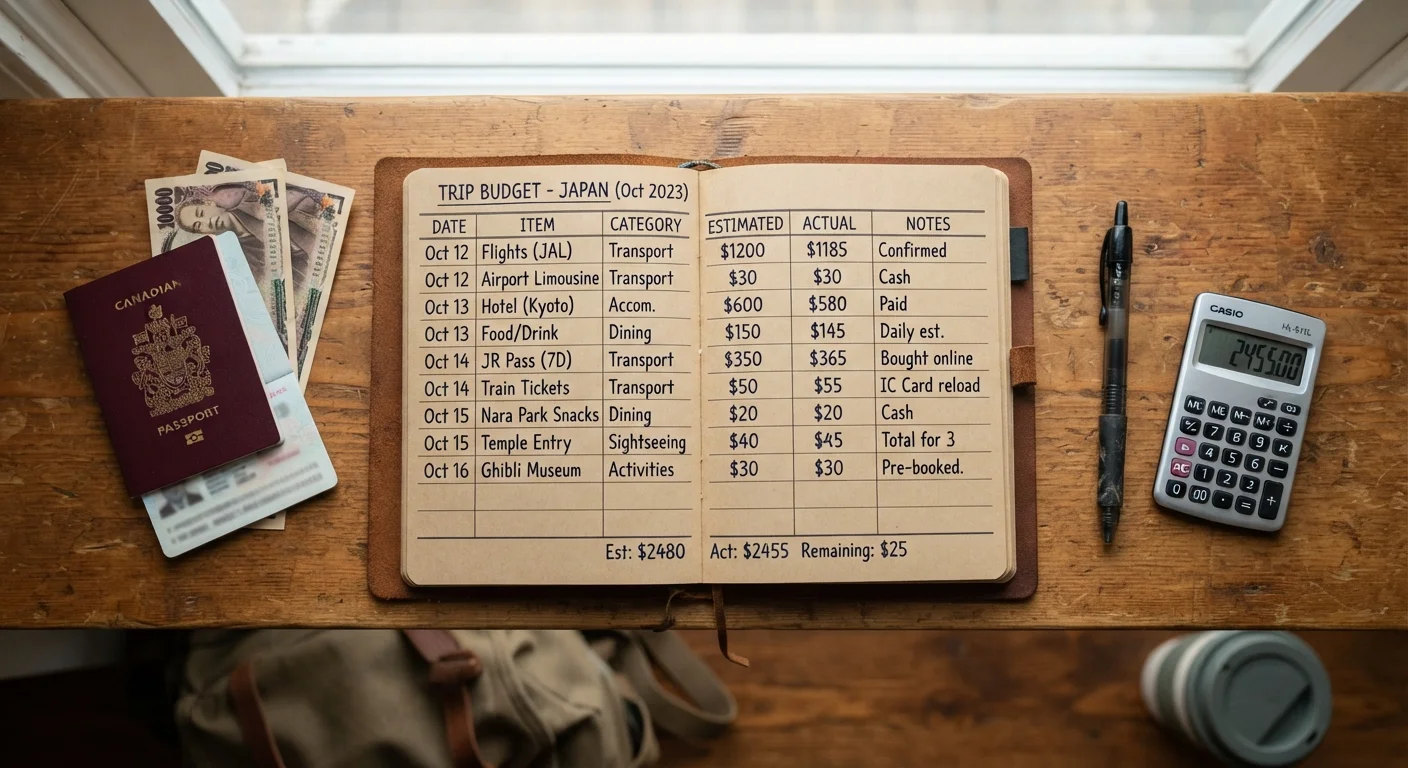
Why Most Travel Budgets Break Down Fast
The gap between a pre-trip budget and actual spending is rarely random. It follows predictable patterns: travelers lock in flights and accommodation, treat those as the whole budget, then discover that meals, local transport, entry fees, and incidental costs weren't accounted for at all. The result is a budget that's technically accurate on paper for two line items and completely blind to the rest of the trip.
A secondary failure mode is building a budget using best-case prices - off-peak averages, home-country food costs, or airport rates as proxies for everything. Real trip spending is messier. Prices vary by neighborhood, time of day, and how exhausted you are when you make a decision. A budget that can't flex with those realities isn't a budget - it's a wish.
The fix isn't to budget more conservatively across the board. It's to structure your budget with more precision: separate categories, realistic local benchmarks, and a genuine contingency reserve. The steps below walk through exactly that. For those starting from scratch with travel finances, the Trip Planning Essentials hub is a useful broader reference.
Spreadsheet (Google Sheets or Excel)
Used to organize budget categories, project costs, and track actual spending against estimates.
Notes app or expense-tracking app
Used for logging individual purchases in real time while traveling.
Destination cost-of-living reference (e.g., Numbeo or similar public databases)
Used to benchmark realistic local prices for food, transport, and accommodation before departure.
How to Build the Budget
The following steps are designed to be completed before departure, with step five and six applied during the trip itself. You don't need specialized software - a spreadsheet and a notes app are sufficient.
What you will need
List Every Cost Category Before Estimating a Single Number
Most budgets fail at the category stage - travelers list flights and hotels, then stop. Before you assign any dollar amounts, write out every possible spending area: transportation to and from the airport, accommodation, meals, local transit, activities and entrance fees, travel insurance, visa fees if applicable, souvenirs, tips, and communication costs (SIM cards, Wi-Fi). Omitting a category entirely is how budgets collapse on day two.
For a broader foundation on planning your trip finances from scratch, the first-time budget traveler guide covers the full planning mindset in detail.
Separate Fixed Costs from Variable Costs
Fixed costs are the amounts you've already paid or can price precisely: flights, pre-booked accommodation, travel insurance premiums, and any prepaid tour reservations. Variable costs are estimates - meals, local transport, entrance fees, and discretionary spending. Keeping these in separate columns matters because they require different kinds of management. Fixed costs are locked in; variable costs are where your real budget discipline happens on the road.
Research Real Local Prices - Not Tourist-Area Prices
Plugging in generic per-day estimates without destination-specific research is where most budgets diverge from reality. Use public cost-of-living databases, traveler forums, and recent trip reports to benchmark actual prices for meals, transit, and activities in each specific location. A sit-down lunch in a local neighborhood can cost a fraction of the same meal near a major tourist site. Food costs in particular deserve careful research - see strategies for eating affordably without sacrificing quality for practical tactics.
Build In a Contingency Buffer
Add a contingency line item of 10-15% of your total projected trip cost. This isn't pessimism - it's how real budgets survive missed connections, surprise entry fees, medical needs, or simply a day when plans change. Label it clearly as a contingency, not a slush fund, so you treat it as a reserve rather than spending it by default.
The same pattern that causes personal budgets to collapse applies to travel budgets. The reasons budgets fail early maps directly onto common trip-budget failures.
Set a Daily Spending Target and Track It in Real Time
Divide your total variable budget by the number of trip days to establish a daily target. Each evening, log what you actually spent that day against that target. A single overspend day isn't a crisis - but if you're consistently running 20% over, you need to know by day three, not day nine. A simple notes app tally works fine; elaborate tracking tools are only useful if you'll actually use them consistently.
Review and Adjust Mid-Trip, Not Just at the End
A trip budget isn't a document you write once and file. Schedule a brief review at the halfway point of your trip: are your variable estimates holding? Are any categories consistently over or under? Use that data to reallocate - if you're spending less on food, you may have room to add a paid activity. If transit costs are higher than projected, cut discretionary spending proportionally. The anatomy of a well-structured itinerary discusses how flexible planning supports this kind of real-time adjustment.
A Budget Is Only as Good as Your Tracking
Writing a pre-trip budget without a plan to monitor it daily is the single most common reason travel budgets collapse. Checking your totals only at the end of a trip is a post-mortem, not a budget. Build in a daily five-minute review - even a simple notes app tally works - so you can course-correct before overspending compounds.
Don't Ignore Currency and Fee Costs
Foreign transaction fees, ATM withdrawal charges, and unfavorable airport exchange rates can add meaningful costs that most pre-trip budgets never account for. Research your card's fee structure before departure and factor those costs in as a fixed line item. For more on how payment method affects trip spending, see how travel and cash-back cards compare.
Anchor Your Budget to a Daily Per-Person Rate
Once you've mapped all categories, divide your total by the number of travel days and people. This daily rate becomes your most useful on-the-road reference point. If you blow it on day three, you know immediately - not when you're checking your bank statement back home.
What to Do When the Budget Isn't Holding
Even a carefully built budget will face pressure at some point. When your daily tracking shows consistent overspending, the response should be systematic rather than reactive. Identify which single category is driving the overrun - it's almost always one or two, not all of them simultaneously. Then make a deliberate trade-off: reduce spending in a lower-priority category rather than trying to cut everything by a small amount, which rarely sticks.
If the overrun is in food, shifting toward markets and local lunch spots can close the gap quickly without sacrificing much. If it's in accommodation, revisiting your options mid-trip - including whether a hostel or shared rental makes sense for remaining nights - can realign costs. For road trips specifically, knowing when to plan rigidly versus stay flexible affects how much budget exposure you carry day to day.
The goal isn't perfection - it's awareness. A budget that gets adjusted mid-trip and finishes within 10% of target has done its job. That outcome is far more achievable than most travelers expect when they build the budget correctly from the start.
For guidance on organizing the documents and payment records that support your budget, how to manage trip documents covers both analog and digital approaches.
This article provides general travel budgeting information for educational purposes. Prices, fees, and financial conditions vary by destination and change over time; always verify current figures from official or local sources before traveling. This is not personalized financial advice.
The content provided on our blog site traverses numerous categories, offering readers valuable and practical information. Readers can use the editorial team’s research and data to gain more insights into their topics of interest. However, they are requested not to treat the articles as conclusive. The website team cannot be held responsible for differences in data or inaccuracies found across other platforms. Please also note that the site might also miss out on various schemes and offers available that the readers may find more beneficial than the ones we cover.