

Why Travel Budgets Quietly Bleed Out
Most travelers don't overspend on one big item - they lose money a little at a time, across charges they didn't notice, didn't expect, or didn't know to question. A $25 resort fee here, a foreign transaction charge there, an airport snack that costs three times what it should: none of it feels catastrophic in the moment, but added up over a week-long trip, these costs routinely push budgets 15-25% over plan.
The problem isn't carelessness. It's that many of these costs are deliberately obscured or normalized through industry convention. Understanding them in advance is the only reliable defense. See also: common travel money myths that compound the problem by giving travelers false confidence about where their money is going.
Accepting dynamic currency conversion (DCC) at payment terminals abroad.
Why it happens: Merchants and ATMs frame DCC as a convenience - "pay in your home currency" sounds reassuring. Most travelers don't realize they're handing exchange-rate control to the merchant, who applies a marked-up rate.
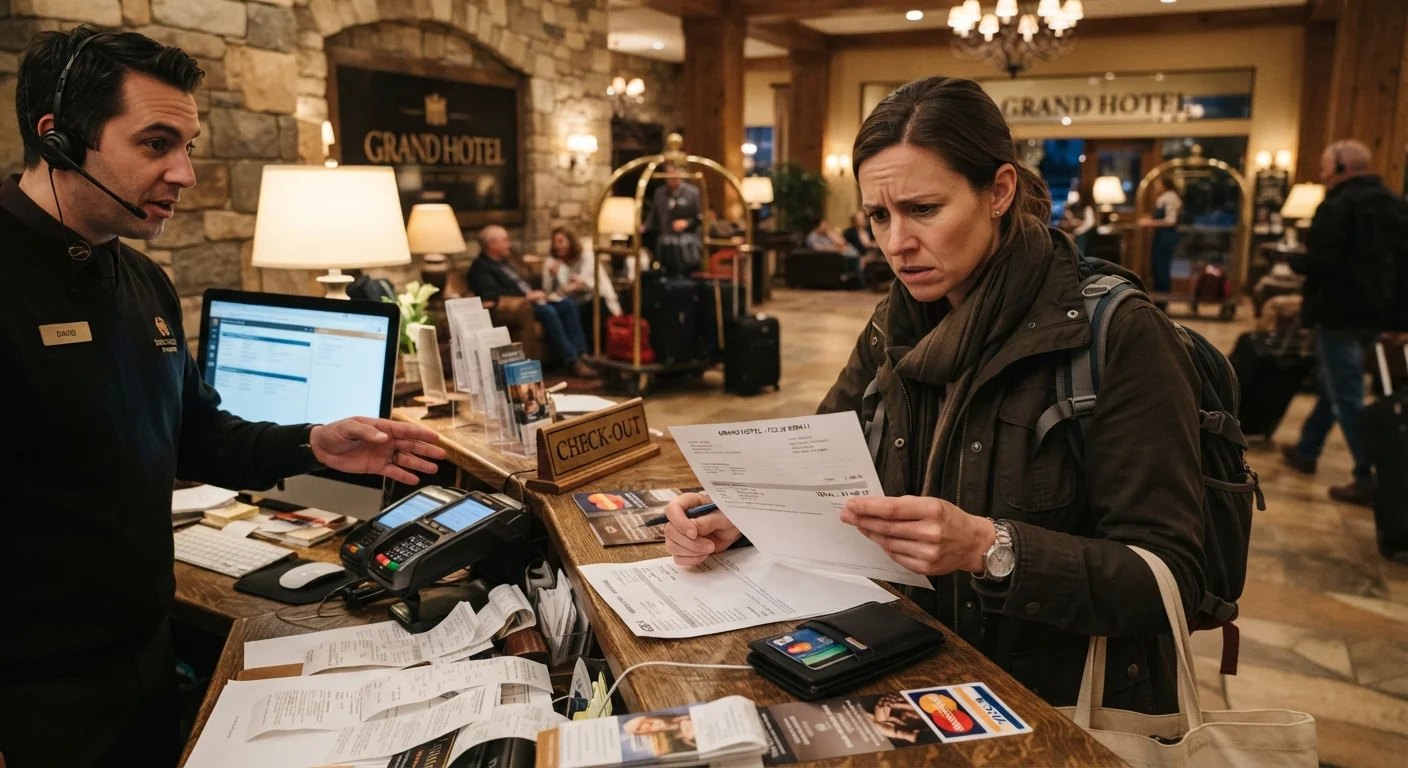
Treating the advertised hotel rate as the final nightly cost.
Why it happens: Mandatory resort fees, destination fees, and amenity fees are frequently added at checkout rather than shown in the booking price. Some fees apply even when the guest never uses the amenities they nominally cover.
Eating and shopping in immediately airport- or landmark-adjacent zones without checking alternatives.
Why it happens: Hunger, fatigue, and convenience override price awareness. Tourist-zone businesses operate with near-captive audiences and price accordingly - often 40-100% above neighborhood equivalents.
Ignoring checked bag fees when comparing flight prices.
Why it happens: Airfare comparison tools typically display base fares, and bag fees are listed separately - often deep in the booking flow. The fare that looks cheapest can become the most expensive once luggage is factored in.
Using hotel or resort Wi-Fi without checking whether it's included.
Why it happens: Wi-Fi access is so standard in everyday life that most travelers assume it's included in the room rate. Some properties - particularly convention hotels - still charge daily connectivity fees of $15-$30.
Skipping travel insurance and underestimating cancellation or medical costs abroad.
Why it happens: Insurance feels like an abstract cost with uncertain payoff, so travelers skip it to save money upfront. The risk only becomes concrete when something actually goes wrong.
The Charges Most Travelers Discover Too Late
Hidden costs cluster in predictable places - accommodations, airports, currency exchange points, and tourist-dense dining zones. Once you know the patterns, you can anticipate and sidestep most of them before they hit your card.
~$45/night
Average US resort fee at affected properties
Analysis by consumer travel researchers has found mandatory resort fees at many US properties averaging around $45 per night, often disclosed only at checkout.
3-8%
Typical DCC exchange rate markup
Industry estimates suggest dynamic currency conversion markups typically add 3-8% above interbank rates, compared to the 0-3% range charged by most travel-optimized cards.
If you want a fuller picture of where travel dollars actually flow, a category-by-category spending breakdown can help you see which costs are fixed and which are genuinely negotiable. For structured pre-trip planning that accounts for these variables, building a trip budget that holds up on the road offers a practical framework.
Airport ATMs and Currency Exchange Kiosks
Airport currency exchange kiosks and ATMs operated by third-party providers frequently apply the steepest conversion rates of any point in a trip. If you need local cash on arrival, withdraw only what you need for immediate transportation, then find a bank-affiliated ATM in town. Check your card's international ATM fee structure before you travel - some accounts reimburse foreign ATM fees entirely.
The broader lesson is that travel pricing is rarely as transparent as it appears at the point of booking. Advertised rates almost always exclude at least one mandatory charge - and the gap between headline price and final cost tends to widen the more convenient or tourist-facing the service. Applying the same skepticism you'd use when reading a retail price tag will serve you well on the road.
This article is for general informational purposes only and does not constitute financial or legal advice. Verify all fees, policies, and entry requirements directly with relevant providers and official government sources before traveling.
The content provided on our blog site traverses numerous categories, offering readers valuable and practical information. Readers can use the editorial team’s research and data to gain more insights into their topics of interest. However, they are requested not to treat the articles as conclusive. The website team cannot be held responsible for differences in data or inaccuracies found across other platforms. Please also note that the site might also miss out on various schemes and offers available that the readers may find more beneficial than the ones we cover.