

Why the Sticker Price Is Just the Starting Point
Walk into a dealership, agree on a vehicle price, and then watch the number climb by the time you reach the finance office. This experience is so common it has its own industry nickname: "payment packing." The advertised price - and even the price you negotiate - rarely reflects what you'll actually pay.
Understanding where extra charges come from is not about assuming bad faith. Some fees are legitimate and required by law. Others are discretionary, inflated, or tacked on without clear disclosure. The goal here is to help you tell them apart. For a broader look at how these costs compound over time, see what a vehicle actually costs year over year.
Below are the most common hidden or inflated fees to scrutinize before signing anything.
Documentation Fee
The "doc fee" covers the dealer's cost to process paperwork - title, registration, and sales contracts. In some states, this fee is capped by law (California limits it to $85; Florida allows up to $999). In states without a cap, dealers set their own amount, and $500-$900 is not unusual.
The doc fee is generally non-negotiable at many dealerships, but you can factor it into your overall price negotiation. If a dealer charges $800 and a competitor charges $200, that $600 difference is real money - get itemized quotes from multiple dealers before committing.
In states without a cap, doc fees can legally reach $900 or more - shop around accordingly.
Dealer-Installed Accessories and "Market Adjustments"
Dealers sometimes add accessories to vehicles before they reach the lot - paint sealant, fabric protection, window tinting, or cargo mats - and then charge a marked-up price for them. A paint protection package that costs a dealer $150 to apply may appear on the window sticker as $799.
"Market adjustment" is a separate line item added during periods of high demand. It's essentially a premium above MSRP with no corresponding product or service. Both can often be negotiated down or removed entirely, especially when demand softens.
Dealer-installed accessories are frequently marked up several times their actual cost.
Financing Rate Markup
When a dealer arranges your financing through a third-party lender, they often receive a "dealer reserve" - a portion of the interest rate markup above what the lender actually requires. For example, if a lender approves you at 5% APR, the dealer might quote you 7%, keeping the difference as additional profit spread across your loan term.
Getting pre-approved through your own bank or credit union before visiting a dealership gives you a baseline rate to compare against dealer financing. If the dealer can beat your pre-approved rate, great - but you'll know if they can't.
A 2-percentage-point rate markup on a $30,000 loan can cost hundreds more in interest over five years.
GAP Insurance and Extended Warranties Through the F&I Office
GAP insurance (Guaranteed Asset Protection) covers the difference between what you owe on a loan and the vehicle's actual cash value if it's totaled or stolen. It can be a worthwhile product - but dealers often charge two to three times more for it than what your own auto insurer would charge for the same coverage.
The same markup dynamic applies to extended service contracts (often called "extended warranties"). These are not manufacturer warranties - they're dealer-sold products with varying coverage terms. Review the contract terms carefully, compare prices, and consider whether the coverage period overlaps with existing manufacturer warranty before agreeing.
GAP coverage sold in the finance office can cost significantly more than the same product from your insurer.
Advertising Fees
Some dealers pass along regional advertising fees - costs they contribute to manufacturer or dealer group marketing campaigns - as a line item on the buyer's contract. These fees are generally not negotiable, but they are worth identifying. They typically range from $100 to $500 and may appear as "regional advertising fee" or "advertising assessment."
While this fee exists, knowing it's there allows you to include it in your out-the-door price calculation rather than being surprised at signing.
Advertising fees passed to buyers can add several hundred dollars to the purchase total.
Nitrogen Tire Fill Upcharges
Nitrogen-filled tires retain pressure slightly more consistently than air-filled tires in certain conditions - but the benefit for everyday driving is minimal. Dealers sometimes pre-fill tires with nitrogen and then charge $150-$300 on the window sticker for the privilege.
Standard air is approximately 78% nitrogen by composition. The practical difference for most passenger vehicle drivers is negligible, and the charge is often non-negotiable because it's already been applied. Awareness of this upcharge is useful when comparing out-the-door prices across dealers.
Nitrogen fill upcharges are among the lowest-value add-ons routinely included in window stickers.
How to Protect Yourself Before You Sign
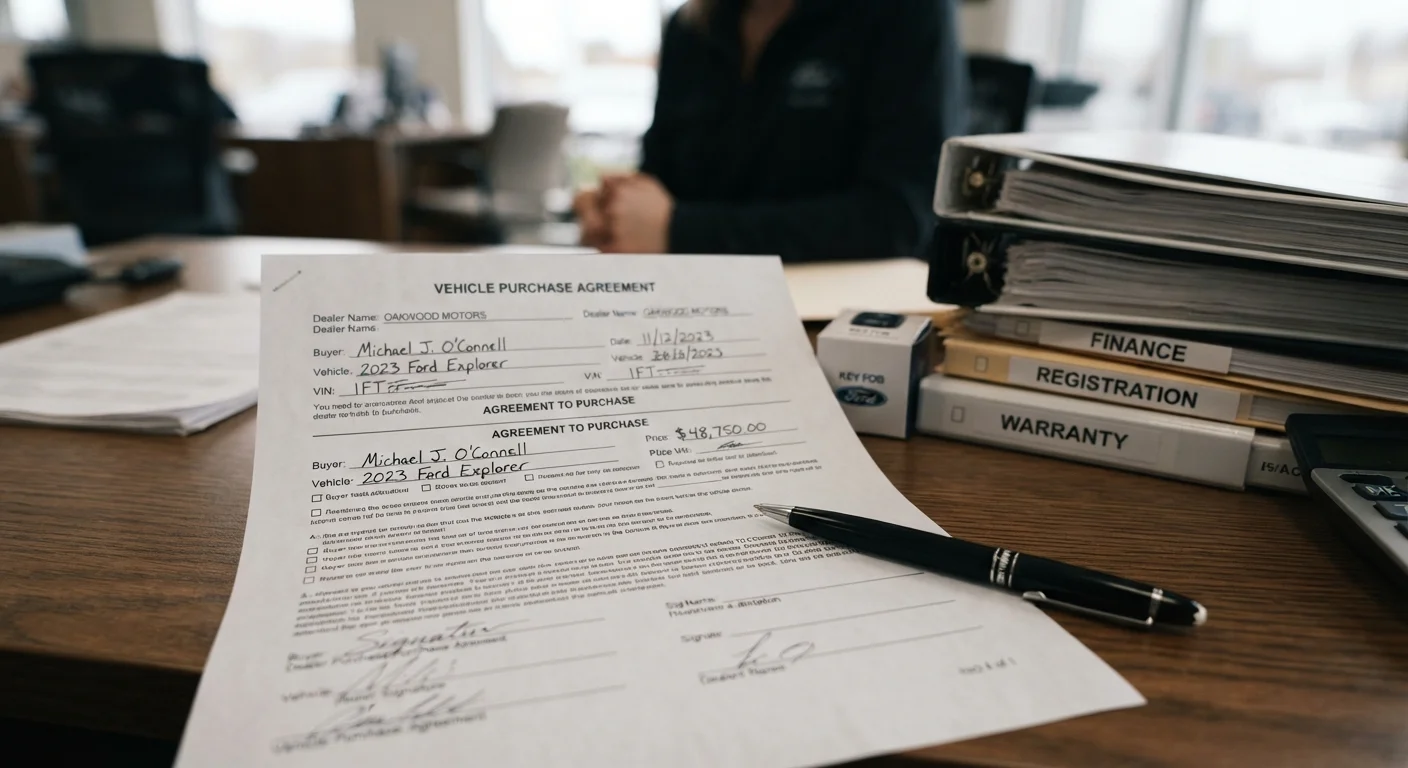
The most effective defense is reviewing every line item on the purchase agreement - not just the monthly payment. Dealers are required to disclose all fees in writing, but they are not required to explain them unprompted. Ask for an itemized out-the-door price before any financing discussion begins.
Request an Itemized Out-the-Door Quote in Writing
Before any financing conversation begins, ask the dealer to provide a complete written breakdown of all charges - including fees, add-ons, taxes, and title costs - that make up the total out-the-door price. This single step makes it much easier to identify unfamiliar line items and compare offers across dealerships on an apples-to-apples basis. If a dealer is unwilling to provide this upfront, treat that as useful information.
If a charge isn't something you asked for and can't be clearly explained, ask to have it removed. Some fees will disappear with a simple request; others are embedded in the contract structure and require more pushback. Our guide on how dealership pricing and financing are structured covers that process in detail.
Not every fee is a red flag - but every fee deserves scrutiny. If you're unfamiliar with terms like APR, GAP insurance, or dealer markup, the Car Ownership Cost Glossary is a useful reference before you negotiate. And for a wider view of where car owners quietly lose money beyond the purchase itself, see the financial blind spots that drain drivers' budgets.
This article is for general informational purposes only and does not constitute financial or legal advice. Consult a qualified financial professional for guidance specific to your situation.
The content provided on our blog site traverses numerous categories, offering readers valuable and practical information. Readers can use the editorial team’s research and data to gain more insights into their topics of interest. However, they are requested not to treat the articles as conclusive. The website team cannot be held responsible for differences in data or inaccuracies found across other platforms. Please also note that the site might also miss out on various schemes and offers available that the readers may find more beneficial than the ones we cover.