

Why Batteries Rarely Die Without Warning
A dead battery that leaves you stranded in a parking lot feels sudden - but it almost never is. Car batteries typically degrade gradually, shedding capacity over months. The problem is that many drivers don't recognize the early signals, or they chalk them up to cold weather or a quirky electrical system.
Understanding what a weakening battery actually looks like gives you the window to act before you're calling for a jump. Most automotive batteries last between three and five years under normal conditions, though heat, frequent short trips, and heavy electrical loads can shorten that window considerably. A battery doesn't have to be dead to cause problems - it just has to be too weak to reliably do its job.
The signals below are the ones worth paying attention to. None of them require specialized knowledge to notice, and spotting even one should prompt you to have the battery tested. Many auto parts stores offer free battery load tests, and a qualified mechanic can do the same. Skipping that simple check is exactly the kind of deferred maintenance that turns a minor expense into a roadside emergency.
Slow or labored engine cranking
This is the most widely recognized early warning. When you turn the key or press the start button, the starter motor needs a strong burst of current from the battery. If the engine turns over sluggishly - with a drawn-out, low-pitched grinding sound rather than a quick, confident catch - the battery is struggling to supply that current.
Drivers often notice this most on cold mornings, which can mask it as a weather issue. But if it happens on mild days too, or if it's noticeably slower than it used to be, treat it as a battery symptom rather than a seasonal quirk.
Sluggish cranking on mild days is a battery symptom, not a weather quirk.
Headlights or interior lights that seem dimmer than usual
Battery voltage directly affects the brightness of your lights. A battery losing capacity may produce noticeably dimmer headlights, especially at idle when the alternator isn't spinning fast enough to compensate. You might also see interior lights that look slightly duller than you remember.
This one is subtle and easy to rationalize away. A useful check: start the engine and watch whether the lights brighten when engine RPM rises. If brightness fluctuates noticeably with engine speed, that's a sign the charging system - including the battery - warrants attention.
Lights that brighten as RPM rises point to a battery or charging system concern.
Electrical accessories behaving erratically
Modern vehicles run a large number of electrical systems - power windows, seat adjusters, infotainment, climate control - all of which depend on stable voltage. A weakening battery can cause these to respond slowly, reset unexpectedly, or behave inconsistently.
If your power windows are moving more slowly than they used to, or your radio or navigation system occasionally reboots without explanation, low battery voltage is a plausible cause worth ruling out. These symptoms can also stem from other electrical faults, so a proper diagnostic is the right move rather than assuming it's the battery.
Erratic power windows or unexpected system resets can signal unstable battery voltage.
Visible corrosion or buildup on the terminals
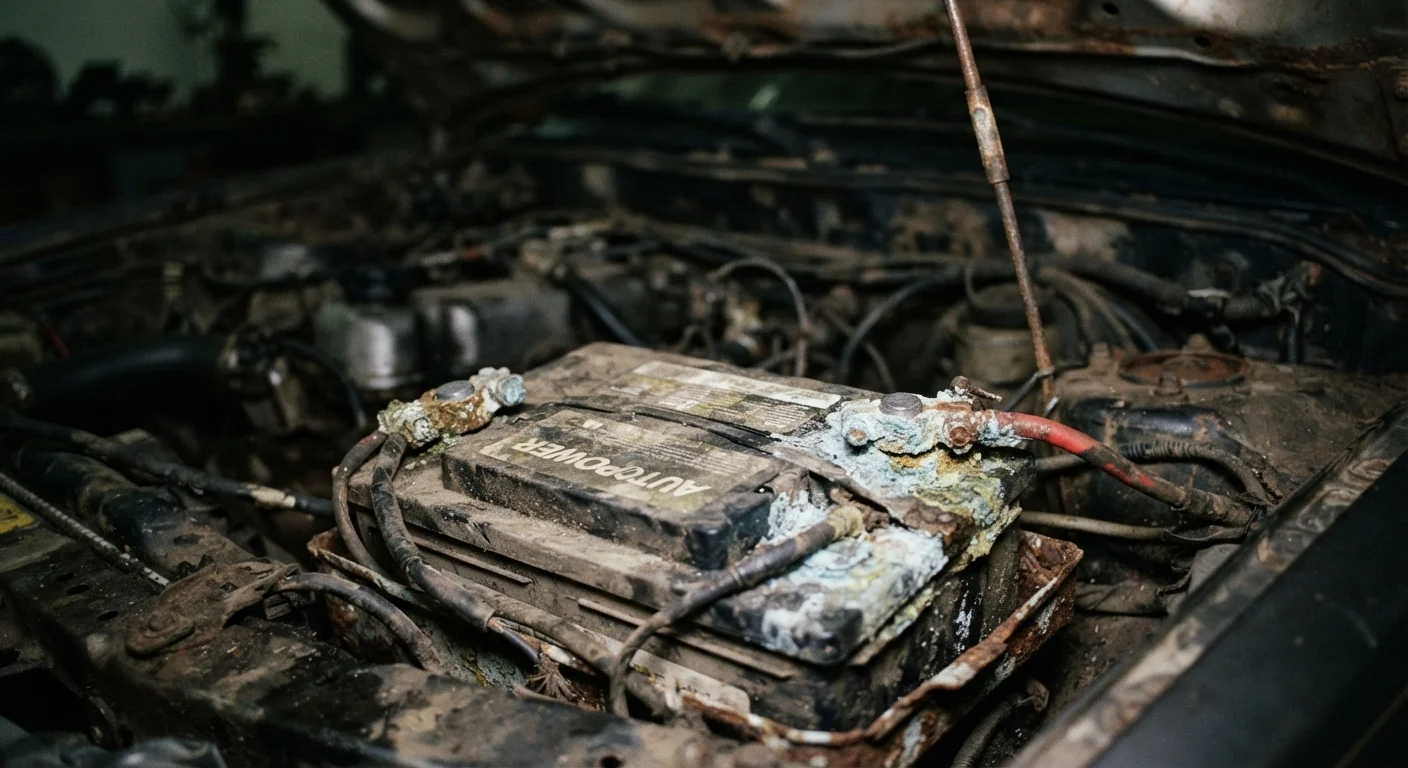
White, blue-gray, or greenish powder accumulating around the battery terminals is a sign of chemical activity. Some corrosion is common over time, but heavy buildup can impede the electrical connection between the battery and the vehicle's wiring. That resistance translates directly into reduced performance.
Terminal corrosion doesn't necessarily mean the battery itself is failing, but it's a clear signal the battery needs attention. A mechanic can clean the terminals and assess whether the underlying battery is still serviceable. Do not attempt to clean corroded terminals without proper safety precautions - battery acid residue is caustic.
Heavy terminal corrosion creates resistance that reduces battery output and should be addressed promptly.
Frequent need for jump-starts
A battery that needs jump-starting more than once in a short period is not recovering adequately between drives. Jump-starting restores enough charge to start the car, but it doesn't restore lost capacity. If you've needed a jump twice in a month, the battery is telling you it can no longer hold a sufficient charge.
One caveat: if you regularly take very short trips - under 10 to 15 minutes - the alternator may not have enough time to fully recharge the battery between starts. In that case, the driving pattern is contributing to the problem. Either way, a load test will tell you where things stand.
Multiple jump-starts in a short period mean the battery can no longer hold adequate charge.
Battery age beyond the three-to-five-year mark
Age alone is a signal worth taking seriously. Even a battery that hasn't shown obvious symptoms loses capacity over time as its internal chemistry degrades. Most conventional lead-acid batteries have a realistic service life of three to five years in average conditions; heat-heavy climates can bring that down to two to four years.
If you don't know your battery's age, many batteries have a date code stamped or labeled on the case. A battery in its fourth or fifth year should be tested annually regardless of how it seems to be performing. Replacing it proactively - before failure - is significantly less disruptive than an unplanned breakdown. For a broader look at how deferred checks like this add up financially, see where car owners quietly lose money.
A battery in its fourth or fifth year should be tested annually, regardless of apparent performance.
What to Do Once You Spot the Signs
Noticing one of these signals doesn't mean your battery will fail tomorrow, but it does mean you should stop guessing. A load test measures how much current the battery can deliver under realistic starting conditions - it's a far more accurate picture than simply checking voltage with a multimeter. Voltage alone can look acceptable even when the battery lacks the reserve capacity to crank a cold engine.
If your battery is under three years old and tests poorly, have the charging system checked as well. A failing alternator or a parasitic drain - caused by a faulty module or accessory drawing current when the car is off - can kill an otherwise healthy battery. Dashboard warning lights related to charging are another cue worth cross-referencing.
Temperature swings deserve special mention. Cold weather reduces a battery's cranking power while simultaneously increasing the energy needed to start the engine - a double burden. Heat degrades battery chemistry faster over time. If you live somewhere with significant seasonal shifts, seasonal battery checks should be part of your routine, not just something you consider after a failed start.
Get a Free Load Test Before Winter
Many auto parts retailers offer no-cost battery load testing. Having this done before cold weather arrives is practical timing - cold temperatures hit weakened batteries hardest. If your battery tests marginal in the fall, you'll have far more flexibility to plan a replacement than if it fails on a freezing January morning.
The content provided on our blog site traverses numerous categories, offering readers valuable and practical information. Readers can use the editorial team’s research and data to gain more insights into their topics of interest. However, they are requested not to treat the articles as conclusive. The website team cannot be held responsible for differences in data or inaccuracies found across other platforms. Please also note that the site might also miss out on various schemes and offers available that the readers may find more beneficial than the ones we cover.