

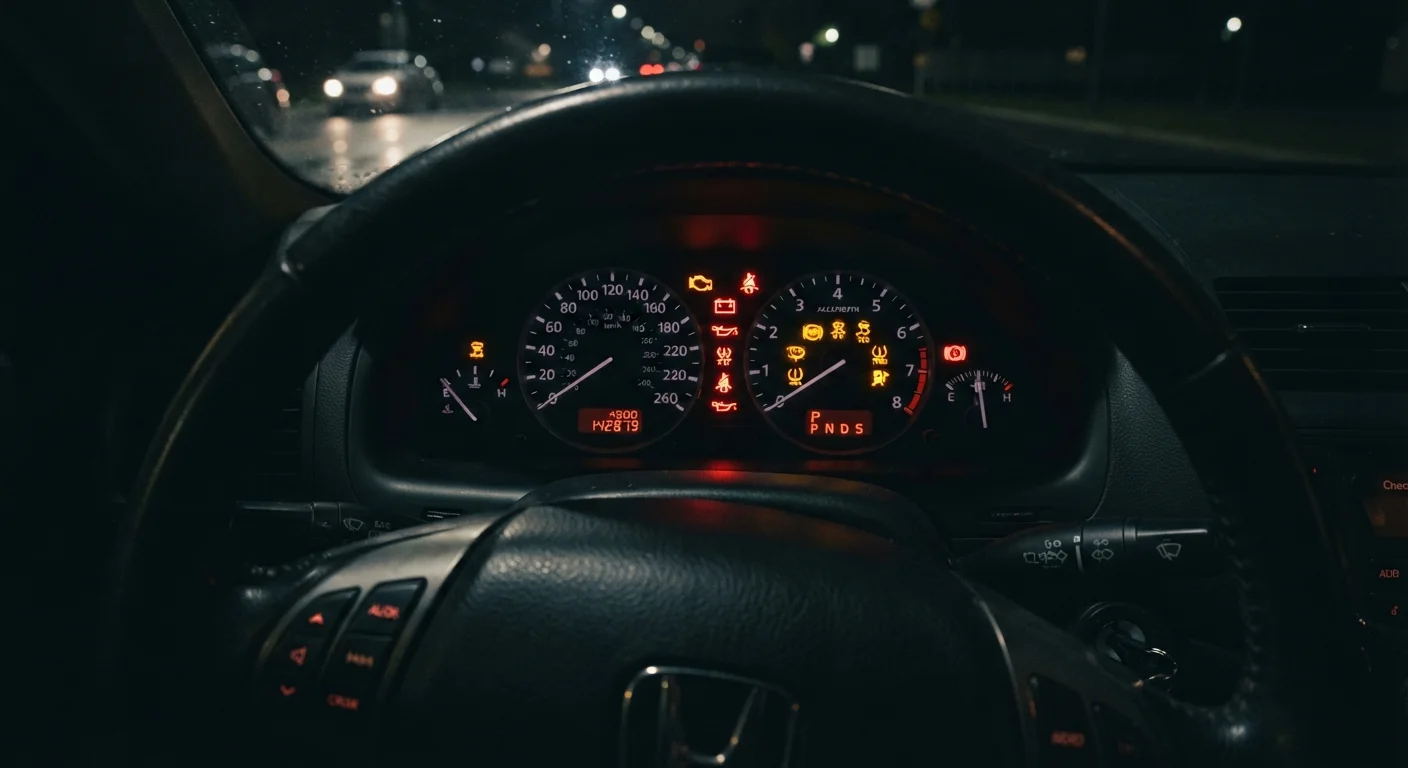
How Dashboard Warning Lights Are Organized
Modern vehicles use a standardized color system to communicate urgency. Red lights require immediate attention - pull over safely when it's possible to do so. Amber or yellow lights indicate a developing issue that needs attention soon but isn't necessarily an emergency. Green and blue lights are informational, confirming a system is active (high beams, turn signals). This color framework is consistent across virtually all vehicles sold in the US market.
Your owner's manual remains the definitive reference for your specific vehicle. However, the lights below follow industry-standard symbols that apply across most makes and model years.
The Most Common Warning Lights, Explained
Check Engine (Malfunction Indicator Lamp)
The check engine light - technically the Malfunction Indicator Lamp (MIL) - covers a broad range of powertrain and emissions issues. A steady amber light could be anything from a loose gas cap to a failing oxygen sensor. A flashing check engine light typically signals active engine misfiring and warrants reducing speed and seeking prompt service to avoid catalytic converter damage. See how your maintenance schedule intersects with these codes for context on staying ahead of issues.
Oil Pressure Warning
This red light - often shaped like an oil can - means the engine is detecting low oil pressure, not simply low oil level. Low pressure can cause severe engine damage within minutes of driving. Pull over safely, shut off the engine, and check the oil level before driving further. Do not ignore this light.
Battery / Charging System
A battery-shaped red icon indicates the charging system isn't maintaining voltage - most commonly a failing alternator, a worn serpentine belt, or a battery nearing end of life. The vehicle may continue running temporarily on battery reserve, but electrical systems will begin failing. For signs of a weakening battery before it triggers this light, see signals your battery is fading.
Brake System Warning
This light has two meanings depending on context. If the parking brake is engaged, releasing it will clear the light. If the parking brake is off and the light remains red, it may indicate low brake fluid or a hydraulic fault - both safety-critical concerns. Learn more about what brake wear looks and feels like in brake wear explained.
Tire Pressure Monitoring System (TPMS)
The TPMS icon - a cross-section of a tire with an exclamation point - activates when one or more tires drops roughly 25% below the recommended pressure. It can also trigger from temperature swings, since cold air causes pressure to drop. TPMS is a warning system, not a substitute for regular pressure checks. For proper technique, see checking your tire pressure the right way.
Temperature Warning
A red thermometer icon means the engine coolant has exceeded safe operating temperature. Pull over promptly, turn off the engine, and allow it to cool before inspecting the coolant reservoir. Never open a hot radiator cap. Continued driving risks warping cylinder heads or seizing the engine.
Traction Control / Stability Control
A car with wavy lines beneath it (often labeled ESC or VSC) flashing briefly during acceleration on a slippery surface is normal - the system is working. If the light stays on solid, the system may be disabled or malfunctioning and should be inspected.
Malfunction Indicator Lamp (MIL)
The official name for the check engine light. It illuminates when the vehicle's onboard diagnostic system detects a fault in the powertrain or emissions system and stores a corresponding trouble code.
OBD-II
On-Board Diagnostics second generation - a standardized system built into all US vehicles sold after 1996 that monitors vehicle systems and stores diagnostic trouble codes (DTCs) readable by a scan tool.
TPMS
Tire Pressure Monitoring System - a federally mandated sensor system that alerts the driver when a tire's pressure drops significantly below the recommended level.
Diagnostic Trouble Code (DTC)
A standardized alphanumeric code stored by the OBD-II system when a sensor reading falls outside acceptable parameters. A mechanic reads these codes to pinpoint the source of a warning light.
Charging System
The combination of the alternator, battery, and associated wiring that keeps a vehicle's electrical systems powered while the engine is running.
ESC / VSC
Electronic Stability Control / Vehicle Stability Control - a safety system that detects and reduces loss of traction by selectively applying brakes and reducing engine power.
When to Drive On vs. When to Stop Immediately
Not every warning light demands you pull over on the spot, but categorizing them correctly prevents both unnecessary panic and dangerous delays.
- Stop immediately (red, active symptoms): Oil pressure, engine temperature, brake system with soft pedal, battery with failing electrics.
- Seek service within 24-48 hours (amber, no drivability change): Steady check engine, TPMS, ABS warning, low fuel.
- Schedule at next service interval (amber, informational): Service due, low washer fluid, door-ajar.
When in doubt, treat any unfamiliar red light as a stop-immediately situation. A qualified mechanic can retrieve stored diagnostic trouble codes (DTCs) using an OBD-II scanner to identify the root cause - this is far more reliable than guessing from the symbol alone. For a broader look at keeping your vehicle road-ready, the complete driver's reference is a useful companion resource.
Your OBD-II Port Can Help You Decode Lights
Every US vehicle from 1996 onward has a standardized OBD-II diagnostic port, typically located under the dashboard near the steering column. Inexpensive handheld scanners and smartphone-paired adapters can read stored fault codes yourself before visiting a shop. This won't replace a professional diagnosis, but it helps you arrive informed and reduces the risk of being surprised by a repair estimate.
The content provided on our blog site traverses numerous categories, offering readers valuable and practical information. Readers can use the editorial team’s research and data to gain more insights into their topics of interest. However, they are requested not to treat the articles as conclusive. The website team cannot be held responsible for differences in data or inaccuracies found across other platforms. Please also note that the site might also miss out on various schemes and offers available that the readers may find more beneficial than the ones we cover.