

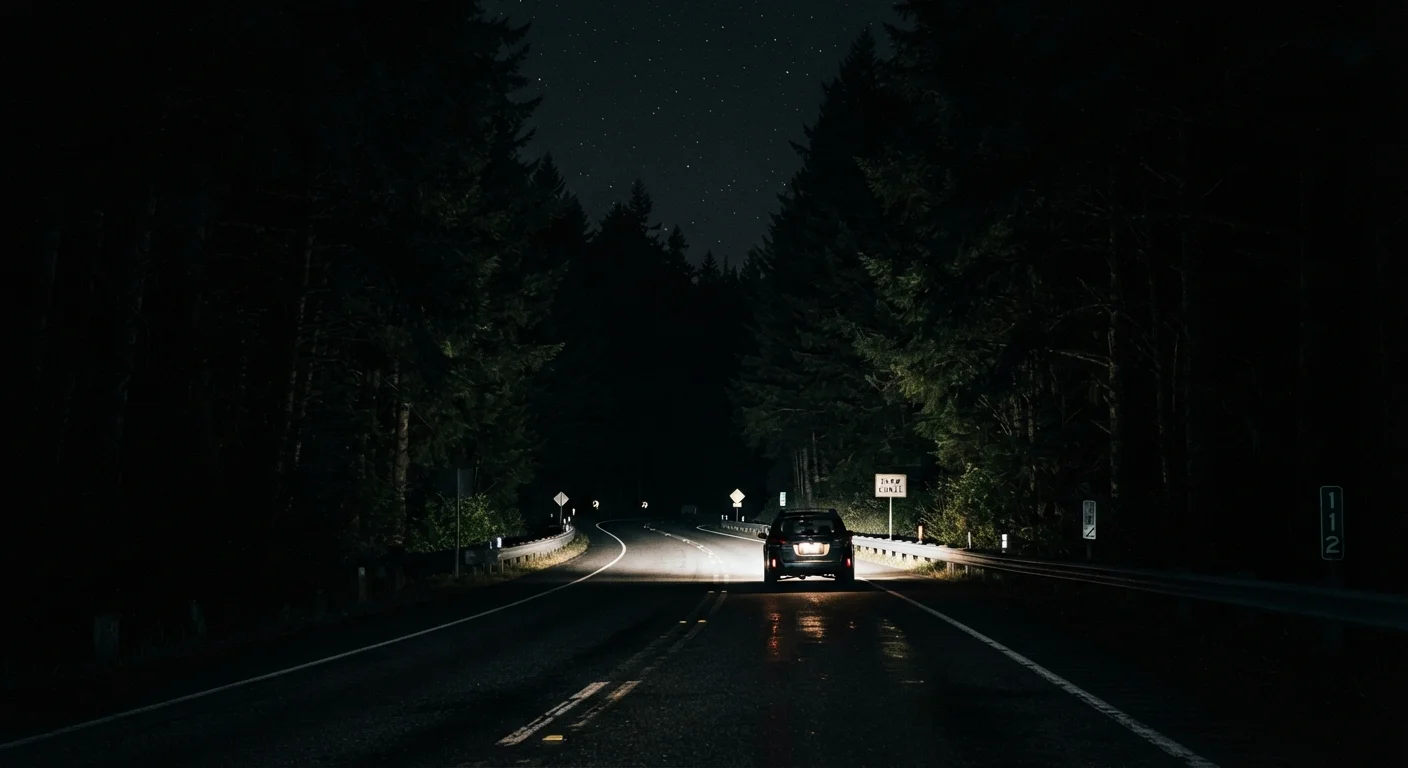
Why Nighttime Driving Is Statistically Deadlier
Traffic volume drops substantially after dark, yet the share of fatal crashes rises. According to the National Safety Council, fatal crash rates per mile driven are roughly three times higher at night than during the day. Fewer cars on the road creates a false sense of safety - open lanes encourage speed, and the absence of congestion masks real hazards.
The core problem is visual. Human eyes are not optimized for darkness. Peripheral vision narrows, depth perception degrades, and the ability to distinguish color drops sharply under artificial lighting. A pedestrian in dark clothing or a deer at the road edge may not register until it's too late to stop at highway speeds.
Experienced drivers know that nighttime demands a different mental framework entirely - not just the same habits applied in the dark. See how similar recalibration applies to different road environments in our comparison of urban and highway driving risks.
3×
Higher fatal crash rate at night vs. daytime
The National Safety Council estimates nighttime fatal crash rates are roughly three times higher per mile traveled than daytime rates.
~50%
Of all fatal crashes occur in darkness
Despite most driving happening during daylight hours, roughly half of all traffic fatalities in the U.S. occur at night or in low-light conditions, according to NHTSA data.
The Specific Hazards Most Drivers Underestimate
Beyond reduced visibility, several compounding factors make night driving uniquely dangerous:
- Impaired drivers: Alcohol-involved crashes peak between midnight and 3 a.m. on weekends. Even if you're sober, you share the road with drivers who aren't.
- Drowsiness: Fatigue impairs reaction time similarly to alcohol. The body's circadian rhythm creates a natural dip in alertness between 2-5 a.m., regardless of how much sleep you got.
- Glare from oncoming headlights: Modern LED and HID headlights are significantly brighter than older halogens. Glare temporarily reduces your ability to see the road edge and can cause momentary blindness lasting several seconds.
- Overdriving headlights: Standard low-beam headlights illuminate roughly 160-200 feet ahead. At 60 mph, your stopping distance approaches 200 feet - meaning you're operating at the physical limit of your light coverage, with no safety margin.
Many of these hazards also feed on false confidence. Assumptions about predictable road conditions are especially dangerous at night, when conditions change faster than your headlights reveal them.
Best Practices Experienced Night Drivers Follow
Adjusting your approach - not just your alertness - is what separates competent night drivers from overconfident ones.
Reduce speed enough that you can stop within your headlight range.
Overdriving your headlights is one of the most common - and underappreciated - night driving errors. If something appears in your beam and you can't stop in time, speed was the problem regardless of visibility conditions.
Increase following distance to at least 4 seconds behind the vehicle ahead.
Brake lights give you less warning at night because your eyes take longer to process contrast changes. Extra following distance compensates for slower visual processing and longer reaction times in low light.
Dim your dashboard and avoid interior lights before and during night driving.
Bright interior light constricts your pupils, reducing night vision sensitivity. Your eyes need time - sometimes 20 to 30 minutes - to fully adapt to darkness after exposure to bright light.
Use high beams strategically on unlit roads and dim them for oncoming traffic.
High beams can nearly double your sight distance on dark roads, but drivers often underuse them out of habit. The trade-off: you must switch back to low beams promptly to avoid blinding oncoming drivers.
Scan wider and farther ahead than you would during daytime.
At night, hazards like pedestrians, cyclists, or debris appear closer to your vehicle before you can identify them. Shifting your gaze farther down the road - and sweeping across both lanes - buys processing time.
Plan long or late-night drives around natural fatigue windows.
Drowsiness-related crashes cluster between 2-5 a.m. and, to a lesser extent, mid-afternoon. Knowing this lets you time rest stops proactively rather than waiting for fatigue to appear.
Quick Actions You Can Take Before Your Next Night Trip
Most night driving improvements cost nothing and require no new equipment. They're habit changes, not gear upgrades.
If your trip involves genuinely hazardous conditions - rain, fog, or ice alongside darkness - review our pre-trip bad weather safety checklist before heading out. The risk layers compound quickly.
The content provided on our blog site traverses numerous categories, offering readers valuable and practical information. Readers can use the editorial team’s research and data to gain more insights into their topics of interest. However, they are requested not to treat the articles as conclusive. The website team cannot be held responsible for differences in data or inaccuracies found across other platforms. Please also note that the site might also miss out on various schemes and offers available that the readers may find more beneficial than the ones we cover.