

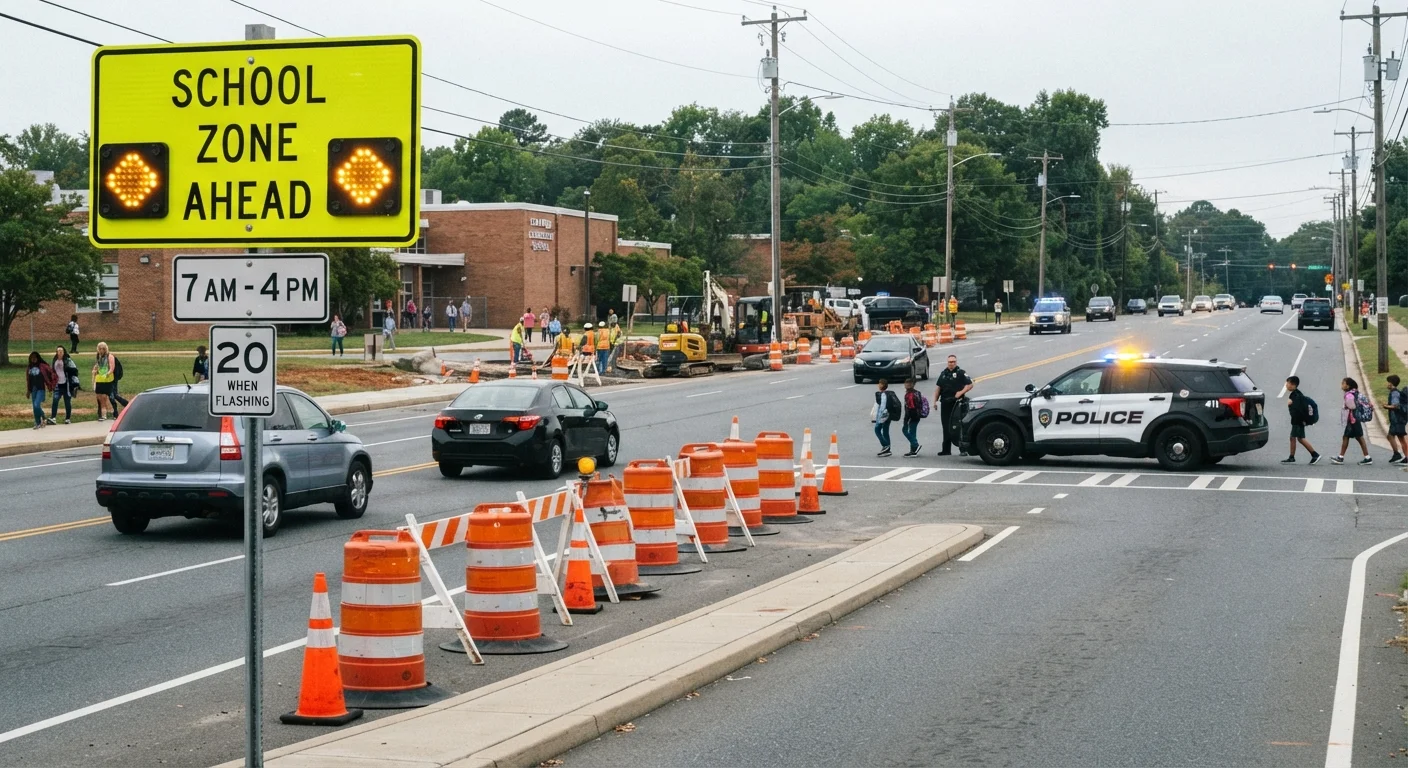
School Zones: Reduced Speeds Are Just the Starting Point
Speed limit reductions in school zones - typically to 15-25 mph in most states - are the most visible requirement, but they're not the only one. These limits often apply only during designated hours: when children are present, when school is in session, or when flashing beacons are active. The exact trigger varies by state and even by individual zone, so drivers should never assume a static sign means the limit is always in effect.
Beyond speed, school zones commonly prohibit:
- Passing a stopped school bus: When a school bus displays its stop arm and flashing red lights, traffic in both directions must stop on undivided roads. Divided highways with four or more lanes often exempt oncoming traffic, but drivers should know their state's specific rule. Fines for illegal passing frequently start at several hundred dollars and can include license suspension.
- Using a handheld device: Many states apply stricter hands-free requirements inside school zones, with elevated fines. See distracted driving laws by state for specifics.
- U-turns and passing: These maneuvers are commonly banned within the zone's boundaries, even where otherwise legal.
Penalties in school zones are routinely doubled or tripled compared to standard traffic violations. Points on a license accumulate faster, and in some states a single infraction here can trigger a mandatory court appearance rather than a simple fine payment.
Construction Zones: Worker Safety Laws with Real Teeth
Active construction zones - marked by orange signs, barrels, or cones - impose their own speed reductions, often 10-15 mph below the normal limit. The critical legal distinction: in most states, fines are doubled in work zones, and that doubling applies whether or not workers are physically present at the moment of the violation. Signage indicating the zone is sufficient.
2×
Minimum fine multiplier in most work zones
The majority of US states double standard fines for traffic violations committed within posted construction zones, even when workers are absent.
All 50
States with Move Over laws
Every US state has enacted a Move Over law requiring drivers to change lanes or slow down for stationary emergency and maintenance vehicles with lights activated.
300-500 ft
Minimum following distance behind emergency vehicles
Most state laws prohibit following closer than 300 to 500 feet behind an emergency vehicle actively responding with lights and siren engaged.
Key rules to understand in construction zones:
- Posted work zone speed limits are regulatory, not advisory. Unlike advisory speed signs (explained in our guide to speed limit sign types), these are enforceable limits carrying full legal weight.
- Move Over laws extend to construction vehicles: In many states, the same move-over requirement that applies to emergency vehicles also applies to stationary maintenance and construction vehicles with flashing amber lights. Failure to move over or slow down can result in fines comparable to those for emergency vehicle violations.
- Lane discipline: Merge early - late merging near the taper point, while sometimes efficient in light traffic, is illegal in some jurisdictions when signs direct earlier lane changes.
- Reckless driving thresholds drop: Some states lower the mph-over threshold that constitutes reckless driving inside a work zone, meaning a speed that would be a civil infraction elsewhere becomes a criminal charge inside the zone.
A common driver assumption is that a zone with no visible workers is a lower-risk zone. Legally and practically, that's incorrect - equipment, unmarked hazards, and sudden re-entry of workers make the speed reduction necessary regardless.
Emergency Vehicles: What You Must Do and When
When an emergency vehicle - police, fire, or EMS - approaches with lights and siren active, federal and state law requires two actions: yield and pull over. Specifically, drivers must move to the nearest edge of the roadway (generally the right side) and stop until the vehicle has passed. Failing to yield to an emergency vehicle is a moving violation in every US state and can result in license suspension for repeat offenses.
Move Over laws address a separate but related scenario: a stationary emergency vehicle on the roadside with lights activated. Every US state has a Move Over law. The standard requirement is to move one lane away from the stopped vehicle if it's safe to do so, or - if a lane change isn't possible - to reduce speed significantly below the posted limit. Specific required speed reductions vary: some states mandate 20 mph below the posted limit; others require slowing to a defined speed such as 25 mph. Fines, license points, and in some cases criminal charges apply for violations.
A few practical points drivers frequently misunderstand:
- Blocking intersections is still prohibited even when pulling over. Don't stop in a crosswalk or block the path of the emergency vehicle itself.
- Don't follow closely behind an emergency vehicle responding to a call. Most states prohibit following within 300-500 feet of an emergency vehicle using its lights and siren.
- Volunteer and privately operated emergency vehicles (some fire and EMS units) may also carry legal right-of-way; the trigger is the activation of lights and siren, not necessarily official government markings.
For context on how right-of-way logic applies more broadly, see our breakdown of right-of-way rules. Penalties for emergency vehicle violations can also affect your insurance and, in serious cases, result in criminal charges - which may intersect with SR-22 filing requirements if your license is suspended.
School Zone
A designated area around a school where reduced speed limits and additional traffic restrictions apply, typically during school hours or when children are present. Exact activation conditions vary by state and sign type.
Work Zone
A section of roadway marked with orange signage and traffic control devices indicating active or recent construction or maintenance activity. Speed reductions and doubled fines typically apply whether or not workers are present.
Move Over Law
A state law requiring drivers approaching a stationary emergency, law enforcement, or maintenance vehicle with flashing lights to change lanes away from it or, if that's not safely possible, to reduce speed substantially.
Stop Arm (School Bus)
The extendable arm on a school bus, deployed with flashing red lights, legally requiring approaching traffic to stop while students board or exit. Passing a deployed stop arm is a serious traffic violation in all states.
Regulatory Speed Limit
A legally enforceable maximum speed established by statute or traffic order, indicated by a standard white rectangular sign. Exceeding it is a violation regardless of road or traffic conditions.
Reckless Driving
A criminal traffic offense defined as operating a vehicle with willful or wanton disregard for the safety of others. The speed threshold that triggers this charge is often lower inside work zones.
The content provided on our blog site traverses numerous categories, offering readers valuable and practical information. Readers can use the editorial team’s research and data to gain more insights into their topics of interest. However, they are requested not to treat the articles as conclusive. The website team cannot be held responsible for differences in data or inaccuracies found across other platforms. Please also note that the site might also miss out on various schemes and offers available that the readers may find more beneficial than the ones we cover.