

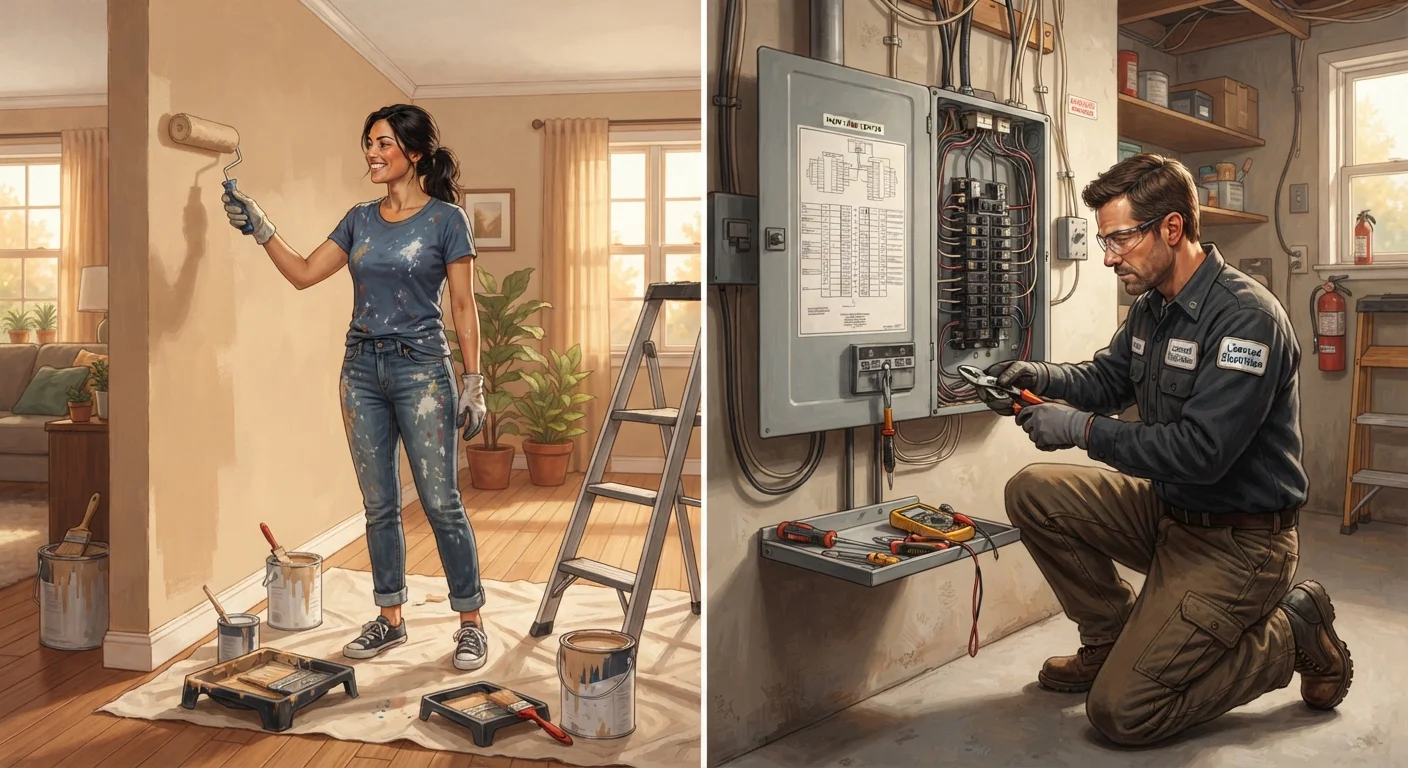
Option A
DIY
The hands-on, cost-saving approach for capable homeowners.
Best for: Cosmetic upgrades, maintenance tasks, and low-risk projects where mistakes are recoverable and no permits are required.
Option B
Hiring a Pro
The licensed, accountable choice for complex or hazardous work.
Best for: Electrical, structural, plumbing-into-mains, gas, and any work that requires permits, inspections, or specialized liability coverage.
The Real Question Isn't Cost - It's Risk
Most homeowners frame the DIY vs. pro decision as a budget question. Labor is expensive, and skipping it feels like straightforward savings. But the smarter framework starts with risk, not price. Ask three questions before picking up a tool or a phone: What's the worst that could happen if this goes wrong? Does this work require a permit? And am I honestly qualified to do this safely?
Cosmetic and maintenance-level projects - painting interior walls, replacing a faucet, patching drywall, or refreshing caulk around a tub - are generally well-matched to DIY because failures are recoverable and costs are bounded. You strip paint unevenly; you repaint. You over-caulk; you trim it back. Contrast that with a miswired outlet or an improperly vented gas appliance, where a mistake can cause a fire, an explosion, or carbon monoxide buildup. The stakes aren't comparable, and the decision shouldn't be treated the same way.
For new homeowners especially, understanding where to start and what to leave to professionals can prevent costly early missteps.
A Practical Side-by-Side: What Belongs in Each Column
Not every project is clearly DIY or clearly professional - many fall in a gray zone that depends on your specific skills and local codes. The table below reflects general guidance, not a guarantee. Always verify permit requirements with your local building department.
| Criterion | DIY-Appropriate | Hire a Pro |
|---|---|---|
| Interior painting | Yes - low risk, no permit needed | Not necessary |
| Electrical panel or wiring | No - safety and code risk | Licensed electrician required |
| Tile installation | Often yes - skill-dependent | For complex or large-format tile |
| Gas line work | No - serious hazard | Licensed plumber or gas fitter |
| Deck building (ground level) | Possible - permit usually required | Recommended if structural |
| Load-bearing wall removal | No - structural risk | Contractor + structural engineer |
| Caulking and weatherstripping | Yes - low skill, high value | Not necessary |
| Roof repair or replacement | Minor patches only, carefully | Licensed roofer for full jobs |
Notice that the "hire a pro" column isn't just about technical difficulty - it's about consequence. Electrical and gas work is regulated because errors in these systems routinely cause property damage and fatalities. Structural changes require engineering logic, not just construction effort.
Permits: The Factor Most DIYers Underestimate
Permit requirements are where well-intentioned DIY projects most commonly go sideways. Many homeowners assume permits are optional bureaucracy - in reality, they exist to ensure work meets minimum safety standards and is inspected by a qualified official.
Check Permit Requirements Before You Start
Permit requirements vary significantly by municipality - a project that needs a permit in one county may not require one in a neighboring town. Your local building department's website is the authoritative source, and many departments now offer online permit lookup tools. When in doubt, call before you start: it's free, and the answer could save you from tearing out completed work.
Unpermitted work can void your homeowner's insurance coverage for related claims, complicate or block a home sale when a title search reveals discrepancies, and force you to tear out finished work for a belated inspection. None of those outcomes are cheaper than pulling the permit upfront.
Our detailed guide on permits, inspections, and local codes walks through exactly when permits are required and how the inspection process works - read it before starting any project that touches your home's systems.
When You Do Hire: What to Look For
Deciding to hire a pro is only step one. Protecting yourself through the hiring process is equally important. Verify that any contractor you consider holds a current license in your state, carries general liability insurance, and - for larger projects - is bonded. Ask for proof of each; a reputable contractor provides these documents without hesitation.
Beyond credentials, get at least two or three written quotes. Price is one data point, but scope descriptions, material specifications, projected timelines, and payment schedules matter just as much. Our guide on what to compare across contractor quotes breaks down exactly what to scrutinize. And before you sign anything, review how to hire a contractor without getting burned for red flags that signal a risky hire.
~35%
Homeowners who've hired an unlicensed contractor
Industry surveys consistently find a significant share of homeowners have unknowingly hired unlicensed contractors, often discovered only after problems arise.
3+
Quotes recommended before hiring
Consumer protection agencies and trade associations generally recommend getting at least three written bids to establish a fair market baseline for your project.
A signed, detailed contract protects both parties. It should specify the full scope of work, materials to be used, payment milestones, and what happens if the project scope changes. Verbal agreements are not enforceable protection.
The content provided on our blog site traverses numerous categories, offering readers valuable and practical information. Readers can use the editorial team’s research and data to gain more insights into their topics of interest. However, they are requested not to treat the articles as conclusive. The website team cannot be held responsible for differences in data or inaccuracies found across other platforms. Please also note that the site might also miss out on various schemes and offers available that the readers may find more beneficial than the ones we cover.