

Our Verdict
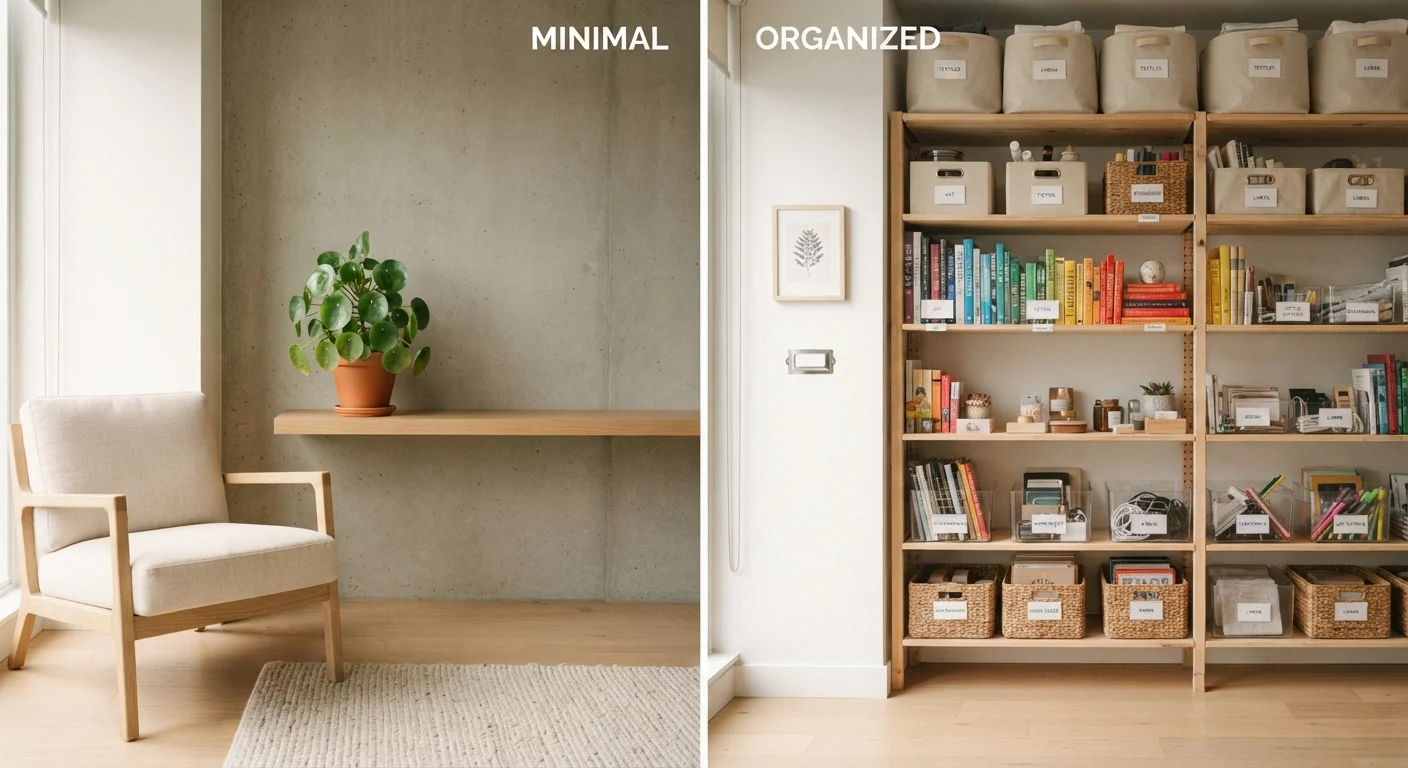
Minimalism and category-based organization are complementary philosophies, not competitors. Minimalism is a mindset about ownership; category-based organization is a system for managing what you own. The most practical households often apply both: they define categories to create structure, then minimize aggressively within each one.
| Best for | Recommended |
|---|---|
| Solo or small households with a low-stuff lifestyle | Minimalist approach |
| Families or multi-person households with varied belongings | Category-based organization |
| Those who want both calm spaces and functional storage | Hybrid: minimize within categories |
| First-time organizers who need a clear starting framework | Category-based organization |
What Each Philosophy Actually Means
These two terms get conflated often, but they address different problems. Minimalism is a philosophy about ownership - the idea that limiting what you possess leads to less mental clutter, lower costs, and more intentional living. It's not about aesthetics; it's about quantity and purpose. You keep what serves a clear function or brings genuine value and let go of everything else.
Category-based organization - most famously associated with the KonMari method - is a system for sorting and storing belongings by type rather than by room. Instead of tidying the kitchen, then the bedroom, you work through categories: clothing, books, papers, miscellaneous items, and sentimental objects. The goal is to see every item you own within a category at once, making decisions more deliberate.
The core distinction: minimalism asks how much should I own? Category-based methods ask how should I organize what I own? You can practice one without the other - though combining them tends to produce the most durable results. If you're just beginning to think about this, this practical introduction to home organization is a useful starting point.
The Real Demands of Going Minimalist
Minimalism is often misrepresented as a one-time purge. In practice, it requires sustained gatekeeping - consistently evaluating what enters your home, resisting impulse purchases, and periodically reassessing whether existing items still earn their place. For budget-conscious households, this friction at the point of acquisition can actually translate into meaningful savings over time.
The approach works best for individuals and couples without heavy storage obligations: no children's gear, no hobby equipment, no shared household items that serve multiple people's needs. When multiple people with different needs share a space, radical minimalism can create friction rather than calm.
A Purge Is Not a Sustainable System
Minimalism practiced as a one-time declutter without changing acquisition habits will reset to its previous state within months. Research on household clutter consistently finds that volume tends to creep back unless the incoming flow is addressed. Before discarding items, identify what habits or purchases generated the excess - that's where lasting change happens.
It's also worth separating minimalism from the aesthetics associated with it. You don't need white walls or empty countertops - you need to own less than you're tempted to. The philosophy applies equally to a small apartment or a large suburban home. Common myths about the process are worth examining; this look at decluttering myths addresses several that stall real progress.
How Category-Based Organization Works in Practice
The category method's strength is visibility. By pulling every item in a category - say, all clothing - into one location before making decisions, you eliminate the invisible duplicates hidden in closets, drawers, and storage bins. Most people are genuinely surprised by how much they own until they see it all together.
This approach handles complexity well, which makes it particularly suited to households with children, hobbies, or professional equipment that can't simply be eliminated. You're not asking whether to own camping gear; you're asking how much camping gear is reasonable and where it lives.
| Minimalist Approach | Category-Based Organization | |
|---|---|---|
| Core question asked | Do I need to own this at all? | Where does this type of item belong? |
| Best suited for | Small households, low-stuff lifestyles | Families, hobbyists, complex households |
| Upfront time investment | Moderate - ongoing purging | High - full category sorts required |
| Ongoing maintenance | High discipline at point of acquisition | Consistent return-to-category habit |
| Budget impact | Reduces future spending naturally | Neutral - depends on storage purchased |
| Works for multi-person homes | Challenging - requires buy-in from all | More adaptable to varied needs |
| Handles unavoidable clutter | Poorly - elimination is the only tool | Well - organizes what can't be removed |
The tradeoff is upfront effort. A thorough category sort of a full household can take several weekends. Maintaining it requires putting things back in their designated category homes rather than wherever is convenient - a habit that takes time to build. For households considering how far to take storage systems, this honest look at label-everything organization outlines what the maintenance actually involves.
Choosing Your Starting Point
A useful diagnostic: stand in your most cluttered room and ask yourself whether the problem is too much stuff or no system for the stuff you have. If items are genuinely homeless - no logical place to belong - that's a category problem. If every category already has a home but the homes are overflowing, that's a volume problem minimalism addresses directly.
Many households discover the answer is both, which is why a hybrid approach - defining clear categories first, then minimizing within each - tends to be the most practical. It gives you the structural clarity of a category system without the ongoing burden of maintaining an ever-growing organizational infrastructure.
For households thinking about how physical space shapes these decisions, the zone method offers a complementary framework that maps organization to how rooms are actually used. Similarly, if you're weighing storage solutions, vertical storage versus drawer systems helps match physical tools to your chosen philosophy.
Start With One Category, Not One Room
Regardless of which philosophy appeals to you, starting with a single category - such as all paper documents or all kitchen tools - builds momentum without overwhelming you. You'll make faster, more confident decisions when you can see everything of one type together. Once that category has a clear home and a reasonable volume, the method becomes easier to apply elsewhere.
Whichever direction you start, the organizational philosophy you can maintain consistently will always outperform the theoretically superior system you abandon after two weeks.
The content provided on our blog site traverses numerous categories, offering readers valuable and practical information. Readers can use the editorial team’s research and data to gain more insights into their topics of interest. However, they are requested not to treat the articles as conclusive. The website team cannot be held responsible for differences in data or inaccuracies found across other platforms. Please also note that the site might also miss out on various schemes and offers available that the readers may find more beneficial than the ones we cover.