

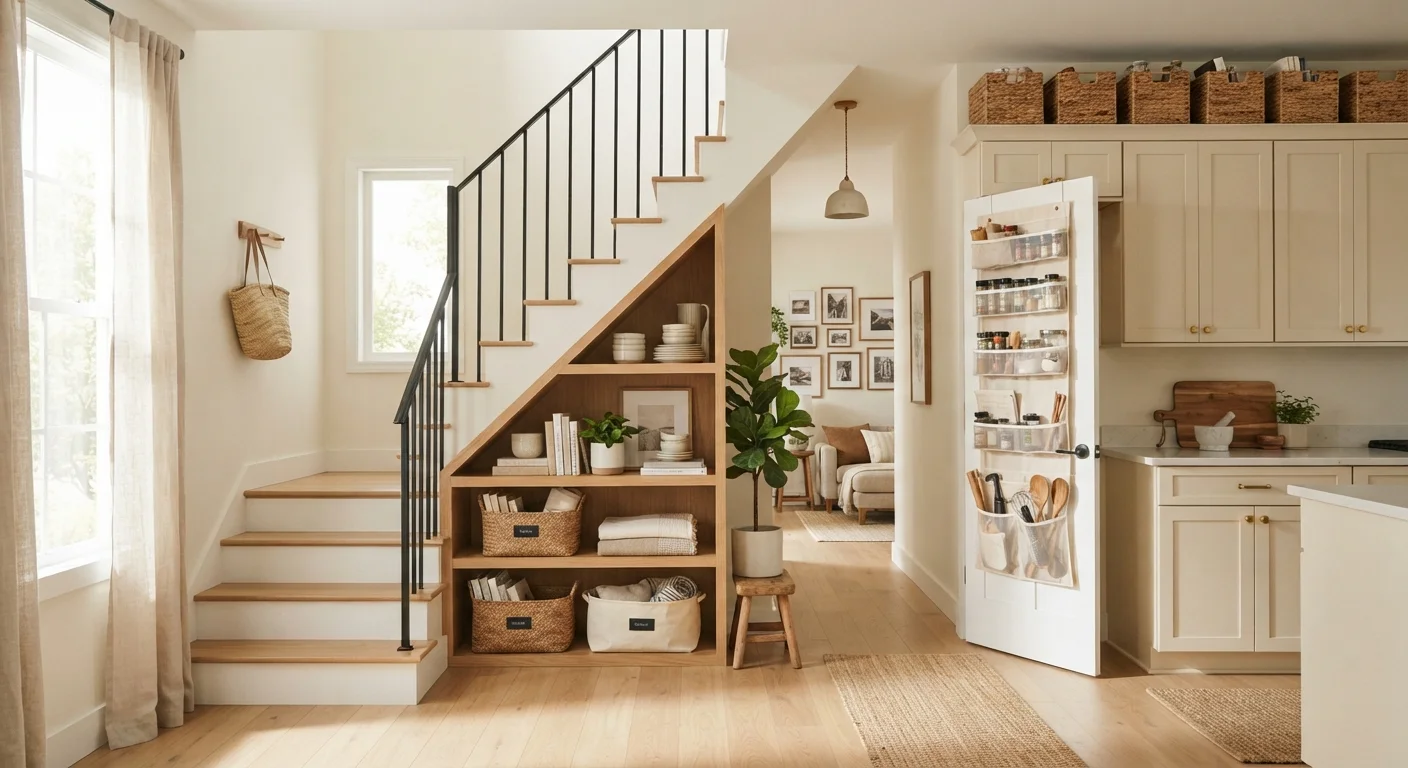
The Hidden Square Footage in Every Home
Most homeowners focus on their main storage areas - closets, cabinets, the garage - and assume that's the ceiling on what's available. But the average home contains significant usable space that goes untouched: the gap above kitchen cabinets, the hollow under a staircase, the back of every door, and the dead zone beneath a bed or sofa. Individually, none of these feel like much. Collectively, they can rival the capacity of a small spare bedroom.
The goal isn't to fill every corner for its own sake. It's to identify which underused spots align with what you actually need to store - then apply the simplest system that works. For a deeper framework on matching storage to behavior, see the zone method approach - it pairs naturally with the ideas below.
The Space Above Kitchen Cabinets
The gap between the top of your upper cabinets and the ceiling - often 12 to 18 inches - tends to collect dust and decorative items that nobody really needs. It's prime real estate for storing items used seasonally or infrequently: large serving platters, holiday cookware, extra small appliances, or bulk dry goods in labeled containers.
Woven baskets with lids keep things tidy and protect against grease or dust accumulation. For heavier loads, a simple shelf installed flush against the cabinet tops can add structural support and make the area feel intentional rather than improvised. Group items by category and label containers so retrieval stays quick.
Labeled baskets above cabinets can hold an entire season's worth of rarely used cookware.
The Back of Every Door
Door backs are one of the most consistently ignored surfaces in the home. A standard interior door offers roughly 15 square feet of vertical space - enough for a multi-pocket organizer, a row of hooks, a small shelf unit, or a full-length shoe organizer depending on the room.
In bathrooms, over-door organizers can hold toiletries, hair tools, and cleaning supplies. In pantries, they're ideal for spices, foil and wrap boxes, or snack bags. In bedrooms, hooks handle bags, robes, or tomorrow's outfit. The hardware is typically lightweight and renter-friendly - no tools required for most tension or over-door mounting systems.
A single door back can store an entire category of items that would otherwise crowd a drawer.
Under-Stair Space
The triangular cavity beneath a staircase is often sealed off entirely or used as an afterthought for miscellaneous clutter. With some basic planning, it becomes one of the most versatile storage zones in the home.
Open configurations work well for shoe storage, book collections, or a small mudroom-style bench with baskets underneath. Enclosed built-in cabinetry - while a more involved project - can hold seasonal gear, luggage, or household supplies. Even a partial solution, like a few pull-out drawers fitted to the lower treads, dramatically increases usable volume. Note that any structural modifications to stair framing should be reviewed by a qualified contractor to ensure safety and code compliance.
Under-stair cavities often hold more cubic footage than a standard hall closet when fully utilized.
Toe-Kick Drawers in the Kitchen
The recessed base beneath kitchen cabinets - called the toe kick - is typically a 3- to 4-inch-deep void running the entire length of your cabinetry. Toe-kick drawers, which slide out flat and low to the floor, turn this space into hidden storage for flat items: baking sheets, cutting boards, placemats, or cleaning pads.
Retrofit kits are available for many standard cabinet configurations and don't require full cabinet replacement. Installation involves removing the existing toe-kick panel and fitting a low-profile drawer mechanism in its place. If you're uncertain about cabinet structure, a cabinetry professional can assess compatibility quickly. The result is storage that's invisible until you need it.
Toe-kick drawers hide flat kitchen items in a space most homeowners don't realize exists.
The Wall Space Between Door Frame and Corner
Short wall sections - the 8 to 20 inches of drywall between a door frame and an adjacent wall or corner - are routinely left bare. Narrow floating shelves fitted to these strips can store spice jars in a kitchen, paperbacks in a hallway, or folded linens near a bathroom.
Because these shelves are shallow (often 4 to 6 inches deep), they don't intrude into walkways and remain accessible from the front. This approach works particularly well in older homes where corridor widths and irregular room layouts create these narrow bands throughout. For a fuller comparison of vertical storage strategies, vertical versus drawer storage options explores when each format makes the most sense.
Narrow wall strips between doorframes are ideal for shallow shelves that store surprisingly large quantities.
Under Beds and Sofas
The space beneath furniture represents some of the most accessible underutilized storage in the home. A standard bed sits 7 to 12 inches off the floor - enough to slide flat containers holding off-season clothing, extra bedding, shoes, or archived documents.
Wheeled under-bed bins make retrieval easier without lifting. Vacuum storage bags can compress bulky items like comforters significantly. For sofas with deeper clearance, similar containers work for board games, wrapping supplies, or children's toys. If your current bed frame sits too low, furniture risers can increase clearance inexpensively - just confirm the riser weight rating before adding them to heavier frames.
Under-bed space with proper bins can store an entire season of clothing out of sight.
The Garage's Vertical Wall and Ceiling Space
Garages are typically treated as floor-level storage spaces, but the walls above workbench height and the ceiling joists themselves offer significant capacity. Wall-mounted track systems with interchangeable hooks and bins can hold tools, sports equipment, garden supplies, and seasonal items - all off the floor and out of the way of vehicles.
Ceiling-mounted platforms or pulley systems work for bulky lightweight items like camping gear, kayaks, or holiday decorations. Because garage ceiling heights vary and load-bearing capacity depends on joist spacing and structure, it's worth confirming weight limits before installing overhead systems - most manufacturers specify these in their instructions. For a comprehensive approach, organizing your garage from the ground up covers zones, wall systems, and seasonal maintenance in full.
Ceiling and upper-wall space in a garage can double usable storage without touching the floor plan.
Turning Dead Zones Into Daily Assets
The spaces covered above don't require demolition, large budgets, or a weekend-long project. Most can be addressed with a few hours and affordable hardware. The key is resisting the urge to over-engineer: a tension rod and a few S-hooks can transform the back of a cabinet door; a simple shelf bracket kit can claim a wall's vertical real estate that's been blank for years.
If you're working through your home systematically, a room-by-room organization checklist can ensure none of these opportunities get skipped. And if storage decisions in kitchens or small rooms feel particularly pressing, strategies for compact kitchens can complement what you've applied here.
Audit Before You Add
Before installing any new system, spend 10 minutes photographing and measuring each potential storage zone. Dimensions matter more than they seem - a shelf that's 2 inches too shallow for your containers defeats the purpose. Knowing exact measurements before purchasing hardware saves both money and return trips.
Start with one zone per week rather than attempting the whole house at once. That pacing keeps the project manageable and lets you evaluate what's working before committing to more.
The content provided on our blog site traverses numerous categories, offering readers valuable and practical information. Readers can use the editorial team’s research and data to gain more insights into their topics of interest. However, they are requested not to treat the articles as conclusive. The website team cannot be held responsible for differences in data or inaccuracies found across other platforms. Please also note that the site might also miss out on various schemes and offers available that the readers may find more beneficial than the ones we cover.