

Why Counter Space Feels Like It Disappears
In a small kitchen, the counter does double and triple duty: food prep surface, landing zone for groceries, charging station, and sometimes a makeshift desk. That overlap is the core problem. When every square inch serves multiple roles with no defined system, clutter accumulates faster than you can clear it.
The good news is that most compact kitchen problems are organizational, not structural. You rarely need a remodel to cook comfortably. See our overview of common kitchen renovation misconceptions for a closer look at why expensive upgrades often don't solve day-to-day frustrations. What you need instead is a clear set of habits and a smarter use of the space already available to you.
Audit every item on your counter and relocate anything used less than once a week.
Counter space is prime real estate. Items that sit out but are rarely used physically block the workspace you need daily. Moving them to a cabinet or shelf immediately frees usable surface without spending a dollar.
Assign every item a fixed, logical home and always return it there.
Clutter almost always means items have no designated place. Without a home, things land where they fit in the moment, and the counter becomes the default. A consistent system prevents this accumulation from rebuilding each day.
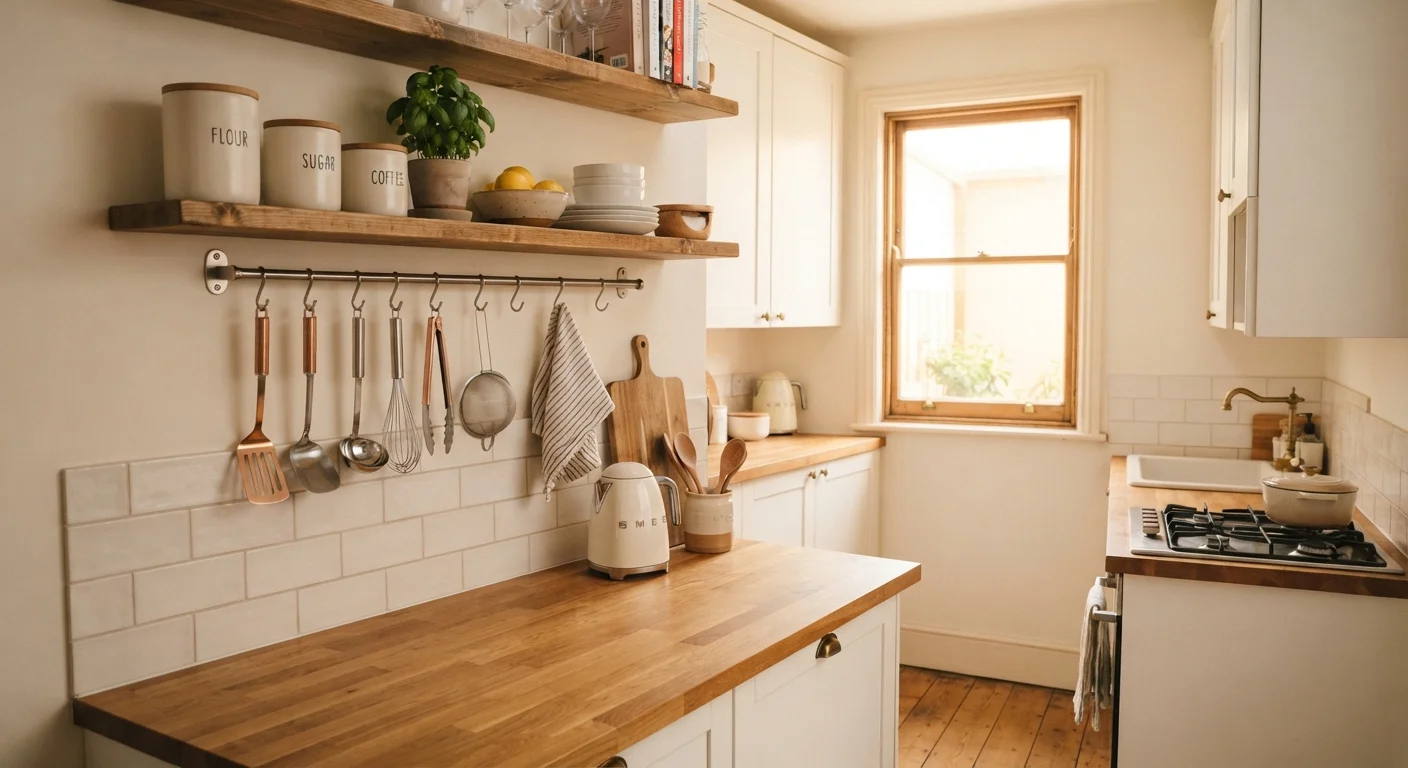
Use vertical wall space for storage instead of reserving it only for decoration.
Most small kitchens have unused wall space between the counter and upper cabinets, or beside the stove. Magnetic strips, wall-mounted rails with hooks, and small floating shelves bring storage off the counter and onto surfaces that would otherwise sit empty.
Choose multi-function tools and eliminate single-purpose gadgets.
Gadgets designed for one task accumulate quickly and are rarely worth the storage space they consume. A tool that does two or three jobs well takes up the footprint of one item while doing the work of several.
Nest and stack cookware intentionally rather than storing pieces randomly.
Randomly stacked pots and pans create a retrieval problem - pulling one piece out disturbs five others, and the mess discourages putting things back properly. Nesting lids separately and stacking pans by size makes access fast and storage compact.
Keep the sink area clear by creating a specific drying and cleaning zone.
The area around the sink is among the most-used spots in any kitchen and the one most prone to chronic clutter. A collapsible drying rack that folds flat when empty, paired with a caddy for sponge and soap, keeps this zone functional rather than perpetually cluttered.
Best Practices for a Functional Small Kitchen
The following practices are drawn from practical home organization principles. Apply them in the order that makes sense for your space - even two or three will produce a noticeable improvement.
Storage Beyond the Counter
Once you've reduced what's on the counter, the next step is distributing the remaining items intelligently. Walls, cabinet doors, and the insides of cabinets all hold more than most people use them for. Vertical shelving versus drawer systems each suit different habits - knowing which fits your cooking style prevents buying storage solutions that go unused.
Don't overlook the spaces you walk past every day. Underused areas like the insides of cabinet doors and the tops of upper cabinets can hold spice racks, cutting boards, foil and wrap dispensers, or seldom-used appliances without touching your counter at all.
Before Buying Any Storage Product
Many storage accessories marketed for small kitchens add more objects to an already crowded space without solving the underlying problem. Before purchasing organizers, bins, or racks, work through the decluttering and zoning steps first. You'll have a much clearer picture of what you actually need - and you'll likely find you need less than you expected.
For a full-home perspective on keeping every room functional, the room-by-room organization checklist walks through kitchens alongside every other major space so nothing gets skipped during a home reset.
The content provided on our blog site traverses numerous categories, offering readers valuable and practical information. Readers can use the editorial team’s research and data to gain more insights into their topics of interest. However, they are requested not to treat the articles as conclusive. The website team cannot be held responsible for differences in data or inaccuracies found across other platforms. Please also note that the site might also miss out on various schemes and offers available that the readers may find more beneficial than the ones we cover.