

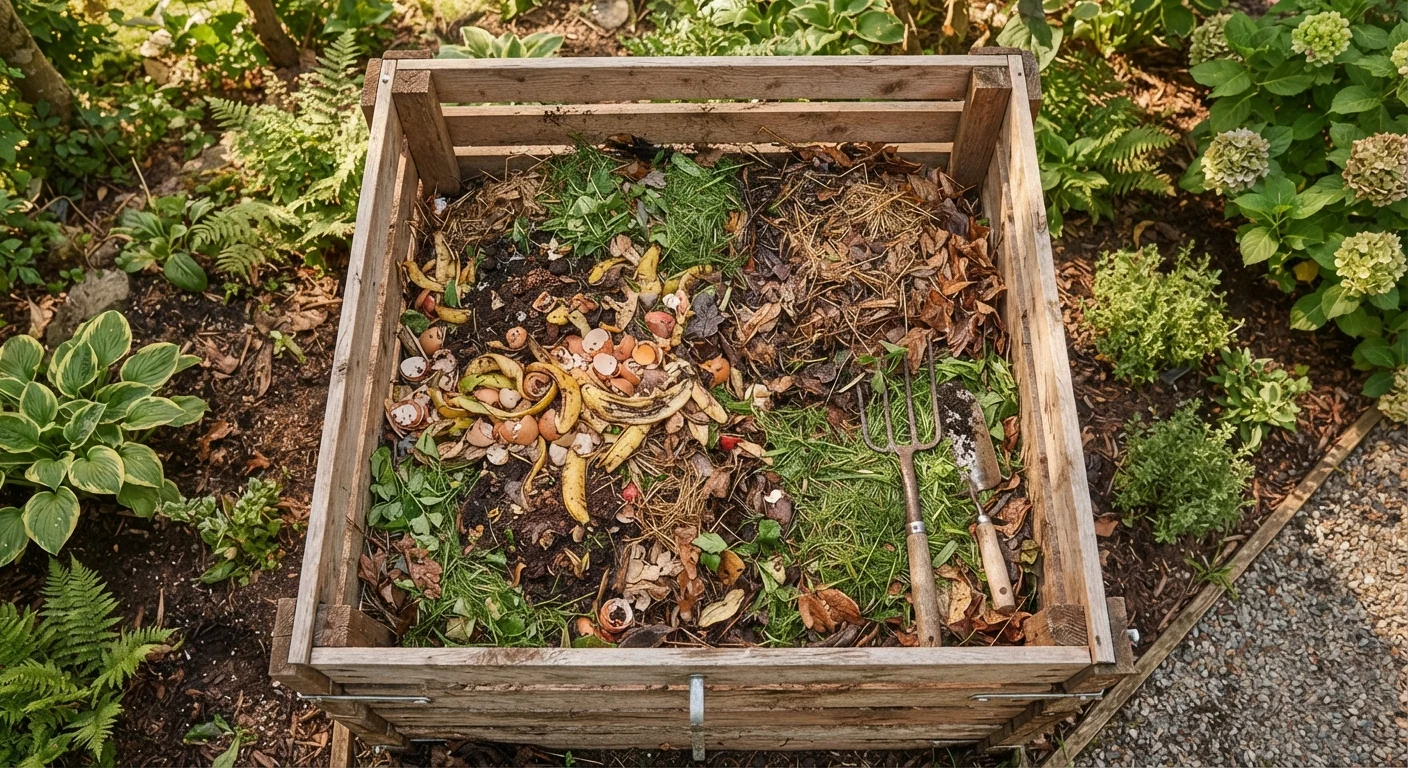
Why Composting Makes Financial and Environmental Sense
Bagged compost and fertilizer represent a recurring cost for any gardener. Building a home compost system eliminates that expense by converting material you'd otherwise throw away - vegetable trimmings, coffee grounds, cardboard packaging - into a steady supply of rich soil amendment. Over a single growing season, a productive home composter can produce enough finished material to meaningfully improve soil across several raised beds or planting areas.
Beyond the savings, composting reduces the volume of organic waste sent to landfill, where it decomposes anaerobically and generates methane. Keeping those scraps cycling through your yard instead is one of the more tangible environmental contributions a household can make. If you're already working to reduce food waste - something explored in our guide to smarter everyday grocery spending - composting is the natural next step for what can't be eaten.
Compost bin or wire mesh enclosure
Contains the pile, retains heat, and keeps pests out.
Garden fork or pitchfork
Turns and aerates the pile to accelerate decomposition.
Small countertop scrap container with lid
Collects kitchen scraps conveniently before transferring to the outdoor bin.
Garden hose or watering can
Adds moisture to keep the pile at the right dampness level.
Thermometer (compost or soil type)
Monitors internal pile temperature to confirm active decomposition.
What You Can (and Cannot) Compost
Most raw, plant-based kitchen waste is compostable. Good candidates include: fruit and vegetable scraps, eggshells, coffee grounds and paper filters, loose-leaf tea and paper tea bags, and plain cooked grains (in moderation). From the yard: dry leaves, grass clippings, plant trimmings, and shredded cardboard or newspaper.
Never Compost These Materials
Meat, fish, dairy, cooked foods with oils, and pet waste should never go into a home compost pile. These attract pests, create harmful pathogens, and produce foul odors that undermine the entire system. Stick to raw plant-based kitchen scraps and dry yard waste.
A few items occupy a gray zone. Citrus peels and onion scraps decompose fine but can temporarily discourage worms if added in large quantities. Weeds are fine to add if they haven't gone to seed; seeding weeds risk spreading through your finished compost. Wood ash is compostable in small amounts but can shift pH, so use it sparingly if your soil is already alkaline.
Diseased Plants Can Contaminate Your Pile
Avoid adding plant material that shows signs of fungal disease or severe pest infestation. Home compost piles don't always reach temperatures high enough to kill pathogens, and spreading finished compost made from diseased material can re-infect your garden beds.
Once your compost is ready to apply, pair it with good mulching technique for maximum benefit - our article on mulching garden beds the right way covers placement and depth in detail. And when you're ready to put that fertilizer to work, see our guide to starting a vegetable garden from scratch.
Step-by-Step: Setting Up and Running Your Compost System
Follow the steps below to establish a working home compost pile from scratch. Most of the setup takes under an hour; maintaining it afterward requires only a few minutes a week.
What you will need
Keep a Small Scrap Container in the Kitchen
A small countertop bin or a repurposed lidded container makes daily scrap collection painless. Empty it into the outdoor pile every one to two days to prevent odors. For ideas on keeping your prep area tidy while doing this, see how a compact kitchen can stay functional even with a collection bin on the counter.
Choose and set up your composting container
Select a spot that gets partial shade and is convenient enough that you'll actually use it. Full sun dries the pile out too quickly; deep shade slows decomposition. You can purchase a plastic bin, build a simple three-sided enclosure from wood pallets, or form a freestanding pile contained by wire mesh. Aim for a minimum volume of about one cubic yard (3 × 3 × 3 feet), which is the threshold at which a pile generates enough heat to decompose efficiently.
Understand the browns-to-greens ratio
Successful composting depends on balancing two categories of material. Browns (carbon-rich): dry leaves, cardboard torn into small pieces, newspaper, straw, and wood chips. Greens (nitrogen-rich): vegetable and fruit scraps, coffee grounds and filters, tea bags, fresh grass clippings, and plant trimmings. A general target is roughly two to three parts browns for every one part greens by volume. Too many greens creates a slimy, smelly pile; too many browns and decomposition stalls.
Build the initial layers
Start with a 4-6 inch layer of coarse browns (like dry leaves or small twigs) at the base to promote airflow. Add a 2-3 inch layer of greens - your kitchen scraps work perfectly here. Follow with another browns layer, then a thin layer of finished compost or garden soil if you have it; this seeds the pile with beneficial microbes. Continue alternating layers as you accumulate material.
Manage moisture and aeration
The pile should feel like a wrung-out sponge - damp but not dripping. In dry climates or summer heat, you may need to water the pile lightly every few days. In wet seasons, cover the pile with a tarp to prevent waterlogging. Equally important is aeration: turn the pile with a garden fork every one to two weeks, pulling material from the outer edges into the center. This introduces oxygen, the key ingredient that keeps decomposition aerobic and odor-free.
Recognize and harvest finished compost
Finished compost looks dark brown, crumbles easily, smells earthy (like forest soil), and contains no recognizable food or plant material. This typically takes two to six months with active management, or up to a year in a passive pile. To harvest, stop adding fresh material to the bin and allow the bottom portion to fully mature. Scoop out finished compost from the base and spread it around garden beds as a soil amendment or top dressing.
The content provided on our blog site traverses numerous categories, offering readers valuable and practical information. Readers can use the editorial team’s research and data to gain more insights into their topics of interest. However, they are requested not to treat the articles as conclusive. The website team cannot be held responsible for differences in data or inaccuracies found across other platforms. Please also note that the site might also miss out on various schemes and offers available that the readers may find more beneficial than the ones we cover.