

Our Verdict
Neither fertilizer type is universally superior - the right choice depends on your timeline, soil condition, budget, and environmental priorities. Synthetics excel when rapid, measurable results are needed; organics win on long-term soil vitality and reduced ecological risk.
| Best for | Recommended |
|---|---|
| Gardeners focused on long-term soil health and sustainability | Organic Fertilizers |
| Homeowners needing fast, reliable nutrient correction | Synthetic Fertilizers |
| Budget-conscious gardeners planning a season ahead | Organic Fertilizers (with home composting) |
| Those managing lawns or crops with specific nutrient deficiencies | Synthetic Fertilizers |
How Each Fertilizer Type Works
Understanding how organic and synthetic fertilizers deliver nutrients to plants helps clarify nearly every trade-off between them.
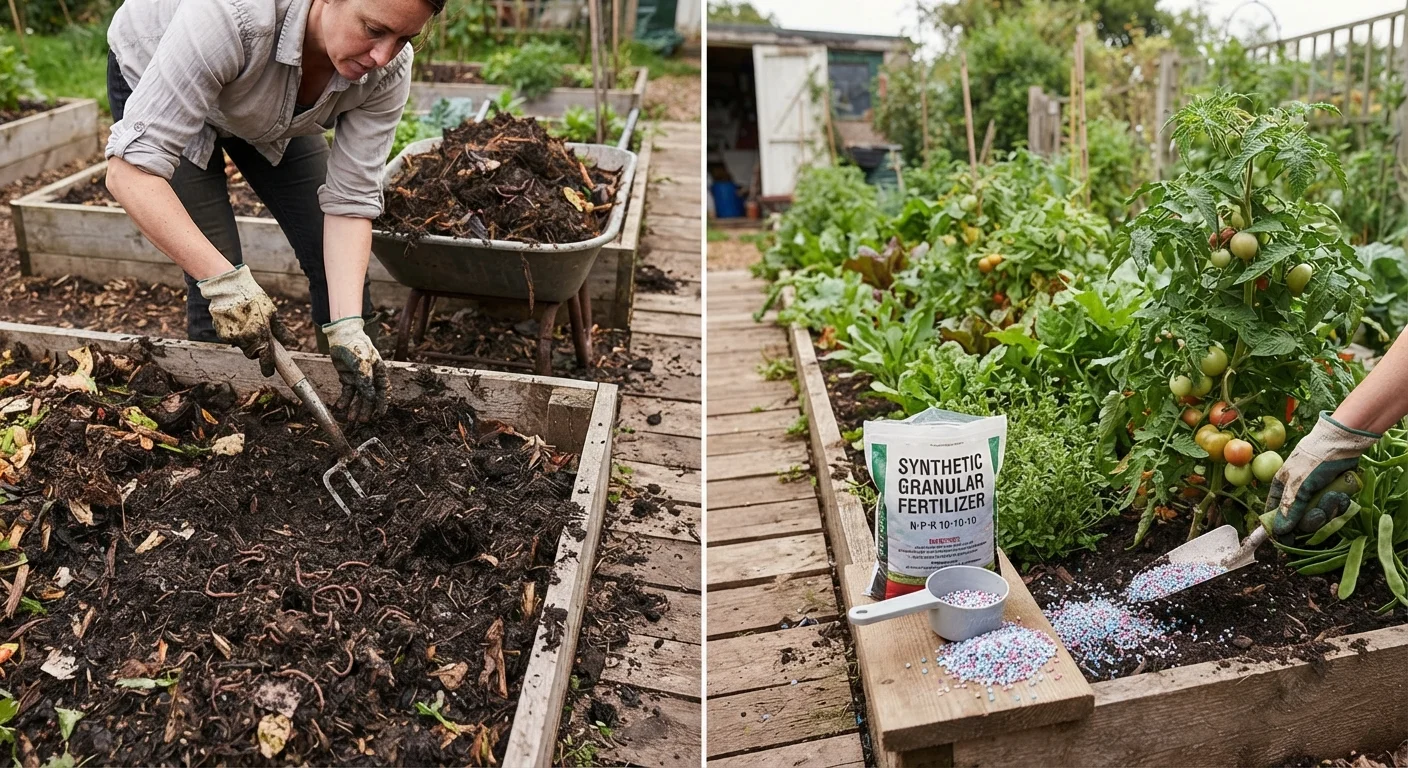
Organic fertilizers - derived from plant matter, animal byproducts, or mineral sources - rely on soil microorganisms to break down raw materials into plant-available nutrients. This biological process is gradual: nutrients become available over weeks or months depending on soil temperature and moisture. The upside is that organic matter simultaneously feeds the microbial ecosystem that supports long-term soil fertility. Common organic sources include compost, bone meal, blood meal, kelp meal, and worm castings. For homeowners interested in building their own supply, composting kitchen scraps is a cost-effective way to produce a continuous supply of slow-release nutrition.
Synthetic fertilizers are manufactured through industrial chemical processes and formulated to deliver specific ratios of nitrogen (N), phosphorus (P), and potassium (K) in immediately water-soluble form. Plants absorb these nutrients directly from soil solution - no microbial conversion needed. This makes synthetics predictable and fast-acting, which can be valuable when correcting a documented nutrient deficiency or pushing growth during a critical window.
Nutrient Release, Soil Impact, and Environmental Risk
The speed difference in nutrient delivery creates a cascade of practical and ecological consequences.
Because organic fertilizers release slowly, they're largely self-regulating - it's difficult to over-apply them to the point of burning plants or causing runoff. Over repeated seasons, organic amendments increase soil organic matter, improve water retention, encourage earthworm activity, and support beneficial fungal networks. These gains compound over time and reduce how much external fertilizer a garden eventually needs.
Synthetic fertilizers carry a higher risk of nutrient leaching - particularly nitrogen - when overapplied or when heavy rain follows application. Excess nitrogen that runs off into waterways contributes to algal blooms and water quality problems. This risk is highest on slopes, sandy soils, or properties near drainage channels. Precision application - using a soil test to calibrate exactly what's needed - dramatically reduces this risk but requires an extra step many homeowners skip.
| Organic Fertilizers | Synthetic Fertilizers | |
|---|---|---|
| Nutrient Release Speed | Slow (weeks to months) | Fast (days to a week) |
| Soil Biology Impact | Builds microbial life over time | Neutral to mildly disruptive with heavy use |
| Risk of Overapplication | Low - self-regulating | Higher - can burn plants or leach |
| Upfront Cost | Generally higher per bag | Generally lower per bag |
| Long-Term Soil Improvement | Yes - builds organic matter | Minimal without added organic matter |
| Environmental Runoff Risk | Low | Moderate to high if misapplied |
| Precision / Predictability | Variable - depends on soil biology | High - labeled NPK ratios |
Repeated synthetic-only fertilization without organic matter additions can gradually reduce microbial diversity and soil structure, creating a dependency cycle where plants rely entirely on external inputs. This isn't inevitable, but it's a documented pattern in intensively managed turf and monoculture settings.
Cost and Practical Considerations
On a per-pound-of-nutrient basis, synthetic fertilizers are typically less expensive upfront. A bag of granular balanced synthetic fertilizer generally costs less than an equivalent volume of bagged organic fertilizer, and the nutrient concentrations are higher - meaning you're moving less material for the same nutrient delivery.
Organic fertilizers, however, often reduce long-term input costs by improving soil so that it holds nutrients better and supports plant health with fewer interventions each season. Homeowners who incorporate home composting into their routine can offset a substantial portion of their organic fertilizer spending using materials they already generate. For lawn-specific decisions, understanding your soil type and grass variety first - as covered in our guide to grass seed versus sod - can help you avoid over-fertilizing newly established turf regardless of which fertilizer type you choose.
Start With a Soil Test
Before purchasing any fertilizer, invest in a basic soil test through your local cooperative extension office. Results typically include pH, organic matter levels, and specific nutrient deficiencies - telling you exactly what your garden needs rather than what a label suggests. This small upfront cost routinely saves homeowners from buying and applying fertilizers that aren't needed.
A soil test, available through most county extension services for a modest fee, removes guesswork from both approaches and is arguably the most cost-effective garden investment a homeowner can make.
When to Use Each - or Both
Most experienced gardeners don't treat this as an either/or choice. A practical hybrid approach uses organic matter as the foundation - applied in fall or early spring to build baseline fertility and soil structure - while reserving synthetic fertilizers for targeted, time-sensitive corrections during the growing season.
For vegetable gardens, a slow-release organic base at planting can be supplemented with a dilute synthetic liquid feed during heavy fruiting periods when demand outpaces supply. For lawns, fall organic top-dressing supports root development over winter while a targeted spring synthetic application addresses any nitrogen deficits before peak growth.
The key principle is to let soil tests guide you, not marketing claims or guesswork. Over-fertilizing - regardless of the source - wastes money, stresses plants, and adds unnecessary load to local waterways. Under-fertilizing limits yield and can lead to costly interventions later.
This article is for general informational purposes only. Fertilizer needs vary significantly by soil type, climate, and plant variety. Consult your local cooperative extension service for region-specific guidance.
The content provided on our blog site traverses numerous categories, offering readers valuable and practical information. Readers can use the editorial team’s research and data to gain more insights into their topics of interest. However, they are requested not to treat the articles as conclusive. The website team cannot be held responsible for differences in data or inaccuracies found across other platforms. Please also note that the site might also miss out on various schemes and offers available that the readers may find more beneficial than the ones we cover.