

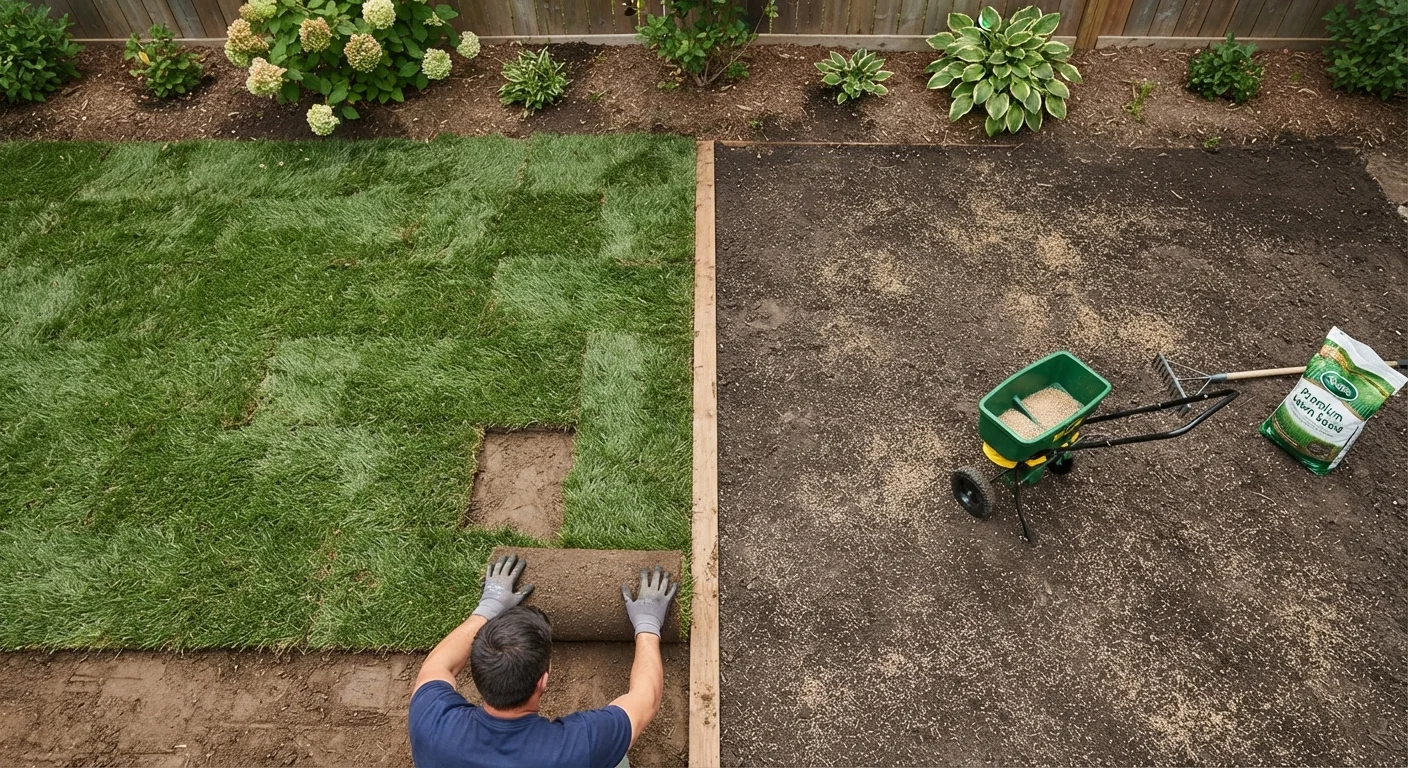
Option A
Grass Seed
The patient, budget-friendly path to a custom lawn.
Best for: Cost-conscious homeowners who can invest time in proper soil prep, watering, and an 8-16 week establishment window.
Option B
Sod
The instant results option for time-sensitive or erosion-prone yards.
Best for: Homeowners who need fast ground cover, are managing slope erosion, or have a tight landscape deadline.
The Core Trade-Off: Cost vs. Convenience
The decision between grass seed and sod almost always comes down to one fundamental tension: how much are you willing to spend, and how long are you willing to wait? These two factors pull in opposite directions, and understanding them honestly will save you both money and frustration.
Seeding a lawn is significantly less expensive. Depending on grass type and region, seed typically runs between $0.05 and $0.30 per square foot in material costs. Sod, by contrast, generally ranges from $0.50 to $0.90 per square foot for the material alone - and professional installation can push the total to $1.50-$2.50 per square foot. For a 2,000-square-foot lawn, that gap can easily mean the difference between a $150 project and a $3,500 one.
But sod's premium buys something real: time compression. A sodded lawn can handle moderate foot traffic within two to three weeks. A seeded lawn requires 8 to 16 weeks of careful tending before it's established enough for regular use - and during that window, the lawn is fragile and needs consistent watering, often multiple times daily in warm weather.
| Criterion | Grass Seed | Sod |
|---|---|---|
| Typical material cost | $0.05-$0.30 per sq ft | $0.50-$0.90 per sq ft |
| Time to usable lawn | 8-16 weeks | 2-3 weeks |
| Grass variety selection | Very wide | Limited by region |
| Erosion resistance | Low during establishment | High immediately |
| Labor intensity | Sustained over weeks | Heavy upfront, then lighter |
| Best installation season | Varies by grass type | Varies by grass type |
| Ideal for patchy repairs | Yes | No |
For a deeper look at how to keep a newly established lawn thriving through every season, see the seasonal lawn care calendar every homeowner should keep on hand.
Timing, Grass Type, and Regional Fit
Neither method works well when planted at the wrong time of year. Cool-season grasses - such as Kentucky bluegrass, tall fescue, and perennial ryegrass - establish best when seeded or sodded in late summer to early fall, when soil is warm but air temperatures are cooling. Warm-season grasses - bermuda, zoysia, St. Augustine - do best with late spring to early summer installation, when ground temperatures are reliably above 65°F.
Seeding offers a meaningful advantage here: variety selection. Sod farms grow a limited range of grass types commercially, and availability varies by region. Seed suppliers, however, offer dozens of species and specialty blends - drought-tolerant mixes, deep-shade formulations, high-traffic cultivars. If your yard has challenging conditions, seed lets you match the solution to the problem.
Sod Source Matters More Than You Might Think
Sod grown in a climate or soil type very different from your yard can struggle to root well after transplanting. When possible, source sod from a farm within your region - ideally one that grows in a similar soil texture to what you have at home. Ask the supplier what soil conditions the sod was grown in and compare that to your own soil test results before purchasing.
Sod, conversely, delivers consistency. Every square foot of sod comes pre-grown to the same density, which matters when you need uniform coverage quickly - around a new home's foundation, along a driveway edge, or on a slope where seed erosion is a real risk.
Understanding your soil before either approach is non-negotiable. A simple soil test - available through most cooperative extension services - reveals pH and nutrient gaps that affect whether seed germinates or sod roots properly. Skipping this step is one of the most common reasons both methods underperform. Our complete guide to growing a healthy lawn walks through soil preparation in detail.
Effort, Aftercare, and Long-Term Outcomes
Both methods demand real work upfront - the difference is in when that work is concentrated. Sod requires heavy physical labor at installation: preparing soil to a consistent 4-inch depth, grading for drainage, laying rolls tightly without gaps, and then watering intensively for the first two weeks. The effort front-loads.
Seed demands sustained attention across a longer window. Germination requires the seed-to-soil contact to remain consistently moist - which often means watering two to three times daily during the first two weeks, then tapering off. Foot traffic must be kept off for months. Overseeding often fails not from bad seed but from poor follow-through on these basics.
Long term, a properly established seeded lawn performs just as well as a sodded one - sometimes better, because the grass has developed from seed in your specific soil conditions rather than being transplanted from a different growing environment. Sod can occasionally struggle to adapt when the soil beneath it differs significantly from the farm where it was grown.
Whatever method you choose, irrigation strategy plays a major role in whether the lawn survives its first summer. See our comparison of drip vs. sprinkler irrigation to choose a watering system that supports establishment without driving up your water bill.
~80%
Potential cost savings with seed vs. sod
Material cost comparisons across common lawn establishment projects consistently show seeding at roughly one-fifth to one-half the cost of sodding the same area.
8-16 weeks
Typical seed establishment period
University extension guidelines for cool- and warm-season grasses indicate full establishment - including root depth adequate for normal traffic - takes two to four months from germination.
65°F+
Minimum soil temp for warm-season sod rooting
Turfgrass specialists generally recommend soil temperatures above 65°F for warm-season varieties to root reliably after laying, typically achievable from late spring onward in most US regions.
The content provided on our blog site traverses numerous categories, offering readers valuable and practical information. Readers can use the editorial team’s research and data to gain more insights into their topics of interest. However, they are requested not to treat the articles as conclusive. The website team cannot be held responsible for differences in data or inaccuracies found across other platforms. Please also note that the site might also miss out on various schemes and offers available that the readers may find more beneficial than the ones we cover.