

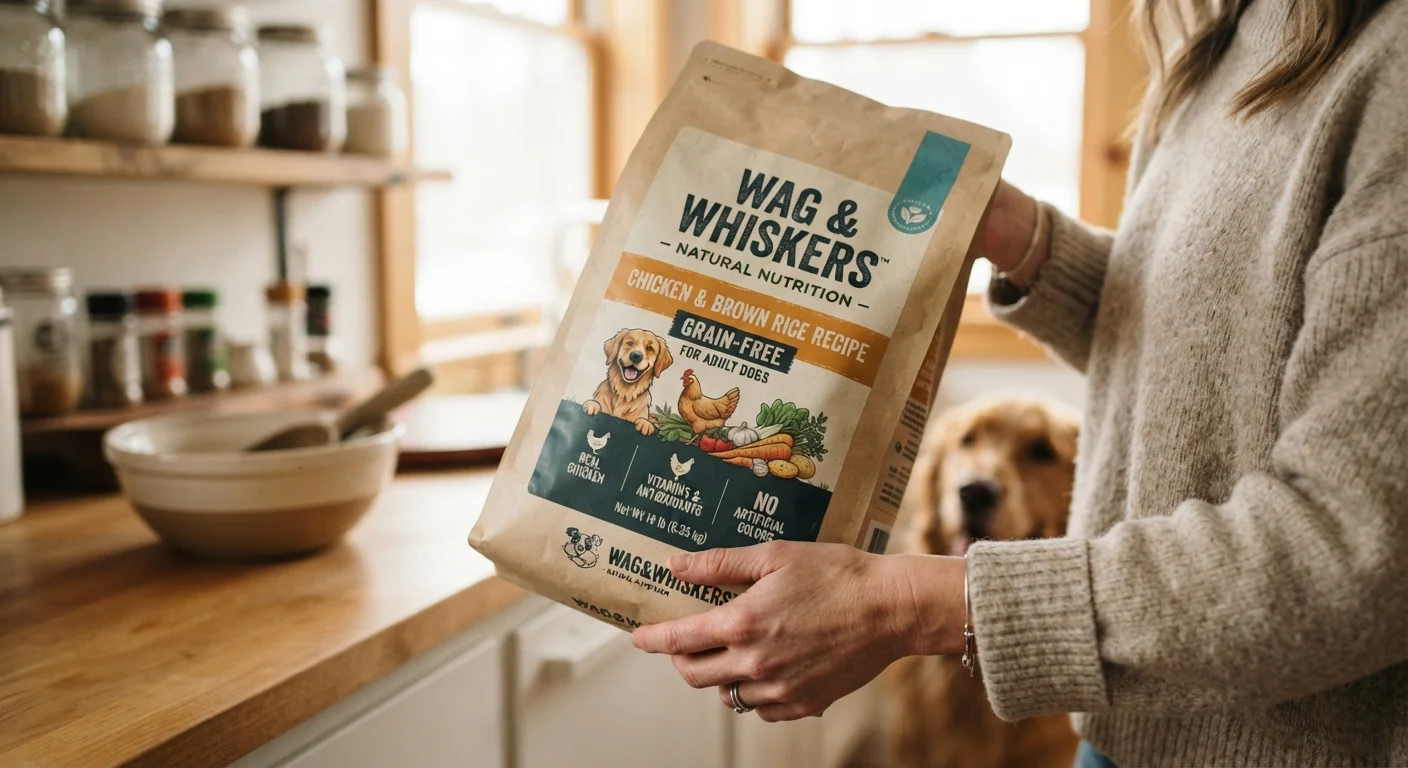
The Ingredient List: What the Order Really Means
Pet food ingredients are listed in descending order by weight before processing. That detail changes how you read the list. Raw chicken, for instance, is roughly 70% water. After cooking, its actual contribution to the final product is considerably smaller than its top-of-list position implies. A meal ingredient - such as chicken meal - has already had moisture removed, so it delivers more concentrated protein per pound.
This doesn't mean fresh meat is inferior; it simply means the label requires interpretation. Look at the first five to seven ingredients collectively, since those make up the largest share of the formula by weight.
One pattern worth recognizing is ingredient splitting. A manufacturer might list pea flour, pea protein, and pea starch separately. Individually, each appears small. Combined, peas could outweigh the meat ingredient listed first. For a deeper look at how marketing language intersects with ingredient labeling, see our guide on pet food marketing claims.
Check for 'Meal' Ingredients
Ingredients ending in 'meal' - like salmon meal or chicken meal - have already had their moisture removed. They are concentrated protein sources and can be a reliable contributor to overall protein content. Don't discount a food simply because 'meal' appears rather than a fresh meat name.
The Guaranteed Analysis: Numbers That Need Context
The guaranteed analysis panel reports four required values: minimum crude protein, minimum crude fat, maximum crude fiber, and maximum crude moisture. Additional nutrients - such as taurine or omega-3 fatty acids - may appear voluntarily.
Two things limit how much these numbers tell you. First, they are regulatory thresholds, not precise measurements. A food showing 26% minimum crude protein could actually contain 28% or more. Second, the percentages are expressed on an as-fed basis, meaning moisture is included. To compare a wet food with a dry food, you need to convert both to a dry matter basis by factoring out their moisture content - otherwise the wet food will always appear lower in every nutrient.
4
Required items in every guaranteed analysis panel
U.S. regulations require all pet food labels to show minimum crude protein, minimum crude fat, maximum crude fiber, and maximum crude moisture as a baseline.
~70%
Moisture content in raw meat ingredients
Raw muscle meat is roughly 70% water by weight, which explains why its post-cooking contribution to a finished dry kibble is substantially smaller than its position at the top of an ingredient list suggests.
2
Methods to substantiate an AAFCO adequacy claim
AAFCO recognizes formulation against established nutrient profiles and actual animal feeding trials as valid methods for supporting a 'complete and balanced' nutritional adequacy statement.
To understand how individual nutrients function once they're inside your pet's body, our explainer on what taurine, omega-3s, and other nutrients actually do provides a plain-language breakdown.
The AAFCO Nutritional Adequacy Statement
This is arguably the most important single line on any pet food package. It tells you whether the food is complete and balanced - meaning it's designed to serve as a pet's sole diet - and for which life stage.
Two methods can support this claim. A food may be formulated to meet AAFCO nutrient profiles, meaning a nutritionist calculated that the recipe contains required nutrients at appropriate levels. Alternatively, a food may have passed AAFCO feeding trials, in which real animals ate the food for a defined period and their health was monitored. Feeding trial foods have gone through a layer of real-world validation that profile-based formulations have not.
If a label reads "This product is intended for intermittent or supplemental feeding only," it is not complete and balanced and should not be your pet's primary food source. Treats and toppers typically carry this language. For foundational context on what nutrients pets require, see the nutritional building blocks every pet diet needs.
Feeding Trial vs. Formulation: A Key Distinction
AAFCO-substantiated feeding trials involve feeding the product to live animals for a minimum period and measuring health outcomes. Profile-based formulations are calculated nutritionally but have not been tested on live animals in the same way. Both are legally acceptable, but they represent different levels of real-world validation. Ask your veterinarian which approach they prefer when recommending foods.
Feeding Guidelines and What They Don't Account For
Feeding guidelines on pet food packaging are population averages. They are calculated for typical, healthy, moderately active adult animals at standard weights. They do not account for your individual pet's activity level, metabolism, reproductive status, or health conditions.
Use the suggested amounts as a starting point, then adjust based on your pet's body condition score - a simple nine-point scale that veterinarians use to assess whether an animal is underweight, ideal, or overweight. If your pet is gaining or losing weight unintentionally, the feeding amount is the first variable to revisit.
If you start noticing signs like a dull coat, low energy, or digestive irregularity, the diet itself may need evaluation. Our article on signs your pet's diet might not be working outlines what to watch for and when to bring your observations to a vet.
This article is for general informational purposes only and is not a substitute for professional veterinary advice. Always consult a licensed veterinarian before making changes to your pet's diet, especially if your pet has a health condition.
Frequently Asked Questions
It means the food meets the minimum nutritional standards established by AAFCO for a specific life stage, such as adult maintenance or growth and reproduction. A food carrying this statement has either passed a feeding trial or been formulated to meet AAFCO's nutrient profiles. It should not need supplementation for healthy pets in that life stage.
Ingredients are listed by their pre-cooking (pre-processing) weight. This is important because raw meat contains a lot of water, so it may appear first on the list but contribute less actual protein after moisture is removed during manufacturing.
It shows minimum percentages for crude protein and fat, and maximum percentages for crude fiber and moisture. These are regulatory minimums and maximums, not precise nutritional measurements. The actual amounts in the product may differ from what's printed.
Not necessarily. 'Grain-free' is a marketing descriptor, not a nutritional standard. The FDA has investigated a possible link between certain grain-free diets and dilated cardiomyopathy in dogs, though causation has not been confirmed. Talk to your vet before choosing a grain-free diet.
Ingredient splitting occurs when a single ingredient - such as corn - is listed in multiple forms (corn flour, corn gluten meal, ground corn) separately, making each appear smaller by weight. Together they might outweigh the first-listed ingredient. Recognizing splitting helps you evaluate ingredient proportions more accurately.
The AAFCO nutritional adequacy statement specifies the intended life stage: puppy or kitten (growth), adult maintenance, all life stages, or senior. 'All life stages' formulas meet the higher nutrient requirements of growth and reproduction, so they are safe for adults but may contain more calories and nutrients than an adult pet strictly needs.
The content provided on our blog site traverses numerous categories, offering readers valuable and practical information. Readers can use the editorial team’s research and data to gain more insights into their topics of interest. However, they are requested not to treat the articles as conclusive. The website team cannot be held responsible for differences in data or inaccuracies found across other platforms. Please also note that the site might also miss out on various schemes and offers available that the readers may find more beneficial than the ones we cover.