

Start here
Why Day One Really Does Matter
Next
Core Commands Every Dog Should Learn First
Then
Crate Training and Settling Skills
Build on it
Loose-Leash Walking From the Start
Troubleshoot
When Progress Stalls: Common Beginner Mistakes
Why Day One Really Does Matter
Every interaction your dog has from the moment they arrive home shapes their expectations about how the world works. Allowing a behavior you plan to correct later - jumping on guests, sleeping on the couch, bolting through the door - makes it harder to change because the dog has already been rewarded for it, even unintentionally.
Behavioral science is clear on this: behaviors that produce good outcomes for the dog will increase in frequency. That principle works in your favor when you're deliberate about what you reinforce, and against you when you're not. Before your first structured session, it helps to run through a readiness check - see our readiness checklist for new owners to make sure your environment and tools are in order.
You don't need to train your dog all day. You need to be consistent in the moments that arise naturally: mealtimes, doorways, greetings. Structure those small interactions and formal sessions become much more productive.
Positive reinforcement
Adding something the dog values (like a treat or praise) immediately after a desired behavior to make that behavior more likely to happen again.
Marker
A precise signal - a short word like "yes" or a click from a clicker - that tells the dog the exact moment they did the right thing, before the reward arrives.
Criteria
The specific standard the dog must meet to earn a reward. In training, you raise criteria gradually - for example, asking for longer stays before rewarding.
Generalization
A dog's ability to perform a learned behavior in different locations and around different distractions. Dogs don't generalize automatically - it must be practiced deliberately.
Variable reinforcement
Rewarding a behavior unpredictably (sometimes, not every time) once it is well established. This schedule tends to make behaviors more persistent over time.
Luring
Using a treat held in the hand to guide a dog into a position, such as moving a treat over the dog's nose to prompt a sit. Lures should be faded once the dog understands the behavior.
Core Commands Every Dog Should Learn First
A practical starter set of behaviors covers the situations you'll encounter every day. Focus on these four before expanding your dog's repertoire:
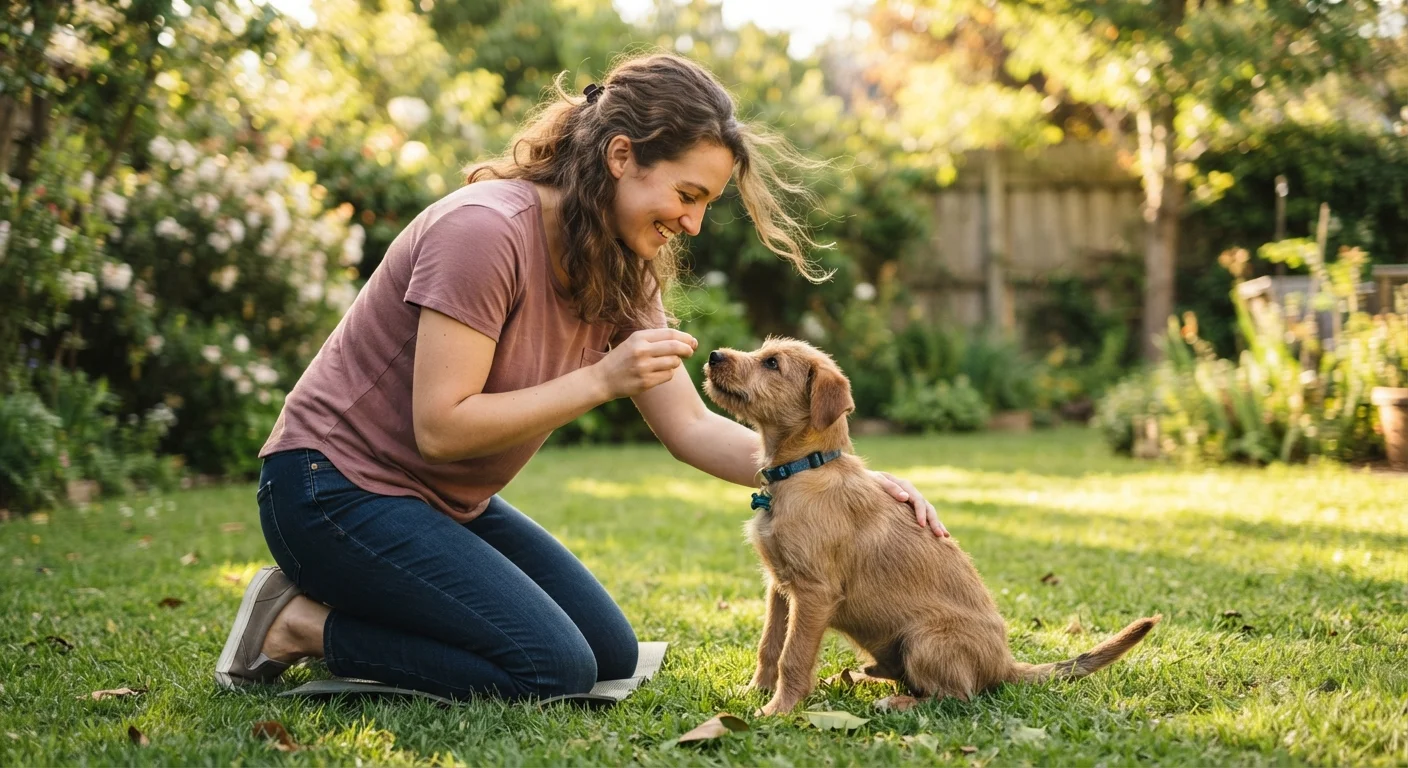
- Sit: The most versatile behavior. Ask for a sit before meals, before crossing the street, before greetings. Prompt it by holding a treat just above the dog's nose and moving it slightly back - most dogs rock naturally into a sit. Mark the moment their bottom touches the floor with a short verbal marker ("yes!") or a clicker, then deliver the treat.
- Stay: Build duration gradually. Start with one second, then two, then five. Release with a consistent cue like "free" so the dog understands the exercise is over. Never increase time and distance in the same session.
- Come (recall): The most important safety behavior. Practice in low-distraction environments first, always making yourself worth returning to - never call your dog to you for something unpleasant. For a deeper look at why recall sometimes breaks down, see why dogs ignore commands.
- Down: A calming position useful when you need the dog to settle. Lure from a sit by moving the treat straight down toward the floor between the dog's paws.
For a plain-language guide to the terminology behind these techniques, pet training terminology explained is a helpful companion resource.
Use What Your Dog Already Wants
Treats are effective, but they're not the only reinforcer. Some dogs work harder for a game of tug, a chance to sniff, or enthusiastic praise. Pay attention to what your individual dog finds most motivating and rotate reward types to keep engagement high.
Crate Training and Settling Skills
A dog who can rest calmly in a crate or on a mat is easier to manage, safer when unsupervised, and generally less anxious - because they have a predictable, safe place of their own. Introduce the crate in stages:
- Place the crate in a busy area of the home with the door open. Toss treats inside without closing the dog in.
- Feed meals near, then just inside, the crate so the dog builds a positive association.
- Begin closing the door for seconds, then a minute, while you remain visible. Increase duration slowly over several days.
- Graduate to leaving the room briefly, then the house for short periods.
Whining during crate time is common at first. Wait for a pause in vocalization before opening the door - even a brief pause - so you don't accidentally teach the dog that whining gets them out. If separation distress is severe or escalating, it may signal a deeper issue; the article on separation anxiety in dogs covers evidence-based approaches for that situation.
Loose-Leash Walking From the Start
Pulling on leash is one of the most common complaints from new owners - and one of the most preventable when addressed from day one. Dogs pull because it works: forward movement rewards the behavior. The fix is mechanical: forward movement only happens when the leash is loose.
A practical approach for beginners:
- Start in a low-distraction environment - your backyard or a quiet hallway.
- The moment your dog moves ahead and the leash tightens, stop moving entirely. Wait. When the dog turns back toward you and slack returns, mark and reward, then continue walking.
- Change direction frequently so the dog learns to check in with you rather than charge ahead.
- Reward the dog for walking beside you - don't wait for pulling to address it, reward the correct position proactively.
Every person who walks the dog must use the same rules. One person allowing pulling undoes the work of everyone else. Consistency across the household is not optional - it is the variable that most determines how quickly a skill becomes reliable. For guidance on structuring sessions so new skills actually stick, see how to structure training sessions.
When Progress Stalls: Common Beginner Mistakes
Plateaus are a normal part of the learning curve, not a sign that your dog is untrainable. Most stalls trace back to one of the following patterns:
- Raising criteria too fast
- If your dog could sit reliably in the kitchen but can't do it at the park, the environment changed faster than the training. Drop back to an easier version of the behavior and build back up.
- Inconsistent cues
- Using "sit," "sit down," "sit!" and "Sit, I said sit" as if they mean the same thing is confusing to a dog. Pick one word per behavior and stick to it across everyone in the household.
- Sessions that are too long
- Fatigue and frustration compound each other. A bored or stressed dog cannot learn efficiently. End each session before the dog checks out, and always finish on a behavior the dog can do successfully.
- Inadvertent reinforcement
- Laughing at jumping, giving attention to barking, or letting the dog out when they scratch the door - these are rewards, even when they don't feel like it. Audit what happens after unwanted behaviors.
If you're approaching your first structured training session, our pre-session checklist can help you catch setup errors before they become habits.
Avoid Punishment-Based Corrections
Techniques that use pain, fear, or startling - such as leash jerks, spray bottles, or shock - can suppress behavior in the short term but research consistently links them to increased anxiety, aggression, and damaged trust between dog and owner. Stick with methods that show the dog what to do rather than punishing what not to do.
This article provides general educational information about dog training and is not a substitute for guidance from a qualified veterinary behaviorist or certified professional dog trainer. If your dog displays aggression, extreme fear, or behaviors that pose a safety risk, consult a credentialed professional before proceeding with at-home training.
Frequently Asked Questions
Most trainers recommend starting with "sit" because it is simple, easy to prompt, and immediately useful for managing your dog's behavior. Once sit is reliable, it creates a calm baseline from which to teach other skills like "stay" and "down."
Keep sessions to 3-5 minutes, two to four times per day. Dogs - especially puppies - lose focus quickly, and ending while they are still engaged prevents frustration and keeps training a positive experience.
When introduced properly, crates align with a dog's natural instinct to rest in a small, secure space. The key is making the crate a positive place through gradual exposure, never forcing the dog inside or using it as punishment.
Training can begin as soon as a puppy arrives home, typically around 8 weeks of age. Young puppies absorb new experiences and associations very quickly. Adult dogs are equally capable of learning new behaviors - there is no age cutoff.
Dogs don't generalize commands automatically - a behavior learned in your kitchen is a different context to them than a busy sidewalk. This is normal and means you need to practice commands in progressively more distracting environments, starting easy and building gradually.
Treats are most valuable when teaching a new behavior. Once a skill is reliable, you can shift to a variable reward schedule - reinforcing intermittently - which actually strengthens behavior over time. You can also replace food rewards with praise, play, or other things your dog values.
The content provided on our blog site traverses numerous categories, offering readers valuable and practical information. Readers can use the editorial team’s research and data to gain more insights into their topics of interest. However, they are requested not to treat the articles as conclusive. The website team cannot be held responsible for differences in data or inaccuracies found across other platforms. Please also note that the site might also miss out on various schemes and offers available that the readers may find more beneficial than the ones we cover.