

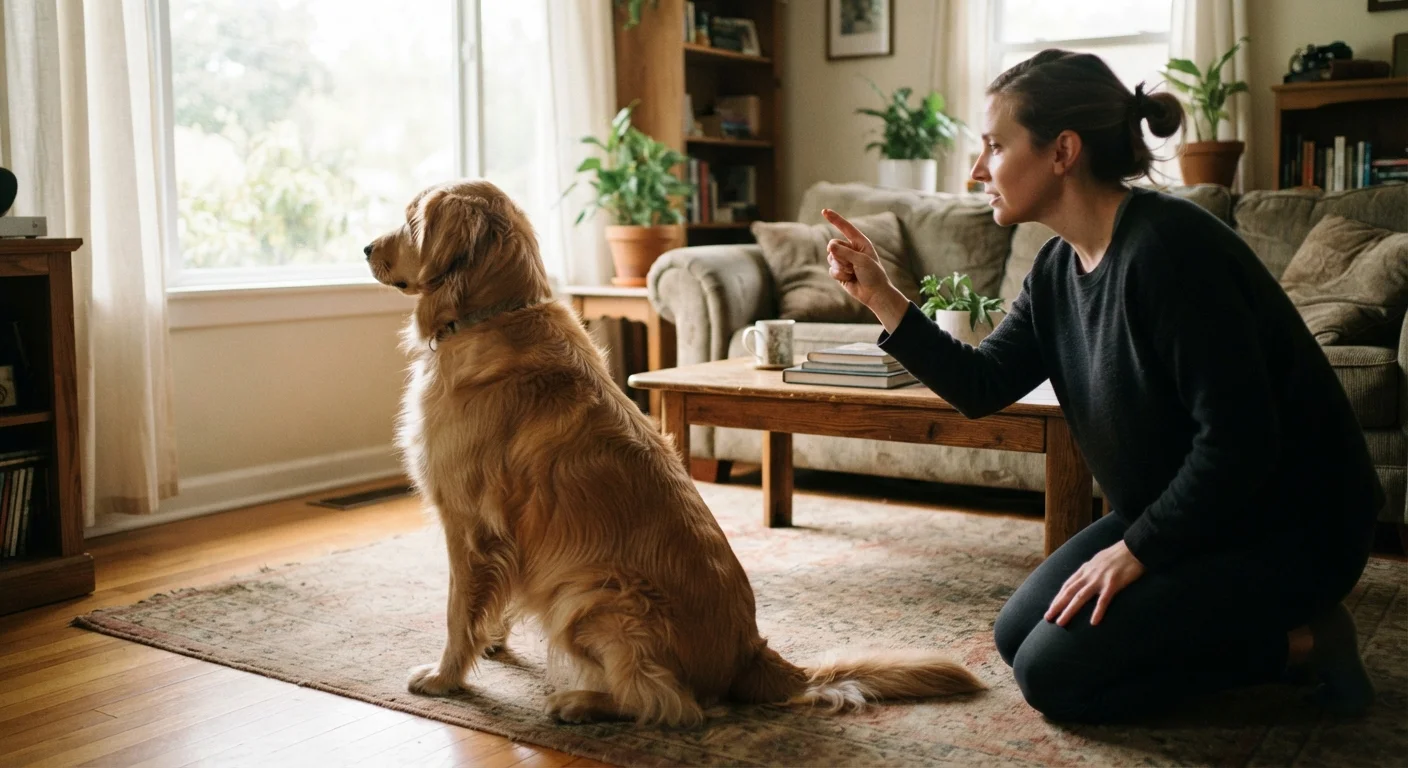
Why 'Stubborn' Is Usually the Wrong Diagnosis
When a dog ignores a known command, the instinctive explanation is stubbornness or a dominant personality. Behavioral science tells a different story. Dogs don't follow commands out of obligation-they respond to cues that have been reliably paired with outcomes they find worthwhile. When that pairing breaks down or was never built solidly in the first place, the behavior stops.
Understanding this reframes the problem usefully. Instead of asking why won't my dog listen?, the more productive question is what does my dog understand about this cue, and what's making compliance unrewarding right now? From that starting point, most cases of selective listening are fixable with straightforward adjustments to technique. If you're starting from scratch, the foundational training roadmap for first-time owners covers how to build reliable behaviors from the ground up.
Rule Out Medical Causes First
Sudden changes in a dog's responsiveness to known commands can sometimes signal a health issue, including hearing loss, pain, or neurological changes-especially in older dogs. If your dog's command reliability has declined noticeably and recently, consult a veterinarian before assuming it's a training problem. This article covers behavioral and training-related causes only and is not a substitute for veterinary evaluation.
The Most Common Training Mistakes-and How to Fix Them
Most command-reliability problems trace back to a handful of predictable errors. Recognizing them is the first step toward correcting them. The mistakes below represent the most common gaps seen in everyday training situations, along with practical ways to address each one.
Training only in one location and expecting the behavior to transfer everywhere.
Why it happens: Owners often practice commands at home where the environment is controlled, assuming the dog has learned the concept. In reality, dogs learn behaviors as context-specific-a 'sit' in the kitchen doesn't automatically mean 'sit' at the park.
Using the same low-value reward regardless of how distracting or difficult the environment is.
Why it happens: Many owners rely on the same treat or praise in every context, not realizing that the reward needs to outcompete whatever else is competing for the dog's attention.
Repeating a command multiple times before the dog complies, then rewarding the eventual response.
Why it happens: It feels natural to keep prompting when a dog doesn't respond immediately. Owners unintentionally teach the dog that waiting through several cues is part of the expected routine.
Using punishment or frustration when the dog fails to comply, which damages the association with the command.
Why it happens: Non-compliance feels like defiance, which can trigger frustration. Owners may raise their voice, repeat commands harshly, or physically correct the dog, believing this will motivate future compliance.
Skipping the step of pairing the command word with the behavior before expecting the dog to respond to the word alone.
Why it happens: Owners often say the command word before the dog understands it, assuming word association happens automatically. In reality, the verbal cue must be deliberately introduced after the behavior is reliable.
Avoid Repeating Commands Repeatedly
Saying 'sit, sit, sit' before your dog complies teaches them that the first cue is optional. Each repetition reduces the signal value of the word. Give the cue once, wait a few seconds, and if necessary, prompt or reset rather than nagging. Consistency here is essential to rebuilding a reliable response.
Rebuilding Reliability: Where to Start
If your dog's response to commands has become inconsistent, the most effective approach is to treat the behavior as partially untrained rather than broken. Go back to a controlled, low-distraction environment and confirm the dog responds reliably there first. Then systematically introduce difficulty-new locations, mild distractions, greater distances-one variable at a time.
77%
Dogs trained with positive reinforcement show faster skill acquisition
Research published in Applied Animal Behaviour Science consistently finds positive reinforcement outperforms aversive methods in both speed of learning and long-term retention.
3-5 min
Optimal single training session length for dogs
Canine cognition researchers generally recommend keeping individual training sessions brief to maintain focus and end before the animal disengages.
Recall is one of the areas where reliability matters most. A dog that won't come when called in a real-world situation is at genuine safety risk. Building that skill methodically is covered in our detailed guide to teaching a reliable recall. Keep sessions short-three to five minutes is enough for most dogs to learn without losing engagement-and always end before attention fades.
This article is for general educational purposes and does not constitute veterinary or professional behavioral advice. If your dog is showing signs of fear, aggression, or significant behavioral change, consult a qualified veterinarian or certified applied animal behaviorist.
The content provided on our blog site traverses numerous categories, offering readers valuable and practical information. Readers can use the editorial team’s research and data to gain more insights into their topics of interest. However, they are requested not to treat the articles as conclusive. The website team cannot be held responsible for differences in data or inaccuracies found across other platforms. Please also note that the site might also miss out on various schemes and offers available that the readers may find more beneficial than the ones we cover.