

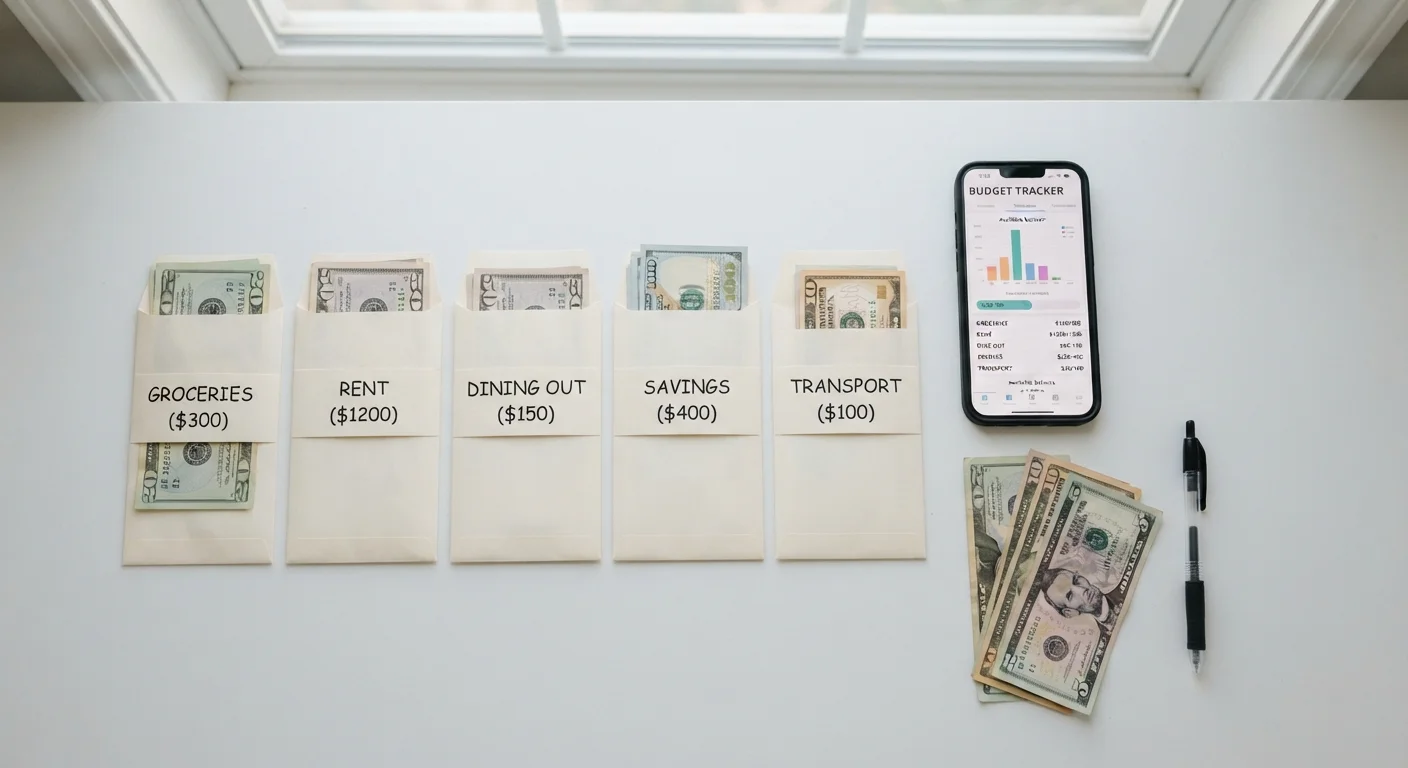
The Original Logic: Why Envelopes Worked
Before digital banking, managing money meant managing cash. Households would divide a paycheck into labeled envelopes - one for groceries, one for rent, one for utilities - and physically spend from each pile. The system worked because the constraint was tangible: an empty envelope meant no more spending in that category, full stop.
That friction wasn't a bug. It was the feature. When you hold $200 in a grocery envelope, you feel the limit in a way that a checking account balance never communicates. There's no mental math required to understand that $12 left means a careful week at the store.
If you're just getting started with managing your money, Budgeting from Scratch: A Complete Introduction covers the foundational concepts that make any system - including this one - more effective.
Start with your three biggest pain points
Rather than building a full envelope system at once, identify the two or three spending categories where your money most often disappears without explanation. Set up envelopes for those categories first and add others once the habit is established. A partial system that you maintain consistently outperforms a perfect system you abandon after two weeks.
Translating Envelopes to Digital Life
Most Americans no longer pay for groceries with cash, which is why the envelope method fell out of daily practice - not because the logic failed, but because the delivery mechanism became inconvenient. The good news is the core principle doesn't depend on paper or currency.
Digital envelope budgeting recreates the same compartments using one of three approaches:
- Sub-accounts at your bank: Many banks and credit unions allow you to open multiple savings accounts under one login. Naming each one after a spending category ("car repairs," "clothing," "dining") and transferring the allocated amount at the start of each month mirrors the physical envelope exactly.
- Category-based budgeting apps: Software built around the envelope philosophy lets you assign income to virtual categories and tracks spending against each allocation in real time. Transactions reduce the relevant category balance automatically when accounts are linked.
- Spreadsheet tracking: A manually updated spreadsheet with columns for each category can achieve the same visibility with no app subscription, though it requires consistent upkeep.
For a direct comparison of physical cash handling versus app-based tracking, Cash Budgeting vs. Digital Tracking Apps walks through the real tradeoffs in discipline and convenience.
~40%
Americans without a monthly budget
According to a 2023 survey by the National Financial Educators Council, roughly four in ten U.S. adults report not following any formal monthly budget.
20-30%
Typical overspend in discretionary categories
Behavioral finance research consistently finds that consumers without pre-set category limits tend to overspend discretionary categories by roughly this margin compared to their stated intentions.
Setting Up Your Digital Envelope System
The setup process matters more than the tool you choose. Start by listing every predictable expense category in your life - housing, transportation, food, utilities, insurance, debt payments, personal spending, and savings. Then assign a dollar amount to each based on your actual income, not aspirational figures.
The total of all your category allocations should equal your take-home pay for the period. If the numbers don't balance, you're facing a prioritization decision, not a math problem. Something has to give - either a category gets less, or income needs to increase. Your First Monthly Budget in Six Steps provides a structured walkthrough for anyone working through this process for the first time.
One common mistake is creating too many narrow categories at the start. Fifteen envelopes for a first-time user creates maintenance fatigue. Begin with broad buckets and subdivide only the categories where you consistently overspend or where granularity would genuinely change your behavior.
This article provides general financial education and is not personalized financial advice. Consider speaking with a qualified financial professional for guidance tailored to your specific situation.
Where the Method Fits in a Broader Budget Plan
Envelope budgeting is a spending management tool, not a complete financial strategy. It works best as one layer within a broader plan that also accounts for saving and debt reduction goals. The Personal Budgeting: The Complete Framework covers how spending systems like this one connect to longer-term financial priorities.
For people who find percentage-based frameworks like 50/30/20 too abstract, envelope budgeting provides something more concrete: a dollar amount, tied to a category, that runs out. That specificity is why the method has stayed relevant through decades of financial tools and trends. The compartment logic works whether your envelopes are made of paper or pixels.
The method is also compatible with smart saving strategies - simply treating your savings goal as its own envelope ensures that money is allocated before discretionary spending begins, rather than saved from whatever happens to be left over.
Frequently Asked Questions
No. The cash-envelope method originated with literal currency, but the underlying logic - pre-allocating spending by category - translates directly to digital tools. Many people use separate savings sub-accounts or budgeting apps to recreate the same compartment effect without handling cash.
Most financial educators suggest starting with five to ten categories covering your major spending areas. Too few categories provide little insight; too many become difficult to maintain. Start simple and add granularity only where it matters most to your spending habits.
The most common approaches are to transfer funds from a lower-priority category, accept the shortfall and adjust next month's allocation, or simply stop spending in that category for the rest of the period. The key is treating the overage as information - a signal to revisit your initial category amounts.
They share the same foundational rule - every dollar gets a job before the month starts - but zero-based budgeting is a broader framework that encompasses savings and debt repayment goals, not just spending categories. Envelope budgeting is often described as a practical application of zero-based thinking.
Several budgeting applications are built around category-based allocation, mimicking the envelope logic. Evaluating them on factors like syncing capability, ease of adjustment, and cost is worthwhile. For a detailed comparison of digital tools versus cash handling, see our related content on cash versus digital tracking.
Yes, though it requires an extra step. People with irregular income typically budget based on their lowest expected monthly earnings, then treat any surplus as an additional allocation decision when it arrives. This conservative baseline prevents over-committing to categories in high-income months.
The content provided on our blog site traverses numerous categories, offering readers valuable and practical information. Readers can use the editorial team’s research and data to gain more insights into their topics of interest. However, they are requested not to treat the articles as conclusive. The website team cannot be held responsible for differences in data or inaccuracies found across other platforms. Please also note that the site might also miss out on various schemes and offers available that the readers may find more beneficial than the ones we cover.